EARLING EXORCISM
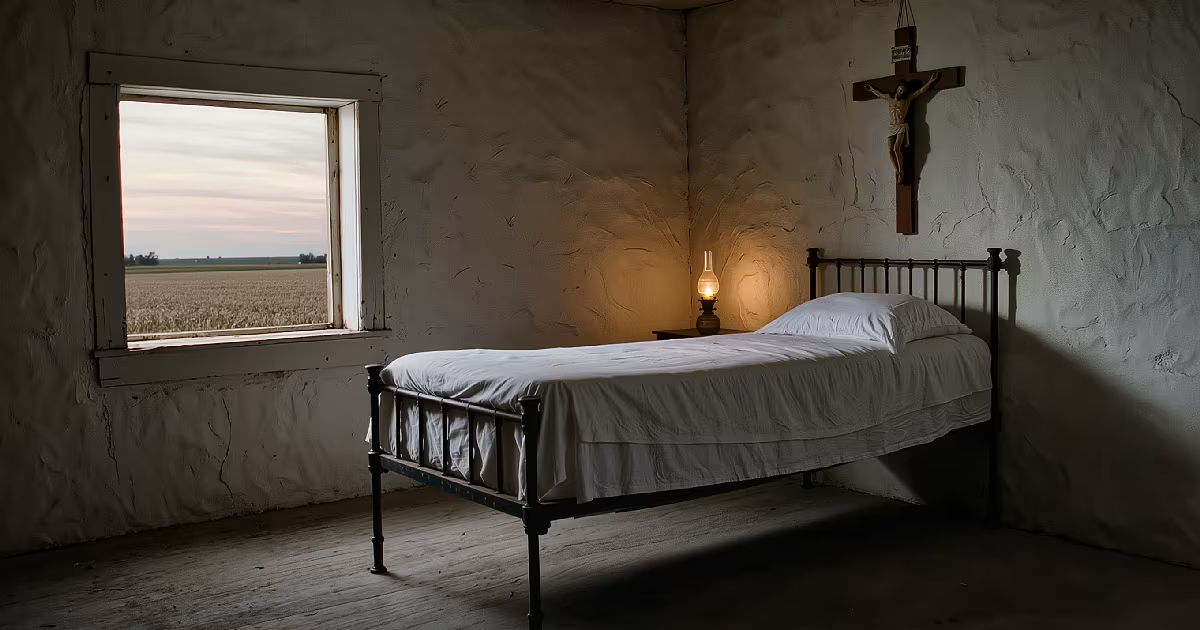
A narrow iron bed in a bare convent room, a crucifix on the wall.
Illustration, not a photograph.

Archive / Paranormal / BOT313-0534
PAR-192823 DEC 1928ParanormalPRIESTS' ACCOUNT
BEGONE SATAN IN AN IOWA CONVENT
Fig. 01 A narrow iron bed in a bare convent room, a crucifix on the wall. Illustration, not a photograph.
Opening
In the late summer of 1928 a woman in her forties arrived at a convent of Franciscan sisters in Earling, a farming town in western Iowa, to be exorcised. The rite was led by Father Theophilus Riesinger, a Capuchin friar originally from Bavaria, who had exorcised her once before, in 1912. Over three sessions between August and December, the nuns and priests say, she howled, hissed, levitated, vomited filth and spoke in languages she had never learned.
The account was published in German in 1935 and soon after in English as a pamphlet called Begone Satan!, under the false name Anna Ecklund. It became one of the most widely read exorcism stories of the century. Almost everything in it comes from the people who performed the rite.
Timeline
About 1896According to the pamphlet, the woman's symptoms begin at the age of fourteen: an aversion to church, holy things and prayer.
18 June 1912Father Riesinger performs a first exorcism on her. Little of it is recorded.
17 August 1928She arrives in Earling. Bishop Thomas Drumm of Des Moines has entrusted the case to Riesinger, and the local priest, Father Joseph Steiger, has agreed that the rite can be held at the Franciscan sisters' convent, away from her home town.
18 to 26 August 1928The first session.
13 to 20 September 1928The second session.
15 to 23 December 1928The final session. On the evening of 23 December, according to the account, she cries out "Hell! Hell! Hell!" and then speaks in her own voice. The exorcism is declared a success.
1935Carl Vogl, a German priest, publishes the account in German. The Benedictine Celestine Kapsner translates it into English as Begone Satan!
February 1936Time magazine reports the case to a national audience.
Key figures
The woman herself is called Anna Ecklund in the pamphlet. She is usually identified as Emma Schmidt, but even that is uncertain: records point to two possible women of that name, one born in Milwaukee in 1882 who died in 1941, and one born in Switzerland the same year who died in 1964.
Father Theophilus Riesinger performed the exorcism. Father Joseph Steiger hosted it and, according to the pamphlet, believed the demons were persecuting him for it. The Franciscan sisters at Earling cared for her and witnessed the sessions. Carl Vogl turned the priests' account into a book.
Physical and documentary trail
The main source is Begone Satan!, which is a devotional pamphlet written to show the power of the Church's rite, based on the testimony of the priests and nuns involved. No independent medical record, no outside witness and no police or newspaper report from 1928 has been published. The pamphlet's account of who she was, and who supposedly cursed her, cannot be checked against public records with any certainty, because her identity itself is in doubt.
Things you might not know
- She was blamed on her family. The account names the demons as including Judas Iscariot and her own dead father, Jacob, who is said to have cursed her with the help of his mistress, her aunt Mina.
- The food test. The pamphlet says she could tell when the sisters had secretly sprinkled her food with holy water, and refused it.
- It was meant to be hidden. Earling was chosen because nobody there knew her.
- It is still in print. Begone Satan! has been reprinted by Catholic publishers for nearly ninety years.
Competing explanations
Possession and a successful exorcism. The view of the pamphlet and of those who performed the rite. The people present were priests and nuns, and their account of what they saw is detailed.
Mental illness in a religious setting. A middle-aged woman with a lifelong aversion to religion and a history of distress, an abuse story about her father inside the account itself, and a rite that dramatised every symptom. Many modern readers see trauma and illness in the record, and a setting that turned them into a battle with demons.
Exaggeration in the retelling. The pamphlet was written seven years after the events, for a devotional purpose. Details such as levitation are reported by believers only.
Later life of the case
The Earling case was the best-known American exorcism until the St. Louis case of 1949, which inspired The Exorcist.
Finding
A woman was exorcised in an Iowa convent in 1928, and the priests involved believed they freed her. Everything we know about what happened in the room comes from them, written up years later to promote the rite, and the woman's own identity is not certain.
What still will not resolve: who she really was, and what her own account of 1928 would have been, since she never gave one.
Evidence signature
3/9 Thin
- Witnesses
- several people
- Instruments
- nothing on record
- Paper
- press and later accounts
How well documented the case is, not whether it's true. A strong record can still have an ordinary answer, and a thin one can still be real.
You decide · EARLING EXORCISM
What do you think happened?
One vote per case, anonymous. You'll see how other readers voted once you've voted.