ANNELIESE MICHEL
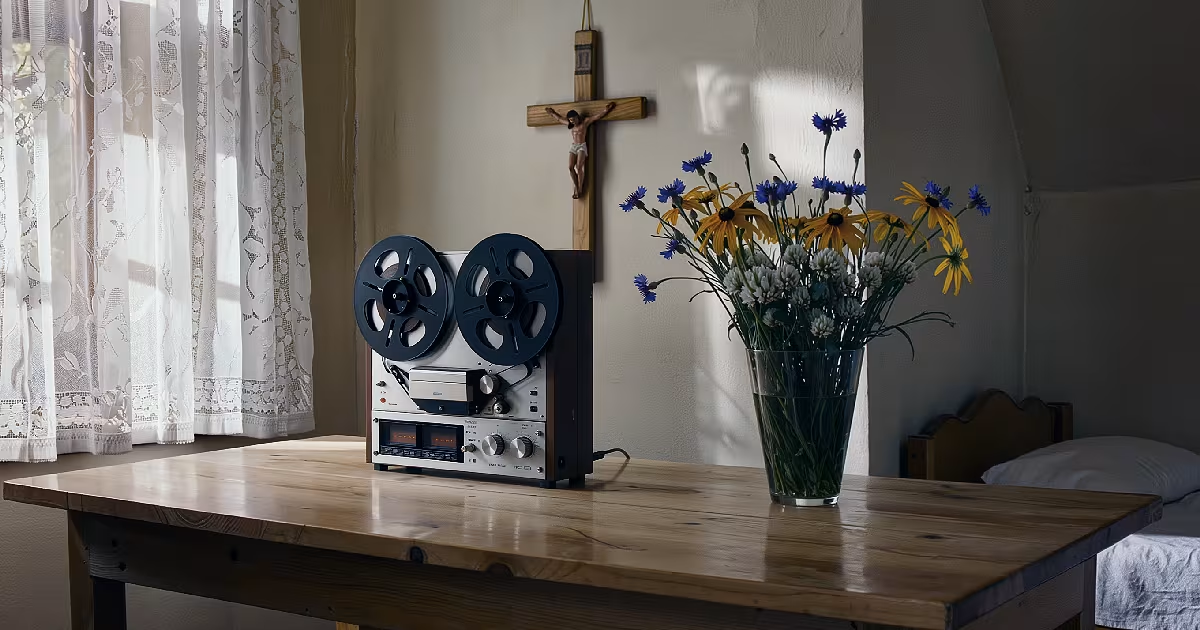
A small reel-to-reel tape recorder on a table in a quiet room.
Illustration, not a photograph.

Archive / Paranormal / BOT313-0532
PAR-19761 JUL 1976ParanormalCOURT VERDICT
THE STUDENT, THE ILLNESS AND THE RITE
Fig. 01 A small reel-to-reel tape recorder on a table in a quiet room. Illustration, not a photograph.
Opening
Anneliese Michel was born on 21 September 1952 in Leiblfing, Bavaria, and grew up in a devout Catholic family in the small town of Klingenberg am Main. At sixteen she had her first seizure. She was diagnosed with epilepsy, and later with depression and psychosis, and for five years she was treated by doctors without getting better. In 1973 she began training as a teacher of religious education at the teacher-training college in Würzburg.
By then she and her family had come to believe she was possessed. From September 1975 two priests performed the Catholic rite of exorcism on her, with their bishop's permission, more than sixty times. She died at home on 1 July 1976, aged 23, of malnutrition and dehydration. Her parents and the priests were convicted of negligent homicide. Her story became the film The Exorcism of Emily Rose.
Timeline
1968 to 1969Anneliese has her first seizures while still at school and is diagnosed with epilepsy at the psychiatric clinic in Würzburg. Over the following years she is prescribed anti-seizure drugs and later antipsychotics.
Early 1970sShe begins to see what she describes as faces, and to hear voices. She comes to feel that she cannot bear religious objects. A family friend takes her on a pilgrimage, and the belief grows that the cause is spiritual, not medical.
1973She enrols at the Pädagogische Hochschule in Würzburg to train as a teacher.
1975After earlier requests are turned down, Bishop Josef Stangl of Würzburg authorises an exorcism, on condition of total secrecy. The Jesuit Adolf Rodewyk had examined her and argued for possession.
24 September 1975Father Arnold Renz holds the first session, with Father Ernst Alt. Sessions continue for about ten months, one or two a week, many of them recorded on tape.
Spring 1976At her request the family stop calling doctors. She refuses most food. She performs hundreds of genuflections a day, to the point of injuring her knees.
1 July 1976She dies in her bed, weighing about 30 kilograms.
25 February 1978Her body is exhumed and reburied in a new coffin, after claims that it would be found uncorrupted.
30 March to April 1978At Aschaffenburg, her parents Josef and Anna and the two priests are tried for negligent homicide. All four are convicted and given suspended sentences.
Key figures
Anneliese Michel comes first in this story. Classmates remembered her as quiet and very religious. She wrote that she wanted to suffer for other people, and she believed it until the end. She was a young woman with a serious illness, in a family and a church that came to read that illness as something else.
Her parents, Josef and Anna Michel, believed they were saving her. Father Arnold Renz and Father Ernst Alt performed the rite. Bishop Josef Stangl authorised it. Doctors at the trial testified that she had not been possessed and that she could have been saved with medical care, even a week before she died.
Physical and documentary trail
The record is large and painful: the medical history, the bishop's authorisation, the court record of 1978, and the audio tapes made during the exorcism sessions, parts of which were played in court and have since circulated widely. Her grave in Klingenberg survives and has become a place of pilgrimage for some Catholics. The tapes are the reason the case is so well known, and also the reason it is so often treated as horror instead of as the death of a young woman.
Things you might not know
- She was a student teacher. She was studying to teach religious education, and the University of Würzburg has looked for people who knew her there.
- The rite was approved. It was not a rogue exorcism. A bishop authorised it, in secret.
- The parents were not punished in prison. The prosecution had asked for no punishment for them, saying they had suffered enough.
- Exorcism became rarer in Germany. Officially sanctioned exorcisms in the country declined sharply after the case.
- Her mother never changed her mind. In 2006 Anna Michel said she believed they had done the right thing.
Competing explanations
Illness and a fatal belief. Epilepsy and serious mental illness, a deeply religious setting that interpreted her symptoms as demonic, and a decision to stop medical care. This was the court's view and is the view of most writers since.
Possession. The view of the priests, her parents and some Catholics who visit her grave. They point to the voices on the tapes and her reaction to holy objects. Those are also known features of the illnesses she was diagnosed with, and none of it explains why she was left to starve.
Later life of the case
Her story inspired The Exorcism of Emily Rose (2005) and the German film Requiem (2006), which tells it far more quietly. For the exorcism that inspired The Exorcist, see the St. Louis exorcism.
Finding
Anneliese Michel died because the people around her stopped treating her illness and tried to cast it out instead. That is what a German court found in 1978, and nothing since has changed it. Whatever anyone believes about possession, the starvation was real and it was preventable.
What still will not resolve: how much of the decision to stop her treatment was hers, and how much was made for her by people she trusted. Rest in peace, Anneliese. 🕯️
Evidence signature
7/9 Strong
- Witnesses
- several people
- Instruments
- radar or measured data
- Paper
- formal investigation, court or declassified file
How well documented the case is, not whether it's true. A strong record can still have an ordinary answer, and a thin one can still be real.
You decide · ANNELIESE MICHEL
What do you think happened?
One vote per case, anonymous. You'll see how other readers voted once you've voted.