POLLOCK TWINS
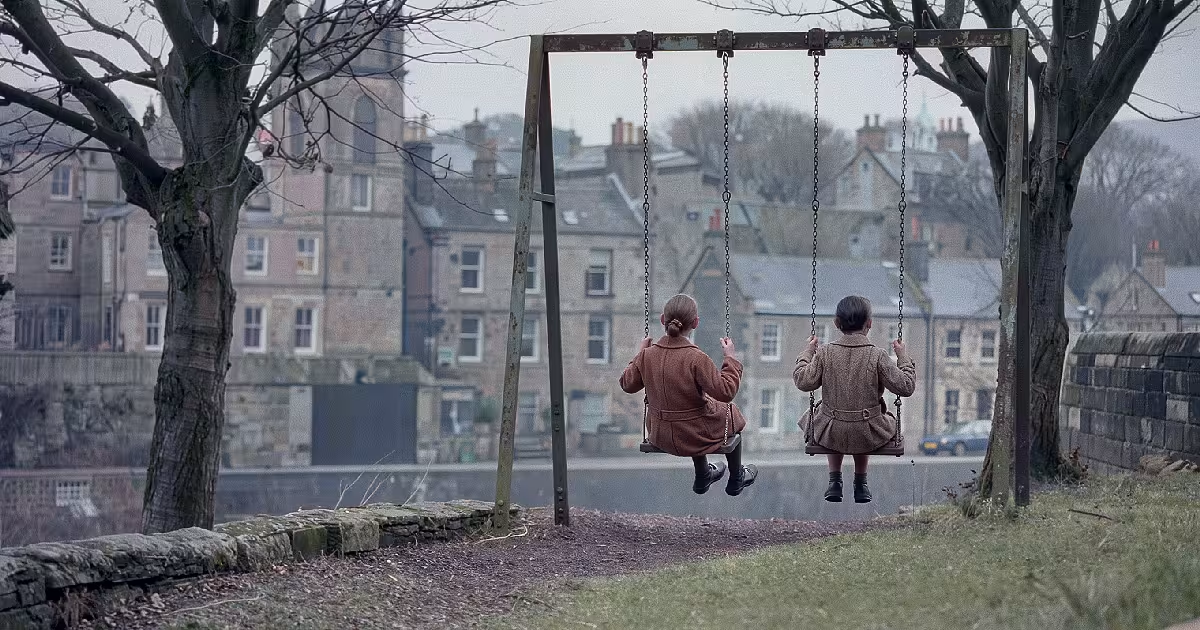
Two small girls on old park swings on an overcast English afternoon.
Illustration, not a photograph.

Archive / Paranormal / BOT313-0473
PAR-19584 OCT 1958ParanormalFAMILY TESTIMONY
THE SISTERS WHO CAME BACK
Fig. 01 Two small girls on old park swings on an overcast English afternoon. Illustration, not a photograph.
Opening
On 7 May 1957, in the market town of Hexham in Northumberland, two sisters, Joanna Pollock, aged 11, and Jacqueline, aged 6, were walking to church with a friend when a car struck them. Both girls died. Their father, John Pollock, had long believed in reincarnation, and in his grief he became convinced that his daughters would be born again into the family, as twins. On 4 October 1958, his wife Florence gave birth to identical twin girls, Gillian and Jennifer.
As the twins grew, their parents said, they seemed to know things they could not have known: they recognised their dead sisters' toys, found their way to a park they had never visited, and were terrified of cars. Jennifer was born with two birthmarks that matched marks on Jacqueline's body. The psychiatrist Ian Stevenson, who spent his career studying children who claim to remember past lives, followed the family for two decades and counted the Pollock twins among his strongest cases. His critics point out who told the story.
Timeline
1946 and 1951Joanna and Jacqueline Pollock are born. The family settles in Hexham in about 1951.
7 May 1957The sisters are killed when a car driven by a local woman in a state of crisis strikes them on their way to church. John Pollock, who had prayed for proof of reincarnation, comes to believe the deaths were a punishment, and that the girls will return.
1958When Florence becomes pregnant, John insists she is carrying twins. Her doctor, going by examination and a single heartbeat, says there is one baby, and there are no twins in either family.
4 October 1958Gillian and Jennifer are born. Jennifer has a mark on her forehead resembling a scar Jacqueline had, and a mark on her waist where Jacqueline had one too. Later blood tests show the twins are identical.
Early 1960sThe parents say the twins identify their sisters' toys, describe things from their sisters' lives, and at about four lead the way to a park in Hexham and its swings.
1963Ian Stevenson reads about the family in the newspapers and visits them. He returns in 1967 and 1978, and sees John and Gillian again in 1982.
1979 and 1985Florence Pollock dies, then John.
1997Stevenson publishes his full account of the case in the second volume of his book Reincarnation and Biology.
Key figures
Joanna and Jacqueline Pollock are at the heart of the story, two children whose deaths shaped everything that followed.
John Pollock, born in Bristol in 1920, had grown up in the Church of England and become a Catholic, and held a firm personal belief in reincarnation that his church did not share. He was the case's main witness and its main believer.
Florence Pollock did not share her husband's belief, and at first resisted it. Stevenson saw her scepticism as important, because the mother was not the one pushing the idea.
Gillian and Jennifer Pollock grew up to say they remembered nothing of any past lives and were mildly sceptical of reincarnation themselves.
Ian Stevenson was a psychiatrist at the University of Virginia who collected thousands of children's past-life claims around the world. Ian Wilson, a British writer, became one of his most careful critics.
Physical and documentary trail
What survives: newspaper coverage of the accident and of the twins, Stevenson's interview notes over twenty years and his published case report, the twins' blood-group results, the birthmarks as Stevenson recorded them, and later interviews with the family.
What is missing is anything written down before the claims were made. The twins' early statements and behaviour were recorded by their parents, especially their father, and reported to Stevenson years later. There is no independent record from the time of what the twins said, when, and in front of whom. The older sisters' lives, toys and habits were well known inside the family, so nobody can rule out that the twins learned about them in ordinary ways.
Things you might not know
- Their father said he caused it. John Pollock had prayed for proof of reincarnation, and after the deaths he believed God had punished him for it.
- The doctor said one baby. John's insistence on twins went against the medical advice, a detail that believers stress and sceptics note was only ever reported by the family.
- They were identical. Because the twins came from one egg and shared the same genes, Stevenson argued that genetics could not explain why only Jennifer had the birthmarks.
- The twins did not know the theory. According to the case report, they were not told about their parents' belief until they were about 13.
- One twin later had a "vision". In 1981 Gillian described seeing a house and garden that matched a home the family had lived in when Joanna was very young, which Gillian had never visited.
- Stevenson found birthmarks in many cases. Across 895 cases, he found birthmarks or birth defects reported in about 35 percent.
Competing explanations
Reincarnation. This was John Pollock's belief and Stevenson's tentative conclusion: the sisters' personalities, memories and marks carried over into the twins. Stevenson himself said his evidence did not compel belief.
Family influence and grief. Critics such as Ian Wilson and Richard Rockley argue that a father who strongly believed in reincarnation, in a family full of memories of the dead girls, could easily have shaped what the twins said and how it was interpreted, without anyone meaning to deceive.
Maternal impression. Wilson suggested that Florence's grief during pregnancy might somehow have marked the unborn twins, an idea Stevenson considered but thought unlikely. It cannot explain cases where the remembered life belongs to a stranger.
Later life of the case
The Pollock twins remain one of the most famous reincarnation cases in the English-speaking world, retold in books, documentaries and countless websites, often with dramatic details that do not appear in Stevenson's own account. For believers it is a case with physical marks and a sceptical mother. For critics it shows how a powerful belief inside a grieving family can produce a powerful story.
Finding
Two girls died in Hexham in 1957, and the next year their parents had identical twins, one of whom was born with marks matching her dead sister's. The family's accounts of what the twins later said and did were collected by Ian Stevenson over twenty years, and he thought them strong evidence. Almost all of it, though, came from the parents, and above all from a father who already believed and who said himself that without his belief there would have been no case.
What still will not resolve: what the twins actually said as small children, in their own words and before anyone wrote it down, and why only one of two identical twins was born with the marks.
Evidence signature
4/9 Solid
- Witnesses
- several people
- Instruments
- nothing on record
- Paper
- official records at the time
How well documented the case is, not whether it's true. A strong record can still have an ordinary answer, and a thin one can still be real.
You decide · POLLOCK TWINS
What do you think happened?
One vote per case, anonymous. You'll see how other readers voted once you've voted.