GREENBRIER GHOST
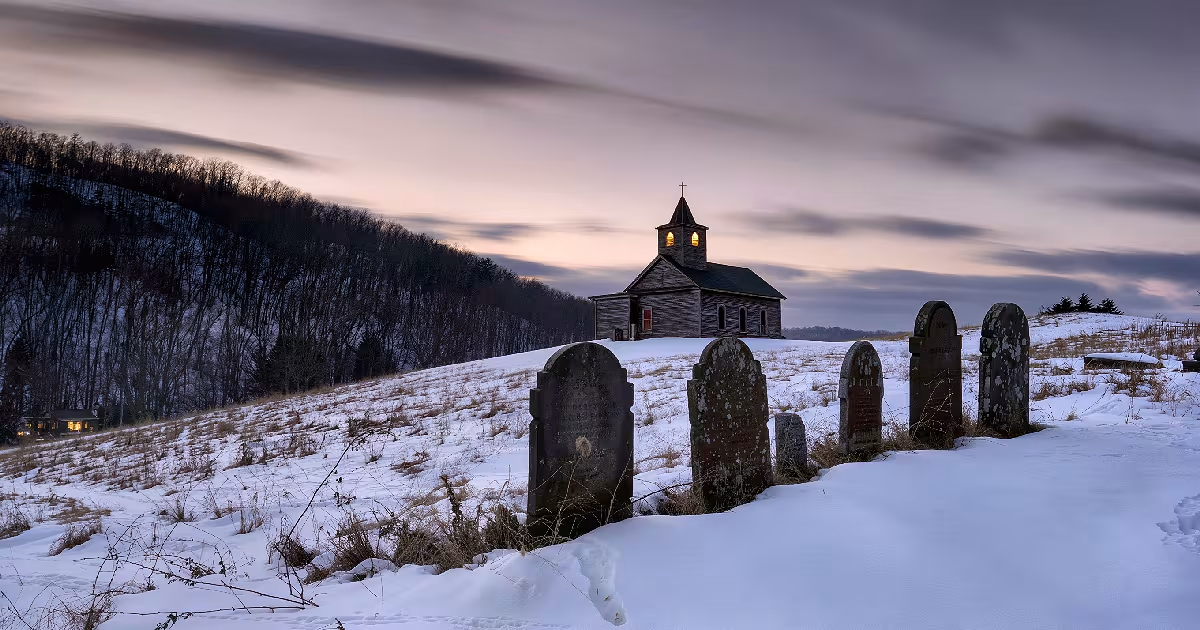
Snow-covered headstones below a lit country church at dusk.
Illustration, not a photograph.

Archive / Paranormal / BOT313-0454
PAR-189723 JAN 1897ParanormalONE WITNESS
THE MOTHER, THE GHOST AND THE BROKEN NECK
Fig. 01 Snow-covered headstones below a lit country church at dusk. Illustration, not a photograph.
Opening
On 23 January 1897, Zona Heaster Shue was found dead at her home in Greenbrier County, West Virginia, three months after marrying a blacksmith named Edward Shue. Her death was recorded as natural. Within weeks her mother, Mary Jane Heaster, told the county prosecutor that Zona's ghost had visited her at night and said Edward had broken her neck. The body was exhumed, the autopsy found a broken neck, and Edward Shue was convicted of murder that summer.
A state historical marker near the cemetery calls it the only known case in which testimony from a ghost helped convict a murderer. The court record tells a slightly different story. The conviction rested on the autopsy and on Shue's behaviour, and the ghost entered the trial mainly because his own lawyer raised it.
Timeline
October 1896Zona Heaster meets Edward Stribbling Trout Shue, a newcomer to the area who also went by Erasmus or Erastus. They marry soon afterwards.
23 January 1897A local boy sent to the house on an errand finds Zona lying dead on the floor. By the time the local doctor and coroner, Dr. George Knapp, arrives, Shue has dressed her himself in a high-necked dress with a veil, and he cradles her head and neck while the doctor looks. Knapp first gives the cause as "everlasting faint", and a coroner's jury later records death by heart disease.
24 January 1897Zona is buried in what is now the Soule Chapel Methodist Cemetery. At the wake, according to later accounts, mourners notice Shue's behaviour around the body: a pillow and folded cloth placed by her head, and his insistence that no one come too close.
February 1897Mary Jane Heaster says that over four nights Zona appeared to her and described how Edward attacked her and broke her neck. She goes to the prosecutor, John Alfred Preston.
22 February 1897After Knapp admits his examination was incomplete, Preston orders an exhumation. A three-hour autopsy in the local one-room schoolhouse finds a broken neck, a dislocation between the first and second vertebrae, a crushed windpipe and finger marks on the throat.
22 June to 11 July 1897Shue is tried for murder. Evidence emerges that one previous wife had divorced him alleging cruelty, and that another had died within a year of marrying him. He is found guilty of first-degree murder. The jury recommends mercy, and he is sentenced to life imprisonment.
1897At one point a lynch mob forms to take Shue from jail. The deputy sheriff disperses it, and four of its organisers are later charged.
13 March 1900Shue dies at the West Virginia State Penitentiary in Moundsville during an epidemic, and is buried in an unmarked grave.
Key figures
Zona Heaster Shue was the victim. Edward Shue was convicted of killing her. Mary Jane Heaster told the ghost story and pressed for the case to be reopened. Dr. George Knapp's admission that he had not examined the body properly was what gave the prosecutor grounds to exhume. John Alfred Preston prosecuted without relying on the ghost. Defence counsel called Mary Jane to the stand and questioned her about the visions, which put the ghost story into the trial record.
Physical and documentary trail
The autopsy findings were published in March 1897, and the trial was reported in local newspapers. The physical evidence of the broken neck and crushed windpipe is the core of the case, and it was found by doctors, not reported by a ghost. Mary Jane's account appears in the trial testimony and in later local histories. The detailed versions most people repeat come from those newspaper reports and later local histories.
strictly on earthly considerations
Things you might not know
- The defence brought up the ghost. The prosecutor avoided it. Shue's lawyer questioned Mary Jane about it, apparently hoping to make her look unreliable, and it backfired.
- The first cause of death was "everlasting faint". It was a vague phrase from an incomplete examination.
- Shue reportedly said he wanted seven wives. Zona was his third.
- The marker is a state marker. West Virginia's roadside sign near the cemetery records the ghost story as the case's distinguishing feature.
- The case is still on stage. It has inspired plays, a musical, a 2017 novel by Sharyn McCrumb and a 2023 opera.
Competing explanations
A genuine visitation. On Mary Jane's account, her daughter appeared and described an injury that was later confirmed by autopsy. For believers this is one of the clearest cases of information coming from the dead.
A mother's suspicion, told as a ghost story. Mary Jane distrusted Shue from the start, and the wake gave plenty of reason for doubt: the high collar, the veil, the way he guarded her head. The writer Katie Letcher Lyle argued in 1999 that Mary Jane likely framed her suspicions as a ghost visit to get the authorities to act, which she would have struggled to do otherwise.
Both at once. A grieving mother's dreams can carry what she already suspects. A dream of her daughter saying her neck was broken would be vivid and sincere without being supernatural.
Later life of the case
The Greenbrier Ghost has become a fixture of West Virginia history and of American ghost lore. It is often told as a court that convicted on a ghost's word, which the record does not support, and as a ghost story that turned out to be right, which it does.
Finding
Zona Shue was murdered, and the autopsy proved it. Her husband's conviction rested on that physical evidence and on his own behaviour, not on testimony from a ghost. What remains is Mary Jane Heaster's account of the four nights, which cannot be tested. It may have been a vision, a dream shaped by suspicion, or a story told to make the authorities listen, and it worked.
What still will not resolve: whether Mary Jane described the visions to anyone before the autopsy confirmed the broken neck, which would show how much the ghost knew before the doctors did.
Evidence signature
6/9 Solid
- Witnesses
- one person, or a tradition
- Instruments
- radar or measured data
- Paper
- formal investigation, court or declassified file
How well documented the case is, not whether it's true. A strong record can still have an ordinary answer, and a thin one can still be real.
You decide · GREENBRIER GHOST
What do you think happened?
One vote per case, anonymous. You'll see how other readers voted once you've voted.