COTTINGLEY FAIRIES
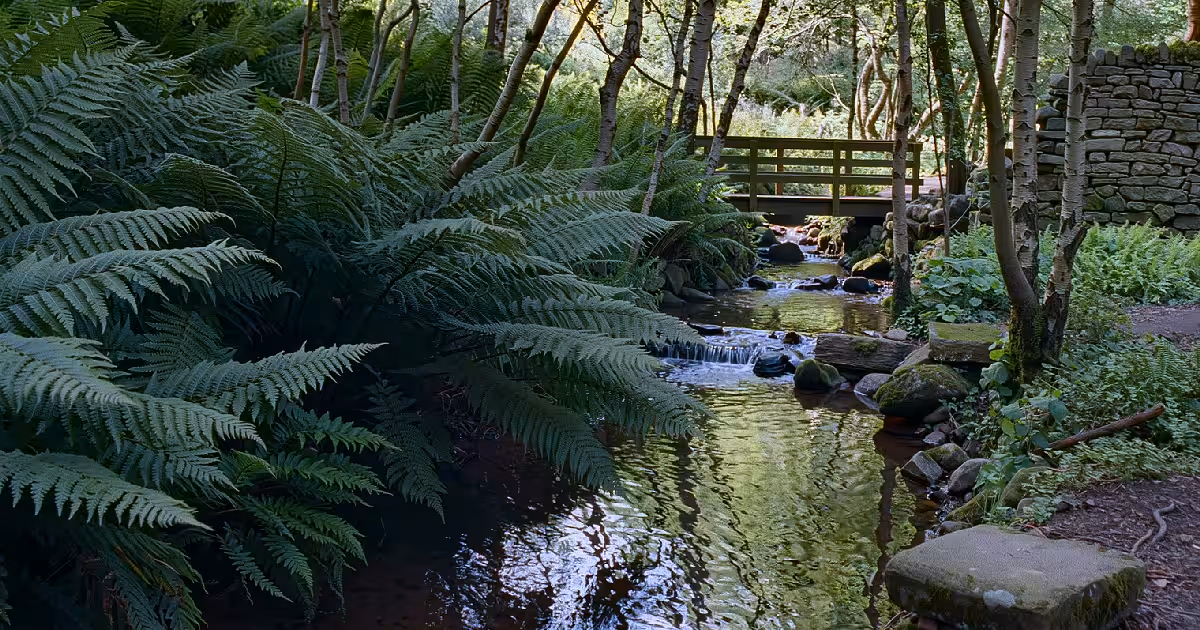
A small stream under ferns and birch trees in a Yorkshire garden.
Illustration, not a photograph.

Archive / Paranormal / BOT313-0455
PAR-1917ParanormalCONFESSED HOAX
THE PHOTOGRAPHS AND THE CONFESSION
Fig. 01 A small stream under ferns and birch trees in a Yorkshire garden. Illustration, not a photograph.
Opening
In the summer of 1917, two cousins in the village of Cottingley, near Bradford in West Yorkshire, took a photograph that seemed to show fairies dancing in front of nine-year-old Frances Griffiths by the stream at the bottom of the garden. Elsie Wright, who was 16, took a second picture that autumn, and in August 1920 the girls took three more. Sir Arthur Conan Doyle published the photographs in The Strand Magazine as evidence that fairies were real.
In 1983, more than sixty years later, the cousins admitted that the first four photographs were faked using paper cut-outs held up with hatpins. They disagreed to the end about the fifth. Both also said, to the end, that they had really seen fairies by the beck.
Timeline
1917, summerFrances, recently arrived from South Africa with her mother, is living with Elsie's family in Cottingley. She keeps coming home wet from the beck and says she goes there to see the fairies. Elsie borrows her father's camera, and the plate shows Frances behind a bush with four small dancing figures. Elsie's father, Arthur Wright, an amateur photographer, develops it and thinks the figures are paper.
About two months laterThe girls take a second photograph, of Elsie holding out her hand to a gnome about a foot tall. Arthur Wright bans them from using the camera.
1919Elsie's mother, Polly Wright, an interested Theosophist, mentions the photographs at a meeting. Prints are shown at the Theosophical Society's 1919 conference in Harrogate and reach Edward Gardner, a leading member, who begins showing them at his lectures.
1920Gardner has the negatives examined by Harold Snelling, a photography expert, who says they show no sign of faking, though he does not say they show fairies. Kodak finds no obvious faking but declines to certify them. Conan Doyle, a committed spiritualist, takes up the case.
19 to 21 August 1920With new cameras and marked plates supplied by Gardner, the girls take three more photographs: Frances with a leaping fairy, a fairy offering Elsie a posy of harebells, and a fifth image later titled "Fairies and Their Sun-Bath".
December 1920Conan Doyle's article "Fairies Photographed" appears in the Strand's Christmas issue and sells out within days.
1921A final visit with the clairvoyant Geoffrey Hodson produces no new photographs.
1922Conan Doyle publishes The Coming of the Fairies.
1982 to 1983The photographic editor Geoffrey Crawley publishes a detailed analysis showing how the photographs could have been made. In 1983, in the magazine The Unexplained, the cousins confess.
1986 and 1988Frances dies in 1986, and Elsie in 1988.
Key figures
Elsie Wright had worked briefly in a photographic shop and was a skilled artist, which matters to how the fakes were made. Frances Griffiths was the younger cousin who started the story. Arthur Wright, Elsie's father, never believed in the fairies. Edward Gardner promoted them, and Conan Doyle gave them a world audience. Sir Oliver Lodge, the physicist and psychical researcher, thought they were faked and was suspicious of the fairies' fashionable hairstyles. Geoffrey Crawley did the analysis that led to the confession.
Physical and documentary trail
The original negatives, prints, cameras and correspondence survive, and many are now in the collection of the National Science and Media Museum in Bradford. The source of the dancing fairies has been identified: they were copied from illustrations by Claude Shepperson in Princess Mary's Gift Book, published in 1914, with wings added. The cousins said they drew and cut out the figures, propped them up with hatpins, photographed them, and then threw the cut-outs into the beck.
entirely genuine, unfaked photographs
Things you might not know
- Elsie's own father thought the fairies were paper. He said so from the first photograph.
- The "genuine" verdict was about the negatives. Snelling said the plates had not been tampered with, which was true. The fakery was in front of the camera.
- The fairies came from a children's book. Princess Mary's Gift Book was in the house.
- The cousins disagreed about the fifth photograph. Elsie said it was faked. Frances said it was real.
- They kept quiet partly for Conan Doyle's sake. The cousins later said they felt they could not embarrass a famous man who had believed them.
Competing explanations
A hoax, as confessed. The cut-outs, the source book and the cousins' own statements settle the first four photographs. This is one of the few cases in the archive where the people involved explained exactly how it was done.
The fifth photograph. Frances insisted that "Fairies and Their Sun-Bath" was genuine. Crawley suggested it was an accidental double exposure of cut-outs set up in the grass. The cousins' disagreement means this one image has no agreed explanation.
The experiences behind the photographs. Both cousins said they had seen fairies by the beck and made the pictures to show others what they had seen. That claim is separate from the photographs, and it cannot be tested.
Later life of the case
The Cottingley Fairies became a standard example of how much weight a respected name can lend to weak evidence. They also inspired two films in 1997, FairyTale: A True Story and Photographing Fairies. Prints, cameras and the glass plates have sold at auction, and the museum in Bradford acquired the third camera in 2019.
Finding
The first four photographs were faked with paper cut-outs copied from a 1914 children's book, and the cousins confessed in 1983. That part of the case is settled. The fifth photograph is still disputed between the two women who took it, and their shared claim to have seen fairies by the stream is something no photograph could prove or disprove.
What still will not resolve: how "Fairies and Their Sun-Bath" was made, and why Frances, having admitted the rest, held to that one image until she died.
Evidence signature
5/9 Solid
- Witnesses
- several people
- Instruments
- photo, film or physical traces
- Paper
- official records at the time
How well documented the case is, not whether it's true. A strong record can still have an ordinary answer, and a thin one can still be real.
You decide · COTTINGLEY FAIRIES
What do you think happened?
One vote per case, anonymous. You'll see how other readers voted once you've voted.