MERCY BROWN
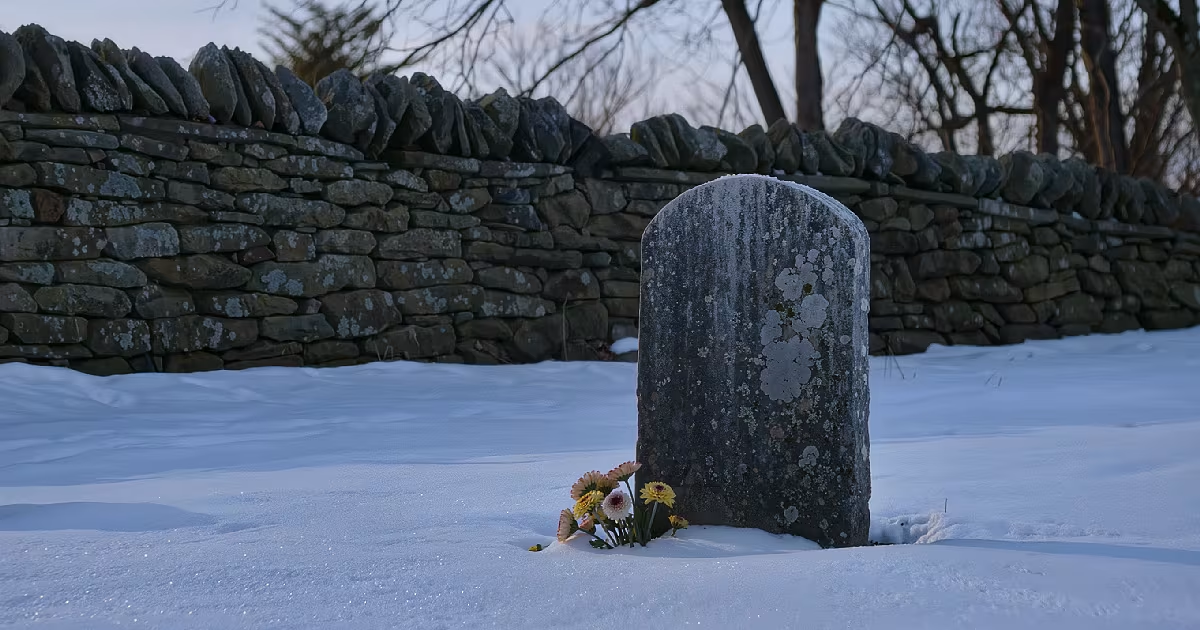
A small weathered headstone in a snowy country graveyard at dusk.
Illustration, not a photograph.

Archive / Paranormal / BOT313-0528
PAR-189217 MAR 1892ParanormalTUBERCULOSIS
THE LAST NEW ENGLAND VAMPIRE
Fig. 01 A small weathered headstone in a snowy country graveyard at dusk. Illustration, not a photograph.
Opening
Mercy Lena Brown, called Lena by her family, died of tuberculosis in Exeter, Rhode Island, on 17 January 1892, aged 19. Her mother and her older sister had already died of the same disease, and her brother Edwin was dying of it. Neighbours became convinced that one of the dead women was draining the life from the living.
On 17 March 1892 the bodies were dug up. Mercy's was found to have blood in its heart. Her heart and liver were burned, and the ashes were mixed into a drink for Edwin. He died two months later. Mercy is remembered as the last of the New England "vampires".
Timeline
8 December 1883Mary Eliza Brown, Mercy's mother, dies of consumption, as tuberculosis was then called.
6 June 1884Mercy's sister Mary Olive, a 20-year-old dressmaker, dies of the same disease. The whole town turns out for her funeral.
1889 to 1891Mercy's brother Edwin falls ill and goes to Colorado Springs with his new wife, hoping the climate will save him. It helps for a while. He comes home after Mercy's death, sicker, and in his fevers says that she is haunting him.
17 January 1892Mercy dies. The ground is frozen, so her body is placed in the receiving vault at Chestnut Hill Cemetery to wait for spring.
17 March 1892At the urging of neighbours, and with their father George Brown's consent, the bodies of all three women are examined in the presence of the local doctor, Harold Metcalf, and a newspaper reporter. The mother and older sister are long decayed. Mercy, dead two months and kept in a cold vault, is not, and blood is found in her heart and liver. They are cut out and burned.
19 March 1892The Providence Journal reports the exhumation.
2 May 1892Edwin Brown dies.
Key figures
Mercy Brown was a young woman from a farming family who had watched her mother and sister die of a disease no one could treat, and then caught it herself. She was not accused of anything while she was alive.
George Brown, her father, gave permission for the exhumation, reportedly more to calm his neighbours than because he believed. Dr Harold Metcalf, the local physician, attended the examination. Edwin Brown was the brother the ritual was meant to save.
Physical and documentary trail
The record is solid for a rural case: death records and obituaries for each member of the family, the Providence Journal report of the exhumation, and later accounts collected by folklorists, especially Michael E. Bell in Food for the Dead (2001). Mercy's grave is in the Chestnut Hill Baptist Church cemetery in Exeter. What is missing is any first-hand statement from George Brown.
Things you might not know
- No one said "vampire". The neighbours never used the word. To them the dead were "feeding" on the living. The label came from newspapers and later writers.
- The blood was normal. A body kept for two months in a winter vault would be expected to still have blood in the heart.
- Her father outlived them all. George Brown was one of the few in his family who never caught the disease. He lived until 1922, after the first tuberculosis vaccine had been developed.
- She may be in Dracula. Some scholars think Bram Stoker read about the case and drew on it for Lucy Westenra. A clipping about New England vampire beliefs was found among his papers.
- Lovecraft knew it. H. P. Lovecraft refers to the case in his story "The Shunned House".
- Her grave is still visited. People leave flowers, coins and notes on her headstone.
Competing explanations
Tuberculosis and folk medicine. The disease moved through the family one person at a time, and folk belief in rural New England blamed the dead. Burning the heart was a known cure. This is the full explanation, and nothing in the record argues against it.
A real undead. Mercy's body was "fresh" and had blood in it. That is what decomposition in a cold vault would produce over two months, and Edwin's death after the ritual is what tuberculosis did to most patients in 1892.
Later life of the case
The case drew national attention in 1892 and has been retold ever since as "the last American vampire". Michael Bell's work showed it was one of many similar exhumations in New England over the previous century, part of a pattern rather than a strange one-off. Rhode Island is now sometimes called the vampire capital of America because of it.
Finding
Mercy Brown was a young woman who died of tuberculosis and was then blamed for her brother's illness by frightened neighbours. The exhumation, the burning and the drink are all documented, and so is the disease that explains everything that happened.
What still will not resolve: what George Brown believed when he agreed to open his wife's and daughters' graves, since he left no account of his own. Rest in peace, Mercy. 🕯️
Evidence signature
6/9 Solid
- Witnesses
- several people
- Instruments
- photo, film or physical traces
- Paper
- formal investigation, court or declassified file
How well documented the case is, not whether it's true. A strong record can still have an ordinary answer, and a thin one can still be real.
You decide · MERCY BROWN
What do you think happened?
One vote per case, anonymous. You'll see how other readers voted once you've voted.