OSSETT EXORCISM
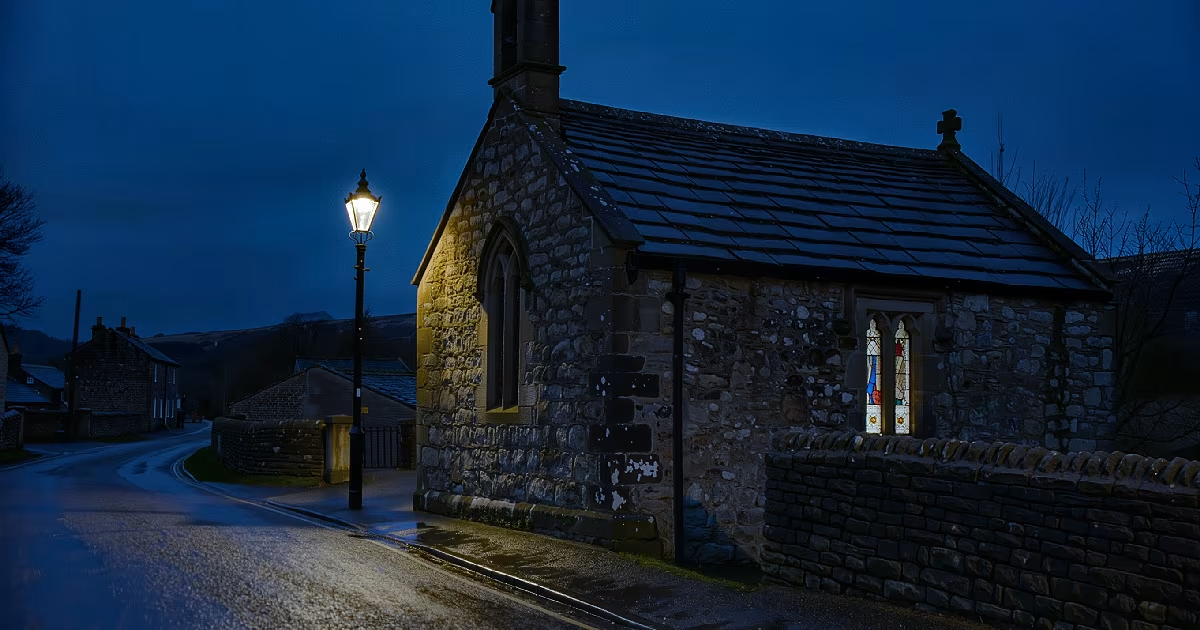
A small stone church in Yorkshire at night, one window lit.
Illustration, not a photograph.

Archive / Paranormal / BOT313-0537
PAR-19746 OCT 1974ParanormalINSANITY VERDICT
THE NIGHT AT GAWBER AND CHRISTINE TAYLOR
Fig. 01 A small stone church in Yorkshire at night, one window lit. Illustration, not a photograph.
Opening
On the night of 5 October 1974, a 30-year-old butcher from Ossett, West Yorkshire, named Michael Taylor was taken to St Thomas's Church in Gawber, near Barnsley, by members of a local Christian fellowship group. There an Anglican vicar and a Methodist minister spent the whole night performing an exorcism on him. By morning they said they had cast out around forty demons, but that the demons of insanity, murder and violence were still in him. They sent him home.
Within hours Taylor had killed his wife, Christine Taylor, the mother of their five children, in their home. He was found by police in the street, naked and covered in her blood. He was later found not guilty by reason of insanity. The case shook the Church of England, which within a year had issued its first formal rules on exorcism.
Timeline
1974Michael and Christine Taylor join a small Christian Fellowship Group in Ossett, led by a young lay preacher, Marie Robinson. Christine comes to believe that her husband's relationship with Robinson has become intimate and says so to the group. Over the following weeks Michael's behaviour becomes increasingly disturbed and frightening.
Night of 5 to 6 October 1974Members of the group take him to St Thomas's, Gawber. The vicar, the Reverend Peter Vincent, and a Methodist minister, the Reverend Raymond Smith, lead an all-night exorcism with others present.
Morning of 6 October 1974Taylor returns home and kills Christine. He also kills the family dog. Police find him in the street.
March 1975At trial, he is acquitted on the grounds of insanity. He is sent to Broadmoor Hospital.
July 1975The Archbishop of Canterbury, Donald Coggan, sets out guidelines for exorcism in the Church of England at the General Synod: it should be done only with the bishop's permission, by experienced people, and in collaboration with medicine.
About 1977 to 1979Taylor spends two years at Broadmoor and two more in a secure unit in Bradford, and is then released.
Key figures
Christine Taylor was a young mother of five who saw that something was going wrong in her husband and in the group around him, and said so. She is the person this case should be remembered for.
Michael Taylor killed her during a severe mental breakdown, according to the court. Peter Vincent and Raymond Smith performed the exorcism and sent him home believing he still carried the demon of murder. Marie Robinson led the fellowship group in which the crisis began.
Physical and documentary trail
The record: the police investigation, the trial and its verdict, newspaper coverage in 1974 and 1975, and the Church of England's guidelines of 1975. The clergy's own description of the night, including the claim to have cast out some forty demons, comes from their accounts at the time. Historians of Anglican exorcism, notably Francis Young, link the case to the 1975 guidelines largely by timing, and describe the guidelines themselves as brief.
Things you might not know
- Two churches took part. The exorcism was led by an Anglican vicar with a Methodist minister.
- They believed murder was still in him. The team's own belief that "murder" remained in him did not lead them to call a doctor or the police.
- The rules came the next summer. Archbishop Coggan's guidelines, issued in July 1975, are still the basis of Church of England practice, in slightly modified form.
- It reached fiction. David Peace drew on it in his novel Nineteen Seventy-Seven.
Competing explanations
A mental health crisis made worse. The court's finding was insanity. A man in acute breakdown, inside a small, intense religious group, was put through a night of ritual that told him he was full of demons, including murder, and then sent home. This is the view of most writers on the case and the reason the Church changed its rules.
Possession. The view of those who performed the exorcism at the time. It was not accepted by the court.
Later life of the case
The Ossett case is still cited in debates about deliverance ministry in Britain. For another case where a religious rite took the place of medical care, see Anneliese Michel, who died in Germany less than two years later.
Finding
Christine Taylor was killed by her husband hours after an all-night exorcism that declared him still possessed by murder and then let him go. The court found him insane. The Church of England's response, formal rules on exorcism and a requirement to work with doctors, is the clearest admission that something went badly wrong that night.
What still will not resolve: why no one in the church that night called for medical help, when they believed what they said they believed. Rest in peace, Christine. 🕯️
Evidence signature
5/9 Solid
- Witnesses
- several people
- Instruments
- nothing on record
- Paper
- formal investigation, court or declassified file
How well documented the case is, not whether it's true. A strong record can still have an ordinary answer, and a thin one can still be real.
You decide · OSSETT EXORCISM
What do you think happened?
One vote per case, anonymous. You'll see how other readers voted once you've voted.