SAWSTON HALL
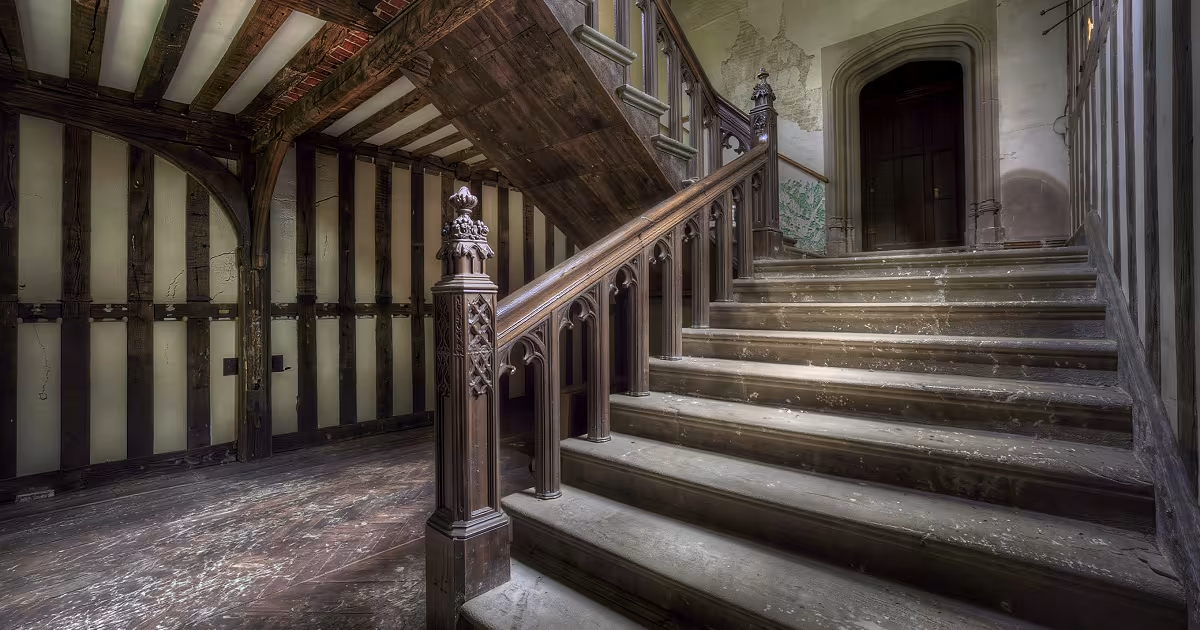
The dark oak staircase and timbered hall of a Tudor house.
Illustration, not a period photograph.

Archive / Paranormal / BOT313-0201
PAR-1553ParanormalFOLKLORE
MARY TUDOR'S REFUGE AND ITS GREY LADY
Fig. 01 The dark oak staircase and timbered hall of a Tudor house. Illustration, not a period photograph.
Opening
Sawston Hall, seven miles south of Cambridge, was the home of the Catholic Huddleston family from 1517 until 1982. In July 1553, days after the death of Edward VI, Princess Mary Tudor spent a night there while the Duke of Northumberland was trying to put Lady Jane Grey on the throne. Northumberland's men followed her. Mary left the next morning disguised as a dairymaid, and the soldiers set fire to the house.
When Mary became queen she helped the family rebuild. The Elizabethan house that replaced the old manor has some of the finest priest holes in England, built when the family kept practising Catholicism under Elizabeth I. It also has a ghost story: a grey lady, usually said to be Mary herself.
Timeline
1517The Huddleston family acquires the Sawston estate.
6 July 1553Edward VI dies. Northumberland moves to secure the crown for his daughter-in-law, Lady Jane Grey.
July 1553Mary, warned that she will be seized if she goes to London, shelters at Sawston with John Huddleston. Northumberland's soldiers arrive, she escapes in disguise, and much of the medieval manor is burned.
19 July 1553Mary is proclaimed queen in London. Huddleston is later knighted for his loyalty.
1557 to 1584Sir John Huddleston and his son Edmund rebuild the hall, using stone from Cambridge Castle under a licence from the queen. Mary dies in 1558, before the work is finished.
Late 16th centuryNicholas Owen, the Jesuit lay brother famous for building hiding places, constructs priest holes in the house.
Second World WarThe hall serves as headquarters of the 66th Fighter Wing of the US Army Air Forces.
1982The Huddlestons sell the hall. It becomes a language school and later returns to private ownership.
Key figures
Mary Tudor, later Queen Mary I, is the house's most famous guest and its supposed ghost.
Sir John Huddleston sheltered her and was rewarded with the stone and the support to rebuild.
Nicholas Owen built several of the hiding places. He died under torture in the Tower of London in 1606 and was later made a saint.
John Dudley, Duke of Northumberland, was the power behind Lady Jane Grey's nine-day reign and the man whose soldiers burned the house.
Physical and documentary trail
The record: the historical record of Mary's flight in 1553, the licence to take stone from Cambridge Castle, the Elizabethan fabric of the house, and the priest holes, which are physical features anyone can see. The house is Grade I listed. The ghost reports come from the 20th century onwards, are anecdotal, and have no named witness on record in any source I could find.
Things you might not know
- The future queen dressed as a dairymaid. That is the disguise the house's history gives for her escape on the morning of the fire.
- The house is built from a castle. Mary licensed the Huddlestons to take stone from Cambridge Castle for the rebuilding.
- The best hiding place is at the top of the stairs. The most notable priest hole sits at the top of the spiral staircase and is counted among the finest in England.
- It was in a horror film. Sawston Hall appears in The Nightcomers (1971), with Marlon Brando.
- American fighter command ran from here. The 66th Fighter Wing used the hall as its headquarters during the Second World War.
- Mary's ghost is a cheerful one. Accounts describe her as smiling and happy, and some add the sound of music played on an old keyboard instrument.
Competing explanations
A haunting. Visitors and staff over the years have reported a grey lady, music from empty rooms, footsteps and knocking. Believers link them to Mary and to the house's dramatic past.
A historic house with a famous story. A royal fugitive, a fire, persecuted priests and hidden rooms make Sawston an ideal setting for ghost stories, and the reports appear centuries after the events they are linked to.
Later life of the case
Sawston Hall appears in haunted Britain lists and ghost books, with the grey lady as its main attraction, and has hosted overnight ghost investigations.
Finding
The history is solid: Mary did shelter at Sawston, the house was burned, she helped rebuild it, and Owen's priest holes survive. The ghost stories are modern and anecdotal, and nothing in the record connects them to Mary beyond the house's history.
What still will not resolve: who first reported the grey lady, and when.
Evidence signature
4/9 Solid
- Witnesses
- several people
- Instruments
- nothing on record
- Paper
- official records at the time
How well documented the case is, not whether it's true. A strong record can still have an ordinary answer, and a thin one can still be real.
You decide · SAWSTON HALL
What do you think happened?
One vote per case, anonymous. You'll see how other readers voted once you've voted.