RESURRECTION MARY
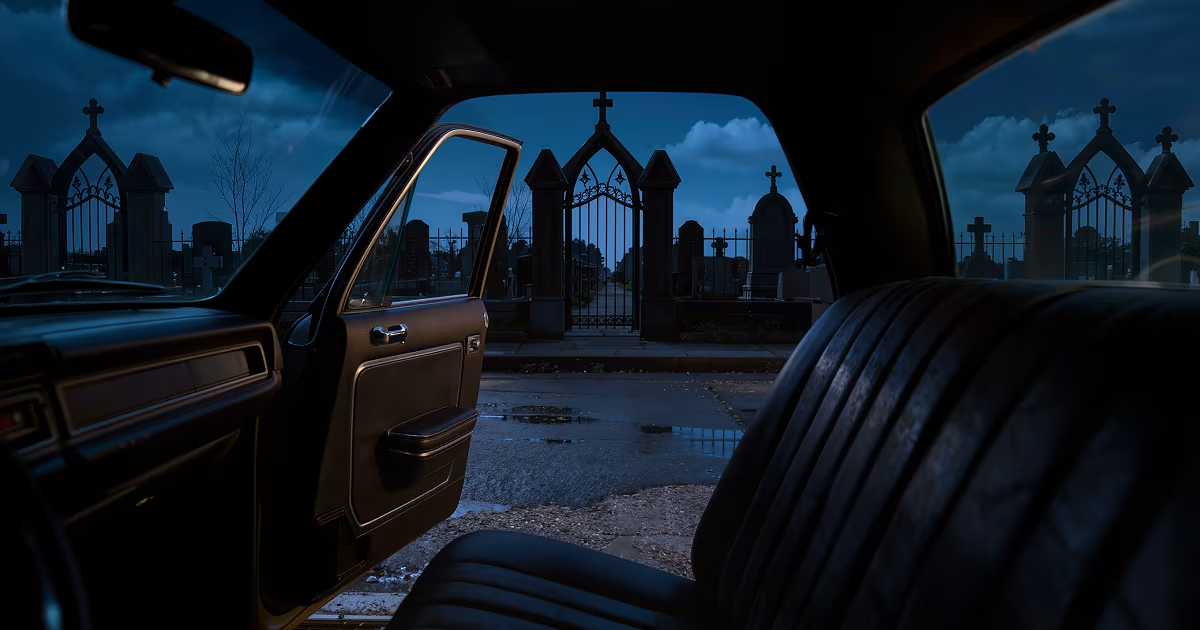
The gates of a cemetery at night, seen from an open car door.
Illustration, not a period photograph.

Archive / Paranormal / BOT313-0200
PAR-2016ParanormalFOLKLORE
THE HITCHHIKER OF ARCHER AVENUE
Fig. 01 The gates of a cemetery at night, seen from an open car door. Illustration, not a period photograph.
Opening
Since at least the 1930s, drivers on Archer Avenue, south-west of Chicago, have told of a young blonde woman in a white party dress who asks for a lift and disappears at the gates of Resurrection Cemetery in Justice, Illinois. In some versions she vanishes from a moving car. In others she simply walks through the cemetery fence.
The legend says she was killed by a hit-and-run driver after a night of dancing at a ballroom along the same road. Researchers have tried to match her to real young women who died in that era. None of the candidates fits every detail, and the stories have kept coming.
Timeline
1921The Oh Henry Park pavilion opens on Archer Avenue in Willow Springs. The enlarged ballroom holds its first dances on 3 May 1931.
1927Anna "Marija" Norkus, aged 12, dies in a car crash on her way home from the Oh Henry Ballroom.
1934Mary Bregovy dies in a car crash in the Chicago Loop.
1939Jerry Palus says he danced with a young woman at the Liberty Grove Hall, drove her home along Archer Avenue, and watched her vanish in front of the cemetery.
1959The Oh Henry is renamed the Willowbrook Ballroom.
1973A cab driver comes into Chet's Melody Lounge, across from the cemetery, asking about a young woman who left his cab without paying.
August 1976Reports spread that Mary has left scorched handprints in the cemetery's iron fence. Cemetery officials say a truck damaged the fence.
1979Chicago Tribune columnist Bill Geist writes up a cab driver named Ralph's story of a passenger who vanished without the door opening.
28 October 2016Fire guts the Willowbrook Ballroom.
Key figures
Jerry Palus gave the best-known early account, with a named dance hall and a drive.
Mary Bregovy and Anna Norkus are the leading candidates for Mary's real identity. Neither fits well: Bregovy died downtown, and Norkus was twelve and is buried at St. Casimir's, not Resurrection.
Richard Crowe, a Chicago ghost hunter, collected what the Tribune called three dozen substantiated reports.
Ursula Bielski and Troy Taylor wrote the main books on the legend. Bielski proposed the Norkus connection.
Physical and documentary trail
What exists: newspaper columns from the 1970s onward, Crowe's compiled reports, the death records of Bregovy and Norkus, and the cemetery's statement on the 1976 fence damage. There is no photograph of Mary, and no coroner's record ties any one death to the hitchhiker. Most accounts are second-hand by the time they reach print.
Things you might not know
- The ballroom is real, and it burned. The Oh Henry, later the Willowbrook, stood at 8900 Archer Avenue until a fire in October 2016.
- The best candidate was twelve. Anna Norkus did die after leaving the Oh Henry, but she was a child, far younger than the woman drivers describe.
- The handprints had a truck. Cemetery officials blamed the famous scorched fence on vehicle damage.
- Palus did not meet her at the Oh Henry. His 1939 dance partner came from the Liberty Grove Hall.
- A columnist gave the verdict. Geist told his cab driver he had simply picked up the Chicago area's pre-eminent ghost.
- She owes a fare. The 1973 cab driver's complaint was that his passenger left without paying.
Competing explanations
A ghost. This reading takes the decades of independent reports, from drivers who often did not know the legend, as evidence of something real on Archer Avenue.
A vanishing hitchhiker legend with local details. The story of a ghostly passenger who disappears near a cemetery is told across the United States and Europe. On this reading, Chicago attached a widely told tale to a real road, a real ballroom and real road deaths.
Some real encounters, retold. A young woman who left a car or a cab near the cemetery would, on that road, become Mary in the retelling. This explains the fare-dodger without explaining every account.
Later life of the case
Resurrection Mary is Chicago's best-known ghost, a fixture of ghost tours, Halloween features and books. The loss of the Willowbrook Ballroom in 2016 removed the building at the centre of the legend, but not the stories.
Finding
The road, the cemetery, the ballroom and the deaths of young women in car crashes are all real. The strongest reading is that a widely told vanishing-hitchhiker story found a home on Archer Avenue and absorbed local details over decades. Many of the individual accounts can't be tested, and a few, like Palus's, are specific enough to remain open.
What still will not resolve: who, if anyone, Mary was, and what Palus and the 1970s drivers actually saw.
Evidence signature
4/9 Solid
- Witnesses
- several people
- Instruments
- nothing on record
- Paper
- official records at the time
How well documented the case is, not whether it's true. A strong record can still have an ordinary answer, and a thin one can still be real.
You decide · RESURRECTION MARY
What do you think happened?
One vote per case, anonymous. You'll see how other readers voted once you've voted.