BETTISCOMBE SKULL
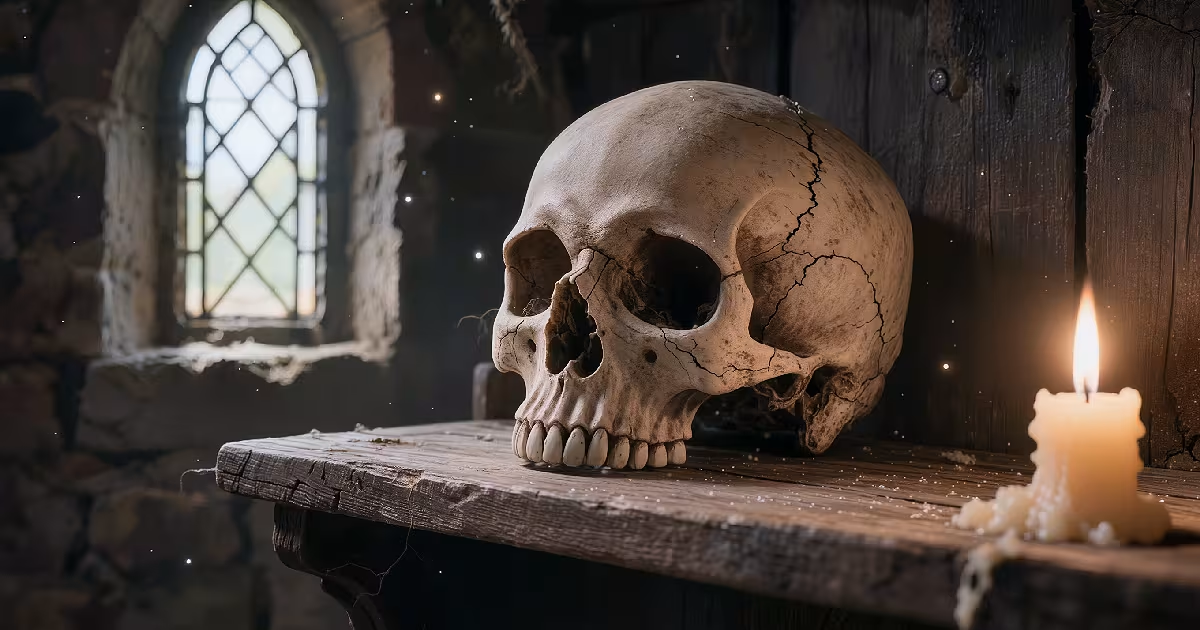
A cracked skull on a shelf beside a candle and a leaded window.
Illustration, not a photograph.

Archive / Paranormal / BOT313-0519
PAR-1897ParanormalLEGEND
THE SCREAMING SKULL OF DORSET
Fig. 01 A cracked skull on a shelf beside a candle and a leaded window. Illustration, not a photograph.
Opening
Bettiscombe Manor is a farmhouse in the Marshwood Vale of west Dorset, about four miles from Beaminster. It is known as the house of the screaming skull. According to a legend that was in print by the end of the nineteenth century, a human skull kept there screams if anyone tries to bury it, and is said to bring misfortune if it is moved.
The skull is the best known of a small English group of screaming skulls. It is also a rare case in which the object has been looked at by a specialist, whose report gave an answer quite different from the legend.
Timeline
Before 1830The Pinney family hold estates on the Caribbean island of Nevis, a link traced back to Azariah Pinney. The story ties the skull to that link.
1830In the legend, descendants of Azariah Pinney give up their Nevis estates and return to the manor with one of the family's enslaved Black servants.
The legendThe servant falls seriously ill, possibly with tuberculosis, and asks to be buried in Nevis. John Frederick Pinney refuses the expense, and he is buried in the churchyard at St Stephen's. Screams and crying are then said to be heard from the cemetery, with windows rattling and doors slamming at the manor. The body is exhumed and brought to the house, and in the telling only the skull remains.
1883Curiosity-seekers visit the manor, according to John Henry Ingram, who describes the visit in his 1897 book The Haunted Homes and Family Traditions of Great Britain. That is the earliest printed account I found.
The early 1900sF. Marion Crawford writes the short story The Screaming Skull, dated 1908 in one source and 1911 in another.
1963A professor of human and comparative anatomy at the Royal College of Surgeons examines the skull and says it is not that of a Black man but of a European woman aged between 25 and 30. The source I found is Roland Gant's Dorset Villages (1980).
Key figures
Azariah Pinney is the family ancestor linked to Nevis. The servant is unnamed in every account I could find. John Frederick Pinney is the owner said to have refused the cost of the burial. John Henry Ingram is the Victorian writer who first printed the tale. The 1963 professor is unnamed in the source. F. Marion Crawford gave the legend its widest circulation through fiction.
Physical and documentary trail
The record: a skull kept at the manor, a single printed account from 1897 of a visit in 1883, and a 1963 anatomical opinion reported in 1980. The legend and the findings do not match. The 1963 opinion, if accurately reported, means the skull is not that of the servant in the story but of a European woman in her twenties or early thirties. The earliest account I found is at least half a century after the date given for the servant's burial, and no burial register entry, exhumation record or contemporary letter is cited.
A second problem is the dating of the legend itself. One source puts the return from Nevis in 1830. A reference article on screaming skulls gives 1897 as the first printed account, and notes an unsupported claim of an earlier date. What the record does not contain is a name for the person whose skull it is.
Things you might not know
- It is a village of about fifty. The 2013 county estimate was 50 people.
- The skull is a woman's. According to the 1963 opinion, aged 25 to 30.
- The servant has no name. No account gives one.
- It is not unique. Burton Agnes Hall, Wardley Hall, Tunstead Farm and Calgarth Hall have their own skull legends.
- It became fiction. Crawford's story and a 1958 American film use the idea.
- The church was rebuilt. John Hicks rebuilt most of St Stephen's in 1862.
Competing explanations
A folk legend fitted to an old skull. The strongest reading. A skull found in or near an old house acquires a story, and the story attaches itself to the household's known history on Nevis. The anatomical result supports this.
A real servant's remains. The legend as told. It fails on the anatomy, unless the skull examined in 1963 was not the original or the report is wrong.
A moral story. The tale also carries a theme: a man's wish to be buried at home ignored by a family that profited from the trade. That may be part of why it lasted.
Later life of the case
The Bettiscombe skull sits with the other household hauntings in the archive, such as Borley Rectory, where legend and record part company. It remains a favourite of ghost-story collectors.
Finding
The screaming skull of Bettiscombe is a legend with a physical object that does not match it. The skull is real, the story is old enough to have been printed in the 1890s, and the one specialist opinion I found says it belonged to a European woman, not an African man.
What still will not resolve: whose skull it is and how it came to the manor, since the person in the story has no name and the examination of 1963 is known to me only through a secondhand account.
Evidence signature
2/9 Thin
- Witnesses
- nothing on record
- Instruments
- photo, film or physical traces
- Paper
- press and later accounts
How well documented the case is, not whether it's true. A strong record can still have an ordinary answer, and a thin one can still be real.
You decide · BETTISCOMBE SKULL
What do you think happened?
One vote per case, anonymous. You'll see how other readers voted once you've voted.