HOWDEN MOOR
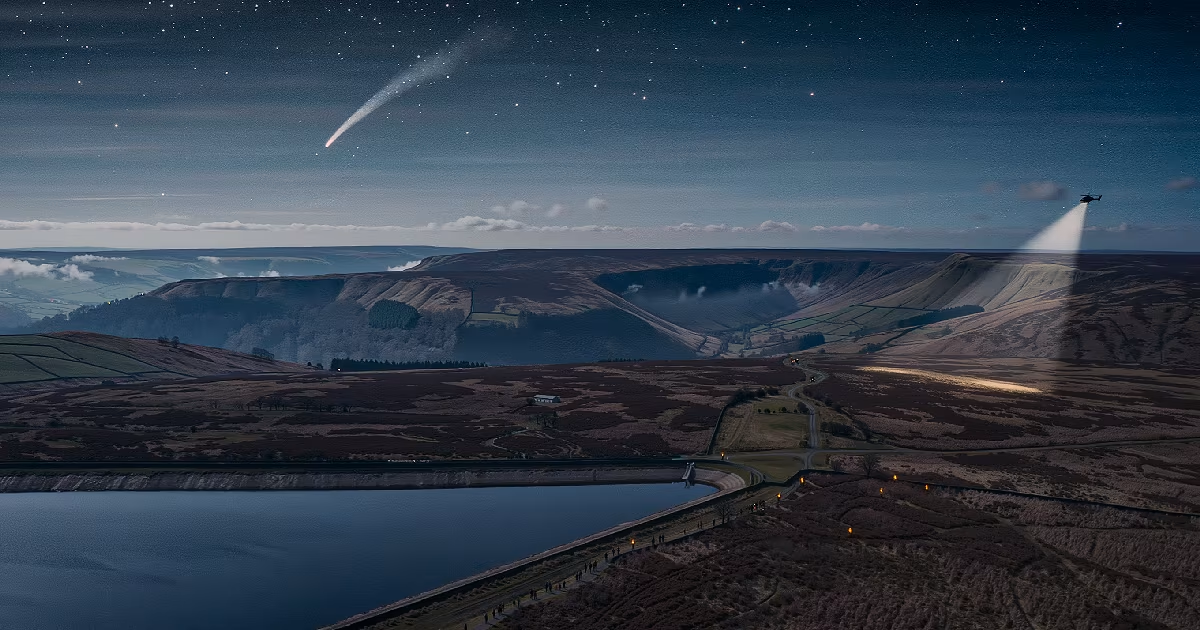
A comet over a dark moor, a helicopter searchlight and torches below.
Illustration, not a photograph.

Opening
Shortly after 10pm on Monday 24 March 1997, people on the moors between Sheffield and the Peak District rang the police to report an aircraft coming down. A farmer at Bolsterstone saw a low plane, then an orange glow and smoke. Gamekeepers at Strines heard an explosion. Many of the witnesses had been outside to look at Comet Hale-Bopp, which was near its brightest that week.
By morning nearly 200 police officers, mountain rescue volunteers and RAF crew had searched up to 50 square miles of moorland around the Howden reservoirs. They found no wreckage, no fuel on the water and no missing aircraft. The British Geological Survey had recorded two sonic booms that evening. The Ministry of Defence said none of its aircraft caused them, and the cause has never been officially established.
Timeline
About 9.52pm, 24 March 1997A low-frequency microphone at Leeds University records the first of two atmospheric booms.
About 10.06pmA second, stronger boom is picked up by the Leeds microphone and by seismograph stations at Haverah Park, near Harrogate, and Holmfirth. The same minute, gamekeepers Mike and Barbara Ellison at Strines hear a loud explosion.
About 10.10pmA farmer and his mother at Edge End Farm, Bolsterstone, ring 999. They saw a low aircraft heading west-south-west, then an orange glow, and smelled burning.
10.30pmAbout 40 police officers have been called out. Manchester Airport reports no distress calls, no missing aircraft and nothing unusual on radar.
Around 11pm to midnightThe West Yorkshire Police helicopter arrives, followed by an RAF Sea King from Leconfield.
25 March141 volunteers from all seven Peak District mountain rescue teams join the search. A ten-mile restricted flying zone is set up around Howden Reservoir at 7am. The search is called off in the afternoon, and police class the incident as unexplained. Its cost was later put at more than £50,000.
27 MarchThe British Geological Survey says the 10.06pm signal was consistent with an atmospheric origin.
March and April 1998Helen Jackson, MP for Sheffield Hillsborough, puts written questions to the MoD. Ministers confirm that aircraft were booked for low flying training over northern England that evening, but say there is no record of RAF or NATO aircraft causing sonic events.
27 May 1998An RAF Police report confirms a pre-booked fighter exercise but concludes that no military link to the event can be established. The case is considered closed. The report only becomes public years later through a Freedom of Information request.
Key figures
The witnesses included the Ellisons; John Littlewood, a gamekeeper on Midhope Moor, who described a large, slow aircraft with two red wing lights; and Special Constable Marie-France Tattersfield, who saw a big, low aircraft with lit windows near Bolsterstone. Chief Inspector Christine Burbeary led the police search, and Mike France coordinated the mountain rescue teams.
The Sheffield journalist and folklorist David Clarke investigated the case for years, and the researcher Andy Roberts obtained the RAF Police report. Helen Jackson pressed the questions in Parliament.
Physical and documentary trail
The record is good for a case like this: the police log, the BGS recordings with their times, the parliamentary answers, the RAF Police report and a long list of named witnesses. RAF Marham later confirmed that six Tornado GR1A aircraft from No. 2 Squadron flew that evening, though by its account they had all landed by about 9.35pm, before the first boom.
What is missing is the source of the booms. A light aircraft cannot go supersonic, and the RAF Police found a Manchester radar trace of a descending aircraft that an officer judged too slow to cause one. No aircraft has ever been matched to the two sonic events.
Things you might not know
- Hale-Bopp brought people outside. The comet passed closest to Earth two days before, so more people than usual were looking at the sky that night.
- The moors already had ghost planes. The Dark Peak is littered with real wartime and post-war crash sites, and local stories of phantom aircraft over the reservoirs long predate 1997.
- A boom reached Harrogate. The 10.06pm event was strong enough to register on seismographs dozens of miles away.
- Someone filmed it. Two young men at Parson Cross caught a low light aircraft on a camcorder that night. Police could not identify it.
- The water was checked. A rumour that a jet had gone into a reservoir led Yorkshire Water to look for oil and debris. It found none.
Competing explanations
A military exercise that ran late. David Clarke's reading. Fast jets were booked over the Peak that evening, a retired RAF officer at Dronfield described two very low jets, and the sonic booms point to something supersonic. On this view, part of the exercise continued after its booked window, and the MoD's denials do not hold up.
An unrecorded crash or covert flight. Some researchers suggested a remotely piloted aircraft or a secret test that went wrong and was cleared up quietly. No wreckage, fuel or witness to a recovery has ever been found.
A bright meteor. Suggested at the time by an astronomer. A fireball can produce a boom and a glow, and the BGS and the RAF Police both raised a re-entering satellite as a possibility. But RAF Fylingdales, which tracks objects in space, reportedly ruled out debris, and a meteor does not explain the low aircraft so many people described.
Several ordinary things at once. Light aircraft out that night, jets on exercise, lights dropping behind hills, and two booms whose source was never found. The witnesses may each have seen something real without seeing the same thing.
Later life of the case
A BBC documentary covered the case in October 1997, and it has returned in books, TV and online ever since, often as a crashed-UFO story, though no one has ever produced a body or a craft. It sits with other British moorland mysteries such as Berwyn in 1974, where a loud bang and lights on a mountain also led to talk of a crash.
Finding
Something made two sonic booms over South Yorkshire that night, and dozens of people saw low aircraft and a glow on the moors. Nearly 200 searchers found no crash. The strongest reading is military aircraft operating outside the published exercise times, but the MoD has never accepted that, and no aircraft has been matched to the booms.
What still will not resolve: what flew fast enough to break the sound barrier over the Peak District at 10.06pm, and why no record of it has ever been produced.
Evidence signature
8/9 Strong
- Witnesses
- trained, independent witnesses
- Instruments
- radar or measured data
- Paper
- formal investigation, court or declassified file
How well documented the case is, not whether it's true. A strong record can still have an ordinary answer, and a thin one can still be real.
You decide · HOWDEN MOOR
What do you think happened?
One vote per case, anonymous. You'll see how other readers voted once you've voted.