BELL WITCH
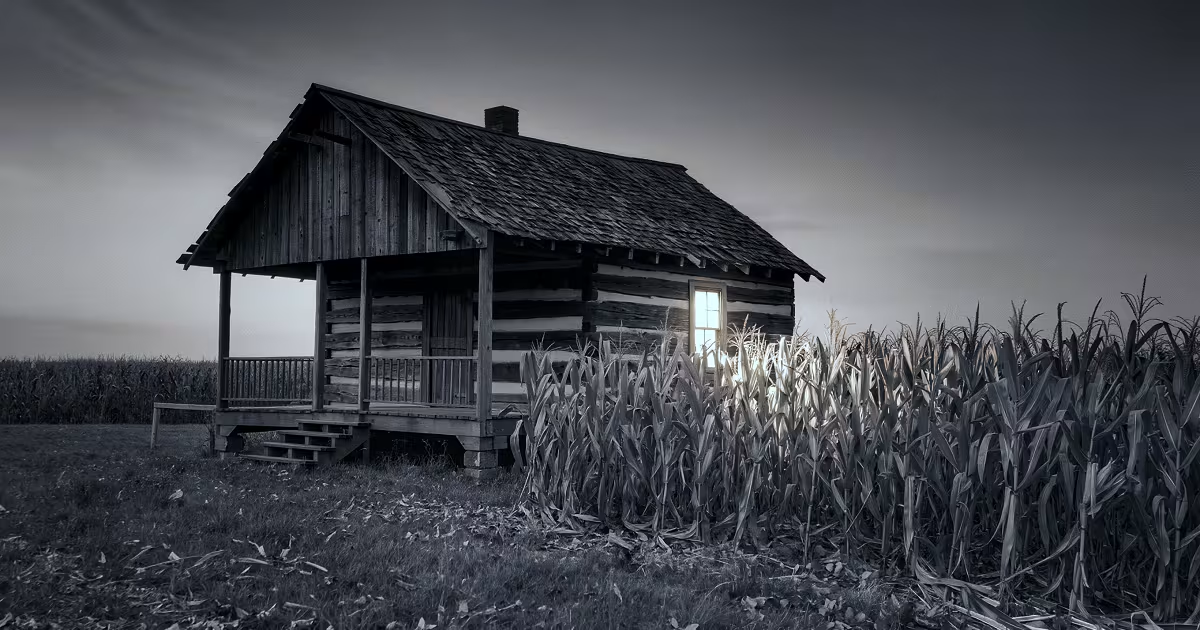
A log cabin beside a cornfield at night, with one window lit.
Illustration, not a period photograph.

Archive / Paranormal / BOT313-0094
PAR-181719 DEC 1820ParanormalFARM VOICE
THE VOICE ON THE TENNESSEE FARM
Fig. 01 A log cabin beside a cornfield at night, with one window lit. Illustration, not a period photograph.
Opening
From 1817 the Bell farm on the Red River near Adams, in Robertson County, Tennessee, lived with a voice. It began with strange animals in the fields and knocks and raps in the walls, then became a speaking thing that named itself, sang hymns, and mocked John Bell and his daughter Betsy. Visitors heard it. Enslaved people on the farm heard it. Andrew Jackson is later said to have heard it too, though that story only appears long afterwards.
In December 1820 John Bell died after an illness the family blamed on the voice, and a vial found in the house became part of the story. Richard Williams Bell wrote the long account years afterwards, and a newspaper editor published it in 1894. That account is why the case has scenes, and also why it is so hard to test: by the time it was printed, everyone who had been there was dead.
Timeline
1817John Bell sees a strange dog-like animal in his field and fires at it, and it vanishes. Betsy reportedly sees a girl in a green dress swinging from an oak branch. Then come the knocks in the Bell house and lights in the fields, and then a voice that can sing a hymn and insult the family in the same hour. Betsy and John are both struck. Word travels the county, and neighbours come to sit and listen.
1817 to 1820Asked who it is, the voice gives different answers. One is "I am a spirit; I was once very happy but have been disturbed." Another is "Old Kate Batts' witch," after a neighbour who had quarrelled with John Bell.
20 December 1820John Bell dies. The family finds a vial of dark liquid, and the voice claims the death as its work. Accounts disagree about where the vial was found: in the chimney flue, or in a cupboard.
1821Betsy breaks off her engagement to Joshua Gardner, a match the voice had opposed, in the family's telling. The voice says it will leave and return in seven years.
1828In the family's account, it returns briefly, as promised.
About 1846Richard Williams Bell, John's son, writes his manuscript, Our Family Trouble, at about 35.
1849 and 1856The Saturday Evening Post runs a sketch about the witch, later withdrawn after a threat of a libel suit. In January 1856 it prints a letter signed only "H." that blames the voice on Betsy's ventriloquism, reprinted by other papers.
1894Martin V. Ingram, a Tennessee newspaper editor, publishes An Authenticated History of the Famous Bell Witch, working from Richard Williams Bell's manuscript. It is the first full-length record of the legend.
20th centuryReports gather around the Bell Witch Cave near the farm: noises and a figure on the cliff in 1937, a reported visit by soldiers from Fort Campbell in 1977, and a night spent there by reporters from The Tennessean in 1986.
Key figures
John Bell is the man the voice wanted. A farmer who did not recover from his last illness.
Betsy Bell is the daughter who was struck and who gave up her engagement.
Lucy Bell and the other children lived in the house with the voice.
Richard Williams Bell wrote the family's account. It is valuable, but it was written long after 1817 by a man who was a child at the time, and it is not a record from the time.
Martin V. Ingram published it, and his book is the source for almost everything people know.
Andrew Jackson's visit remains a story until a document from the time turns up to support it.
Physical and documentary trail
The sources are neighbour and family accounts of raps that became a voice, visitors who said they heard speech they did not think came from a child behind a door, John Bell's death in December 1820 and the vial in the family's account, Richard Williams Bell's later narrative, and Ingram's 1894 book. The sceptic Brian Dunning points out that by the time Ingram began writing, "every person with firsthand knowledge of the Bell Witch hauntings was already dead."
There is no recording and no record from 1817. The vial was never tested. No court named anyone. And no contemporary document places Andrew Jackson at the farm. Dunning notes that if he had fled a haunted house, his opponents in the bitter 1824 presidential campaign would surely have used it.
Things you might not know
- The spirit took a neighbour's name. Kate Batts had accused John Bell of cheating her on a land deal, and the entity at one point called itself "Old Kate Batts' witch".
- The first full account came in 1894. M. V. Ingram, a newspaper editor, published An Authenticated History of the Famous Bell Witch that year, working from Richard Williams Bell's manuscript.
- An 1820 letter may mention it. A letter written in 1820 by a Captain John R. Bell, no relation to the family, refers to the haunting, though not by name.
- It claims a unique death. Richard Williams Bell wrote that his father was the only person in history whose death was attributed to a spirit.
- A newspaper blamed Betsy in 1856. A letter in the Saturday Evening Post said she had been throwing her voice.
- The town has a festival. Adams, Tennessee holds a Bell Witch Fall Festival, which features a play called Spirit.
Competing explanations
An unknown speaking presence that wanted John Bell dead. This is the family's account. It has many visitors who heard it, and no identified speaker.
A family performance that got out of hand, by Betsy or someone else. The 1856 ventriloquism letter took this view, and the investigator Joe Nickell compares the case to the familiar pattern of faked poltergeists, which often centre on a child. It has to explain grown neighbours sitting through hours of hymns and insults without catching anyone.
Illness, suggestion and a death later told as a curse. This explains John Bell's death without a voice, but not the years of visitors who said they heard one.
A folk legend that grew in the telling. Dunning's view: an unsubstantiated story, written down only after its witnesses had died. That explains why the details are so vivid and so hard to check.
Later life of the case
Ingram's 1894 book turned a family story into Tennessee's most famous haunting, and Adams has lived with it ever since: the Bell Witch Cave tours, the autumn festival and its play, and a steady stream of books and films, including An American Haunting (2005), based on Brent Monahan's 1997 novel. For the raps that started a religion a generation later, see the Fox sisters.
Finding
The Bell farm on the Red River spent 1817 to 1820 with a voice in the walls, in the family's account. Neighbours sat and heard it, and John Bell died in December 1820 with the family certain the voice had killed him. Almost everything we know comes from a son's memoir published by someone else seventy years later, which makes the story impossible to confirm and impossible to dismiss.
What still will not resolve: a named person behind the voice, or the vial from that death room with a documented history.
Evidence signature
4/9 Solid
- Witnesses
- several people
- Instruments
- nothing on record
- Paper
- official records at the time
How well documented the case is, not whether it's true. A strong record can still have an ordinary answer, and a thin one can still be real.
You decide · BELL WITCH
What do you think happened?
One vote per case, anonymous. You'll see how other readers voted once you've voted.