SAVANNAH RIVER 1952
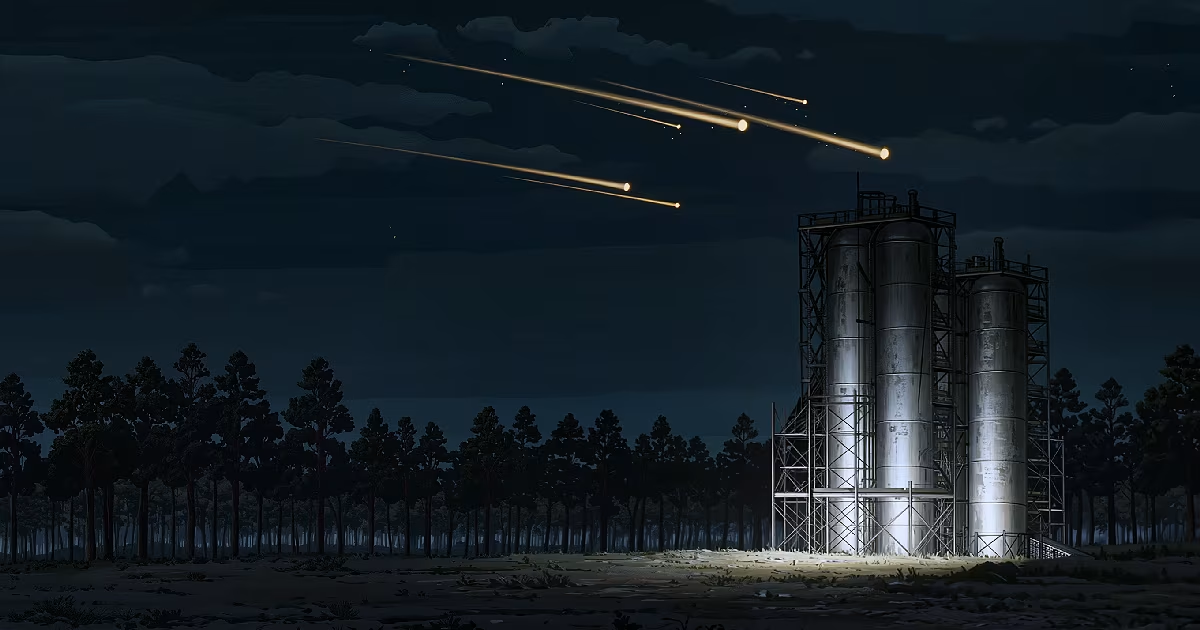
Yellow-gold lights cross the night sky above floodlit tanks.
Illustration, not a photograph.

Opening
On the night of 10 May 1952, four DuPont employees at the Savannah River Plant in South Carolina, then being built to make materials for America's hydrogen bombs, watched yellow-gold, disc-shaped objects cross the site in groups. One came in so low that it had to climb to clear the tall tanks of the 400 Area, where the plant's heavy water was made.
The FBI interviewed the men, J. Edgar Hoover sent a memo about it to the Air Force, and the report went to the Pentagon and the Atomic Energy Commission. Project Blue Book filed it as case 1198 and listed it as unidentified, where it stays. In 2023 a sceptic argued the discs were birds lit from below by the plant's own floodlights.
Timeline
28 November 1950The Atomic Energy Commission announces the plant. About 6,000 people in Ellenton, Dunbarton and other communities are told to leave. DuPont is to build and run it.
1 April 1952The last resident leaves the town of Ellenton, according to the South Carolina Encyclopedia. The new town of New Ellenton is incorporated weeks later.
1952The 400 Area, also called D Area, begins producing heavy water, which the plant's reactors will need before they can start. The first reactor is still more than a year from operating.
10 May 1952, about 10:45 p.mFour objects approach the 400 Area from the south and disappear to the north. The four witnesses are DuPont employees on the site.
About 11:05 p.mTwo similar objects follow the same south to north path.
About 11:10 p.mOne object comes in from the northeast and leaves to the southwest. This is the low one, which rises to pass over the tall tanks.
About 11:15 p.mA last single object crosses from south to north.
25 May 1952Hoover sends a memo to the Air Force's Director of Special Investigations headed "Flying Disks Reportedly Seen in Vicinity of Savannah River Plant Atomic Energy Commission". The case reaches Blue Book, which files it under Ellenton.
May/June 2023Tim Printy, in his newsletter SUNlite, argues that the case should be reclassified as possible birds and removed from Blue Book's list of unknowns.
Key figures
The four witnesses were DuPont employees working at the plant. Their names do not appear in the summaries I've found, only in the original interview documents.
The FBI agents who interviewed them wrote most of what survives; Blue Book's file is short and leans on their report.
J. Edgar Hoover passed the case to the Air Force personally, which tells you how seriously a sighting over an atomic plant was taken in 1952.
Tim Printy is the sceptic who made the case for birds. Robert Hastings, who has spent decades on UFOs at nuclear sites, gives the case a place in UFOs and Nukes.
Physical and documentary trail
The paper trail is official and early: an FBI teletype, a Spot Intelligence Report, an Air Intelligence Information Report, a counterintelligence letter, Hoover's memo of 25 May, and Blue Book's card. Brad Sparks lists it in his catalogue of Blue Book unknowns, and Loren Gross and Hastings both cover it.
It is all testimony. There was no radar contact, no photograph, and no estimate of distance that would turn the witnesses' size figure into a real size. The objects were described as about 15 inches across, but nobody could say how far away they were, so that number cannot tell a small nearby object from a large distant one.
Things you might not know
- Blue Book filed it under a town that no longer existed. The case is listed under Ellenton, whose last resident had left about six weeks earlier to make way for the plant.
- Eight discs, by addition. Some retellings say eight discs. Blue Book's breakdown is four, then two, then one, then one: eight in total, never more than four at once.
- The 400 Area mattered. It made the heavy water the reactors depended on, and the reactors could not start until it was running.
- They made no sound. The witnesses said the objects were silent, very fast and visible for only a few seconds each.
- They weaved. One witness said the objects moved from left to right while still holding a general course, a detail that both sides of the argument now use.
Competing explanations
Unknown craft over a nuclear site. The reading Hastings and others favour, and part of a pattern of reports near atomic plants and weapons sites in the early 1950s. It takes the witnesses at their word: four men who worked on the site, under its lights every night, saw discs and not birds.
Birds lit by the plant's lights. Printy's explanation. A construction site working at night would be flooded with light, and birds flying through it can glow yellow-gold, look disc-shaped, move fast, make no sound and weave. A 15-inch size fits a bird better than a craft. It cannot be tested now, and nobody at the time recorded the lighting or the birds.
Aircraft or other ordinary lights. Possible for a single sighting, but silent objects in groups, crossing low over the site several times in half an hour, do not fit aircraft well.
Later life of the case
The case is a regular on lists of Blue Book unknowns and of UFOs at nuclear facilities. 1952 was the year of the biggest wave Blue Book ever handled, including the Washington radar sightings that July. For the researcher who built the nuclear-site argument, see Robert Hastings.
Finding
Four plant workers saw silent, glowing objects cross a nuclear construction site in groups over half an hour, and their report went through the FBI to Hoover, the Air Force and the Atomic Energy Commission. Blue Book could not identify them. Birds caught in the plant's lights are a real possibility that fits several details, but it is a suggestion made seventy years later, not a finding from the evidence of that night.
What still will not resolve: the full FBI interview notes, with the witnesses' own estimates of distance, which are the only thing that could separate a bird from something larger.
Evidence signature
4/9 Solid
- Witnesses
- several people
- Instruments
- nothing on record
- Paper
- official records at the time
How well documented the case is, not whether it's true. A strong record can still have an ordinary answer, and a thin one can still be real.
You decide · SAVANNAH RIVER 1952
What do you think happened?
One vote per case, anonymous. You'll see how other readers voted once you've voted.