WILLINGTON MILL
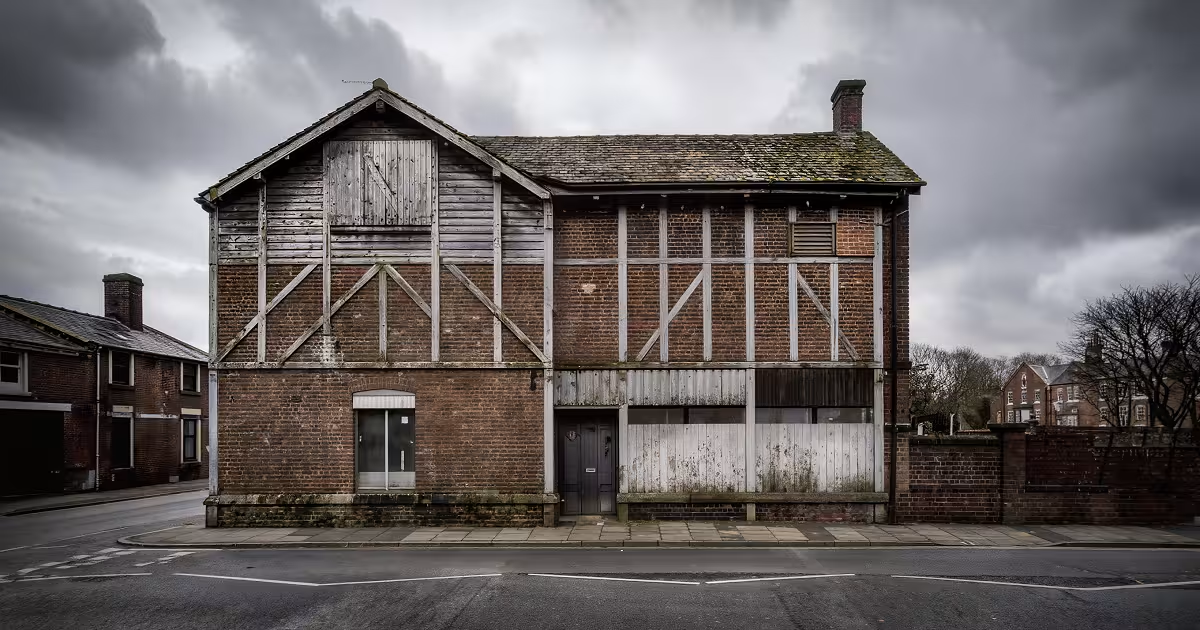
Tyneside mill house across a road. Grey day, no figures.
Illustration, not a period photograph.
Opening
Willington Mill, a house by a flour mill on the Tyne at Willington, Northumberland, was lived in by the Procter family in the 1830s and 1840s. They reported figures in grey, knocks, and beds disturbed. Joseph Procter kept notes. In July 1840 Edward Drury, a chemist from Sunderland, sat a night in the house with a friend to settle it and left shaken, describing a woman who came at him from a closet. Unwin and later writers printed the vigil. Soot that was clean in the morning is one of the household details the notes keep.
The mill house is gone as they knew it. The notes and Drury's letter remain. No later demolition is a verdict on 1840. Newcastle papers treated it as a local wonder. It did not produce a conviction.
The spine of the file is a mill house and a chemist who would not sit a second night. Willington is Procter's notes. It is not a named servant in a dock.
Timeline
1830s the Procters notice the house. Notes accumulate.
July 1840 Drury's vigil. He writes after. The letter circulates.
1840s press and pamphlet interest. The family later leaves.
Twentieth-century reprints keep Drury's closet. Those reprints are later life. The vigil is first for a visitor.
Key figures
Joseph Procter owns the household notes.
The Procter family owns the years in the rooms.
Edward Drury owns the July night and the letter.
Later pamphlet writers own circulation, not the first soot.
Physical and documentary trail
On the paper, 1835-40 give you four hard objects and no dock.
One: Procter household notes of figures and knocks.
Two: the detail of disturbance in a clean room, including soot talk.
Three: Drury's July 1840 vigil and letter.
Four: contemporary local press. Joseph Procter notes and Edward Drury letter on Willington Mill, 1840, are the originating tray.
There is no 1840 instrument. There is no house as they had it. There is no confession the notes close.
A woman came from the closet and I would not spend another night.
Competing explanations
A haunted mill house. This is Procter and Drury. It has a letter. It has no throat.
Rats, river damp, expectation in a known wonder-house. The mundane door. Has to carry a chemist leaving before morning.
A pamphlet stunt. Weak against family notes that predate Drury.
Hybrid caution. A family wrote the rooms. A visitor ran. Morning had no one in the closet they could name.
Later life of the case
Reprints of Drury's closet. I keep those on the later-life shelf. The 1840 letter stays first.
Finding
The Procters wrote Willington Mill as a house that would not stay quiet, and Edward Drury sat a night in July 1840 and left after a woman, he said, came from a closet. Believe the vigil as a night a chemist did not finish. A man with a shop in Sunderland does not invent a bolted door for a later ghost book.
What still will not resolve: a named living hand in that closet, or the rooms themselves, which are gone. Either one would pin the mill. The proving object is still that figure in the closet, held by a second sitter who stayed till morning.