PATIENCE WORTH
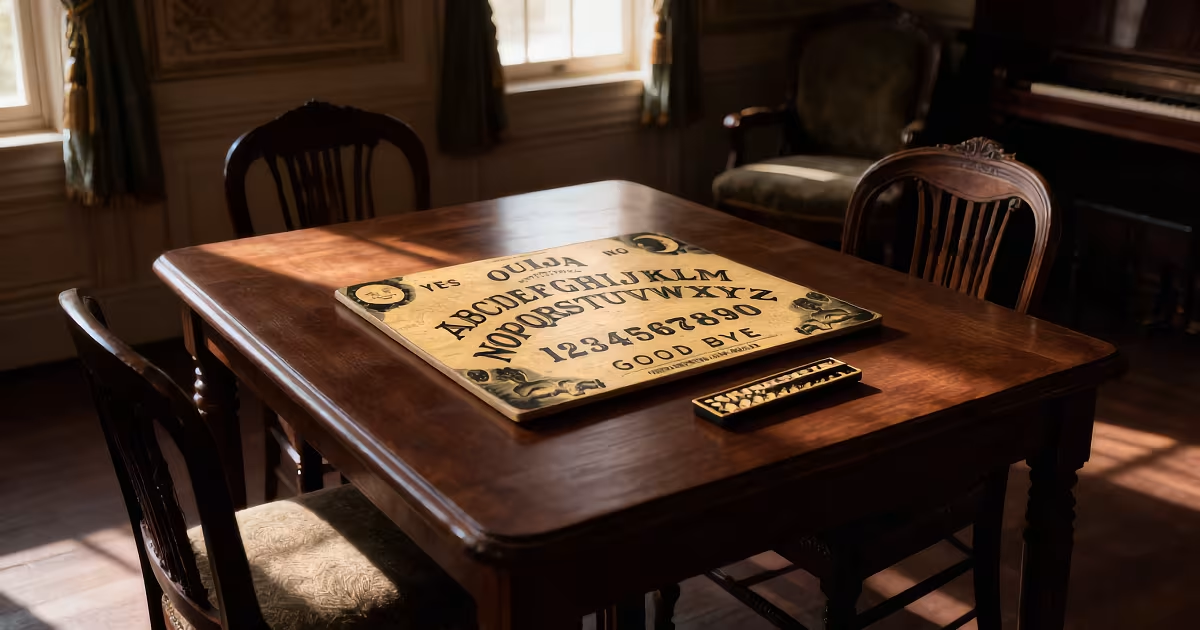
A Ouija board and a planchette on a wooden parlour table.
Illustration, not a period photograph.

Archive / Paranormal / BOT313-0144
PAR-19138 JUL 1913ParanormalUNEXPLAINED
THE GHOST WHO WROTE NOVELS
Fig. 01 A Ouija board and a planchette on a wooden parlour table. Illustration, not a period photograph.
Opening
On the evening of 8 July 1913 in St. Louis, Pearl Curran and her friend Emily Grant Hutchings were working a Ouija board when it spelled out: "Many moons ago I lived. Again I come. Patience Worth my name." Over the next 24 years Patience Worth, who said she was an Englishwoman of the 1600s, produced about four million words through Curran: novels, plays, thousands of poems and a great deal of conversation.
Curran left school at about 13 and had read little. Yet the work came in an archaic English and sometimes at about 1,500 words an hour, and critics praised some of it. Researchers who sat with her could not agree on how she did it. No record of a real Patience Worth has ever been found, and the manuscripts survive in 29 volumes at the Missouri Historical Society.
Timeline
1883Pearl Lenore Pollard is born in Mound City, Illinois.
1912After her father's death, Curran begins using a Ouija board with Hutchings.
8 July 1913Patience Worth introduces herself. From then on every session is written down, at first with pencil and paper and later in shorthand by John Curran.
1914Morton Prince tests Curran.
1915Casper Yost, editorial page editor of the St. Louis Globe-Democrat, publishes articles about Patience Worth.
1916Yost's book Patience Worth: A Psychic Mystery is published by Henry Holt. In April, James Hyslop attacks the case in the Journal of the American Society for Psychical Research as a matter of "fraud and delusion". The Currans adopt a baby girl.
1917The Sorry Tale, a novel of about 640 pages set at the time of Christ, is published. William Stanley Braithwaite's anthology lists five Patience Worth poems among the best of the year.
May 1918Hope Trueblood, a novel set in Victorian England, is published. The Joint Committee of Literary Arts of New York names Patience Worth among the outstanding authors of the year.
1919Charles Cory, writing in the Psychological Review, argues that Patience is a subconscious personality of Curran's. The Saturday Evening Post prints Curran's own story "Rosa Alvaro, Entrante".
1920Goldwyn films that story as What Happened to Rosa, paying Curran $1,500.
1921Yost travels to Dorset to look for traces of Patience and finds none.
1922John Curran dies. Pearl's daughter Eileen is born about six months later.
1927Walter Franklin Prince publishes The Case of Patience Worth, a study of about 500 pages.
3 December 1937Pearl Curran dies of pneumonia in Los Angeles, aged 54.
Key figures
Pearl Curran was the medium. As a young woman she played piano at her uncle's spiritualist church in Chicago, so she knew mediumship before the board. She soon dropped the board and dictated the words aloud as they came to her.
John Curran, her husband and a former Missouri Immigration Commissioner, kept the shorthand record of the sessions.
Emily Grant Hutchings sat at the board in 1913 and was present at the first message.
Casper Yost brought the case to a national audience through a respectable newspaper and a book.
Walter Franklin Prince of the Boston Society for Psychic Research produced the most detailed study. Hyslop and Cory were the leading sceptics of the time.
William Marion Reedy, editor of the St. Louis Mirror, was an early supporter. Patience nicknamed him "Fatawide".
Physical and documentary trail
This is one of the best-documented cases of its kind. The verbatim session records, the published books and the 29 bound volumes at the Missouri Historical Society all survive. So do contemporary studies by Yost, Prince, Hyslop and Cory, and Curran's work published under her own name, which allows a comparison of styles.
The missing piece is Patience herself. Her account of her life is inconsistent: dates of 1649 or 1694, hints of a Dorset childhood near Portesham, emigration to America and death at the hands of Native Americans, with Nantucket sometimes mentioned. Yost's 1921 trip to Dorset turned up nothing. Later researchers, including Joe Nickell in 2012, have found no matching historical woman.
"Many moons ago I lived. Again I come. Patience Worth my name."
"Wait. I would speak with thee. If thou shalt live, then so shall I. I make my bread by thy hearth. Good friends, let us be merrie. The time for work is past. Let the tabbie drowse and blink her wisdom to the firelog."
Things you might not know
- The name was already in a bestseller. A reader of the Mirror pointed out that a character called Patience Worth appears in Mary Johnston's 1900 novel To Have and To Hold.
- Hollywood bought Pearl, not Patience. Goldwyn paid $1,500 for Curran's own short story and released it in 1920 as What Happened to Rosa.
- Patience gave nicknames. She called the Mirror's editor William Marion Reedy "Fatawide".
- A patron kept the household going. After John Curran died in 1922, Herman Behr paid the family $400 a month.
- The name arrived in pieces. On 22 June 1913, more than two weeks before Patience introduced herself, the board spelled "Pat-C".
- The speed was measured. Observers timed dictation at about 1,500 words an hour.
Competing explanations
A discarnate author. Curran's circle and some later psychical researchers held that Patience was who she said she was. The volume, the speed and the archaic vocabulary are the main evidence for this view. Against it, Patience's own life story is inconsistent and no historical record of her has been found.
A secondary personality with unusual gifts. Cory's 1919 reading, and the one most modern writers prefer, is that Patience was a creative persona of Curran's, drawing on reading and memory she could not account for herself. The name in Johnston's novel shows at least one source was within reach. This view explains the persona better than the speed and quality, which remain unusual.
Deliberate fraud. Hyslop suspected it, but the record does not support it well. Curran dictated in public for over two decades, often with sceptics present, and no evidence of a hidden collaborator or prepared manuscripts has been found.
Later life of the case
Patience Worth faded after Curran's death and returned through later research, including Irving Litvag's 1972 biography Singer in the Shadows and renewed attention from writers on creativity and dissociation. Gioia Diliberto's 2010 Smithsonian article brought the case to a new audience. The Missouri Historical Society volumes remain the main primary source.
Finding
The documented facts are not in dispute: Pearl Curran produced a large, archaic and sometimes admired body of work, quickly and in front of witnesses, from 1913 until her death in 1937. The strongest reading is that Patience Worth was a persona of Curran's own mind rather than a returning seventeenth-century woman, since no such woman has been found and the persona had available sources. That reading does not explain how a woman with little schooling produced this much, this fast, in a voice she never used otherwise.
What still will not resolve: the mechanism. A century of study has not settled where Curran's archaic vocabulary came from or how she sustained the dictation.
Evidence signature
1/9 Thin
- Witnesses
- nothing on record
- Instruments
- nothing on record
- Paper
- press and later accounts
How well documented the case is, not whether it's true. A strong record can still have an ordinary answer, and a thin one can still be real.
You decide · PATIENCE WORTH
What do you think happened?
One vote per case, anonymous. You'll see how other readers voted once you've voted.