EDINBURGH VAULTS
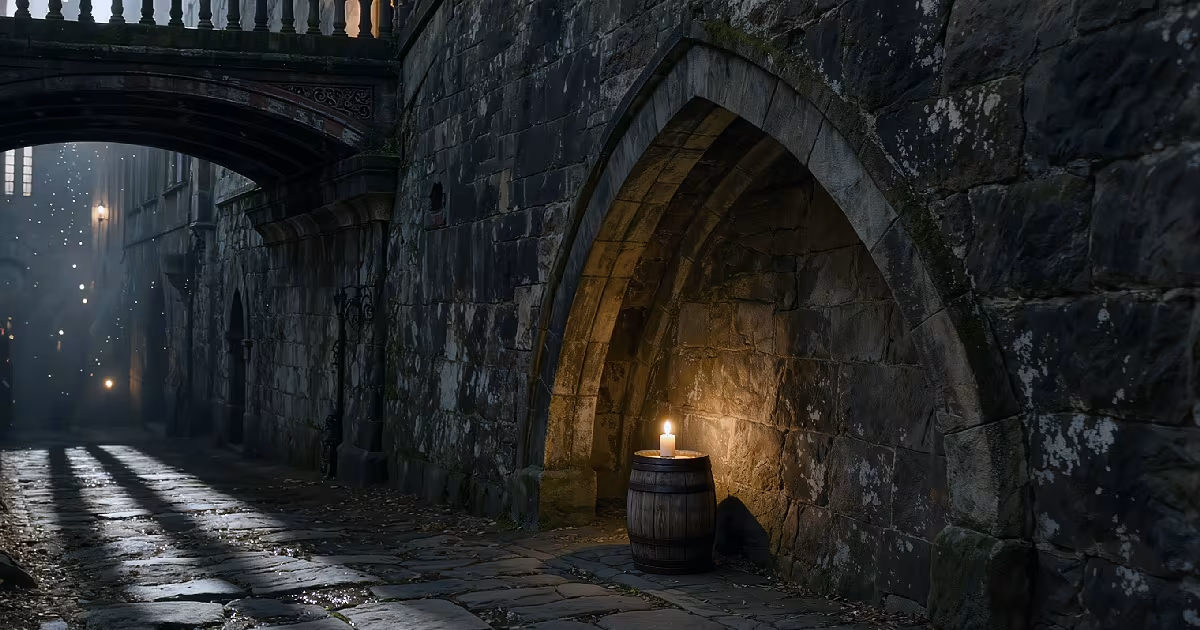
A candlelit stone vault beneath an old city bridge.
Illustration, not a photograph.

Archive / Paranormal / BOT313-0567
PAR-1788ParanormalSTUDIED
THE CHAMBERS UNDER THE SOUTH BRIDGE
Fig. 01 A candlelit stone vault beneath an old city bridge. Illustration, not a photograph.
Opening
Under the Old Town of Edinburgh, inside the arches of the South Bridge, are about 120 small stone rooms. The bridge was built between 1785 and 1788 to carry a street over the Cowgate valley, and the spaces inside its nineteen arches were let out as workshops, taverns and stores. Within a few decades the damp had got in, the trades had left, and the vaults had become a slum for the city's poorest people and a hiding place for illegal whisky stills and gambling dens. Then they were filled with rubble and forgotten.
Since their rediscovery in the 1980s, the vaults have become one of the most visited "haunted" places in Britain, with ghost tours every night. They are also one of the very few haunted places to have been tested by psychologists, who found something real there, though not what the tours sell.
Timeline
1775A bridge over the Cowgate is proposed, to link the Old Town to the university and the south side of the city.
August 1785 to 1788The South Bridge is built under an Act of Parliament: a viaduct of nineteen arches, all but one of which, over the Cowgate, are hidden behind the buildings on either side.
From about 1795Rushed construction and a road surface that was never sealed against water let water through. The vaults flood, and the businesses begin to move out.
1 July 1815The Edinburgh Evening Courant reports that an illegal whisky distillery had been running for about eighteen months under one of the arches, its still hidden behind a fireplace grate.
The early to mid 1800sAs the trades leave, the poorest people in the city move in. Families of more than ten live in single rooms with no water, no sanitation and fish-oil lamps for light. By around 1860 the last residents are believed to have left, and the vaults are filled with rubble.
The 1980sNorrie Rowan, a former Scotland rugby international, finds a way into the vaults. An excavation in 1985 turns up children's toys and medicine bottles. Rowan and his son later clear hundreds of tonnes of rubble by hand.
2001The psychologist Richard Wiseman and colleagues run a haunting experiment in the vaults with hundreds of volunteers.
2003The team publish their results in the British Journal of Psychology. The same year, the television series Most Haunted films an investigation there.
Key figures
The people who lived in the vaults in their worst years are almost entirely unnamed.
Norrie Rowan reopened the vaults and turned part of them into a venue.
Richard Wiseman, of the University of Hertfordshire, led the study, with Caroline Watt and others from the University of Edinburgh. They tested the vaults' haunted reputation with volunteers who did not know which chambers were said to be haunted.
The tour guides of the Old Town, whose stories made the vaults famous.
Physical and documentary trail
The vaults themselves are the main evidence: real rooms, with real traces of the trades and families who used them. The paper trail is thin for the slum years. Newspaper reports such as the 1815 distillery story, the 1985 excavation finds and the published experiment make up most of the rest. The ghost stories have no documentary trail of their own; they grew after the vaults reopened to tours.
The 2003 paper, "An investigation into alleged hauntings," tested people walking through the vaults and through Hampton Court Palace. Volunteers reported more unusual experiences in the areas with a haunted reputation, whether or not they knew the reputation. Those areas also differed in measurable ways, in lighting levels and in variation in the local magnetic field. Press reports at the time put the gap at about half of volunteers reporting something in the "haunted" vaults against about a third in the others, with a local ghost-tour company, not the scientists, choosing which vaults counted as haunted.
Things you might not know
- Only one arch shows. Of the bridge's nineteen arches, the one over the Cowgate is the only one you can see. The rest are buried in the buildings, and many people cross the South Bridge without realising it is a bridge.
- Some rooms are tiny. They range from about two square metres to forty.
- The floors were full of oyster shells. Thousands were found during the clearance, a cheap food of the Edinburgh poor.
- Burke and Hare probably never used them. Tours sometimes say the bodysnatchers stored corpses there, but there is no evidence for it.
- It is a stage now. During the Edinburgh Fringe the vaults host more than 60 shows a day.
- The BBC recorded voices. A 2009 overnight recording with the actor Joe Swash captured about twenty minutes of unexplained sound, broadcast on BBC Three in 2010.
Competing explanations
The building does it. Wiseman's conclusion. Cold, dark, damp, low rooms with odd air movement and light from beyond the arches make people uneasy whether or not they have heard a ghost story. The haunted rooms are the ones that feel worst.
Something in the rooms. Visitors and staff report presences, touches, voices and sudden cold in the same places, including people who knew nothing in advance. The study did not rule out a cause beyond the physical; it found physical differences that could explain the reports.
The tours do it. Expectation is powerful, and the vaults are now visited mainly in the dark by people who have paid to be scared. That cannot account for the study, where knowing the stories made no difference.
Later life of the case
The vaults are now split between ghost tours on the north side and bars and venues on the south. They have been investigated by Most Haunted and Ghost Adventures, and they are often compared with Borley Rectory as a place where the story of a haunting and the study of it became intertwined. Edinburgh has other famous underground spaces, such as Mary King's Close, which is a separate site.
Finding
The vaults are a real and grim piece of Edinburgh history, and they really do make people feel watched. The one controlled study found the effect was there even for people who didn't know the stories, and linked it to measurable differences in the rooms themselves. That doesn't rule out the supernatural, but it gives a solid natural answer to the strongest evidence for it.
What still will not resolve: the voices on the 2009 recording, whose source was never identified, and the names of the people who lived in the vaults in their worst years, since almost no record of them survives.
Evidence signature
4/9 Solid
- Witnesses
- several people
- Instruments
- radar or measured data
- Paper
- nothing on record
How well documented the case is, not whether it's true. A strong record can still have an ordinary answer, and a thin one can still be real.
You decide · EDINBURGH VAULTS
What do you think happened?
One vote per case, anonymous. You'll see how other readers voted once you've voted.