HOOK ISLAND
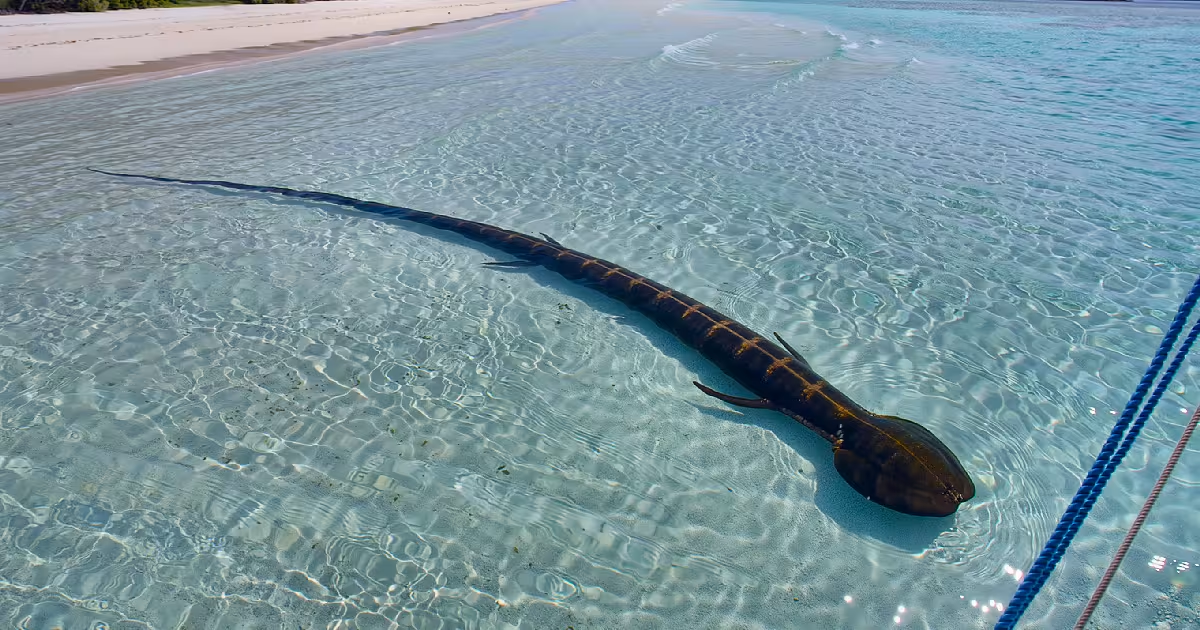
A long dark tadpole shape in clear shallows, seen from a boat.
Illustration, not a photograph.

Opening
On 12 December 1964, a French photographer named Robert Le Serrec was crossing Stonehaven Bay at Hook Island, in the Whitsunday Islands off Queensland, with his wife, children and an Australian friend, Henk de Jong. By their account, they saw a huge dark shape lying still on the sandy bottom in shallow water. Le Serrec photographed it from the boat, then he and de Jong went into the water to film it.
The pictures show a long, tadpole-like creature with a broad head and a tapering tail, lying on the seabed. Published in 1965, they became some of the most famous sea serpent photographs ever taken. They are also widely considered a hoax, because of what Le Serrec had said years before.
Timeline
1959Le Serrec tries to get a group together for an expedition he says will be financially fruitful, adding that he has something else in reserve that will bring in a lot of money and has to do with the sea serpent.
Before the sightingLe Serrec travels to Australia with his family. Heuvelmans later reports that he had left unpaid creditors in France.
12 December 1964The sighting in Stonehaven Bay. Le Serrec takes still photographs from the boat. He and de Jong then swim towards the creature with a camera to film it. By their account it opens its mouth and moves towards them, and they retreat to the boat. When they look again it has gone.
March 1965The photographs and story appear in the Australian magazine Everyone and are soon reprinted around the world.
1965The American naturalist Ivan Sanderson, contacted about the photos in February, offers ordinary explanations, including a large plastic bag or a deflated balloon covered in weed.
1968The zoologist Bernard Heuvelmans, the leading sea serpent researcher, gives the case a detailed write-up in In the Wake of the Sea-Serpents, including what he learned about Le Serrec's debts and his 1959 pitch.
Key figures
Robert Le Serrec took the photographs and told the story. Henk de Jong was the second adult witness and went into the water with him. Le Serrec's wife and children were also on board. Bernard Heuvelmans investigated the case, and Ivan Sanderson commented on it. The palaeozoologist Darren Naish has written the most detailed modern analysis.
Physical and documentary trail
The trail is the still photographs, the magazine story and the witnesses' descriptions. The creature was described as mostly black with brown bands, smooth-skinned, with no fins, pale eyes on top of the head and a pale patch on the tail that looked like a wound. The estimated length grew in later tellings, from about 30 feet to as much as 80.
What is missing is anything that would test the story. The underwater film Le Serrec said he shot has never shown anything useful. There is no body, no second sighting at Hook Island and no witness from outside the boat.
Things you might not know
- It looks like a tadpole because it lies flat. Every picture shows the shape lying still on the seabed, never swimming.
- Heuvelmans had two opinions. In a magazine article he floated a giant eel-like shark. In his 1968 book, by Naish's account, he favoured plastic sheeting held down with sand.
- The sand gives it away. A close-up of the head shows a wavy edge partly covered by sand, and Naish counts at least four spots where it looks as if handfuls were placed on top of the edge.
- The motive came first. Le Serrec's 1959 pitch about money and the sea serpent came five years before he photographed one.
- It still turns up on TV. The photos regularly feature in lists of unexplained photographs and in TV series about mysteries.
Competing explanations
A planned hoax. The view of most researchers who have looked at it. A shaped plastic sheet, weighted with sand and laid in shallow water, could look very like this from a boat, and would never move. The 1959 pitch shows Le Serrec had the idea of a money-making sea serpent years before. Naish called it "undoubtedly a hoax, albeit a pretty good one".
A real, unknown animal. The witnesses' account. Two adults said they swam near it and saw it open its mouth and move. If that is true, it was alive, and a sheet of plastic does not open its mouth.
A known animal or object, misread. Suggestions have included a giant eel, a large ray or a dense shoal of fish. None fits well: the outline is too clean and too still for a shoal, and no known eel or ray has that shape or size.
Later life of the case
Hook Island sits among the classic sea serpent cases, alongside the HMS Daedalus sighting of 1848 and the Gloucester sea serpent of 1817. It is usually the one people remember, because it came with photographs.
Finding
The Hook Island photographs show a large dark shape lying still on the seabed in shallow water. The man who took them had talked about making money from a sea serpent five years earlier, and the shape behaves like something laid on the bottom, not a living animal. The strongest reading is a staged hoax with plastic sheeting. It has never been admitted, and the only accounts of it moving come from the people on the boat.
What still will not resolve: the underwater film, which Le Serrec said he shot and which has never shown the creature.
Evidence signature
3/9 Thin
- Witnesses
- one person, or a tradition
- Instruments
- photo, film or physical traces
- Paper
- press and later accounts
How well documented the case is, not whether it's true. A strong record can still have an ordinary answer, and a thin one can still be real.
You decide · HOOK ISLAND
What do you think happened?
One vote per case, anonymous. You'll see how other readers voted once you've voted.