BEAST OF BUSCO
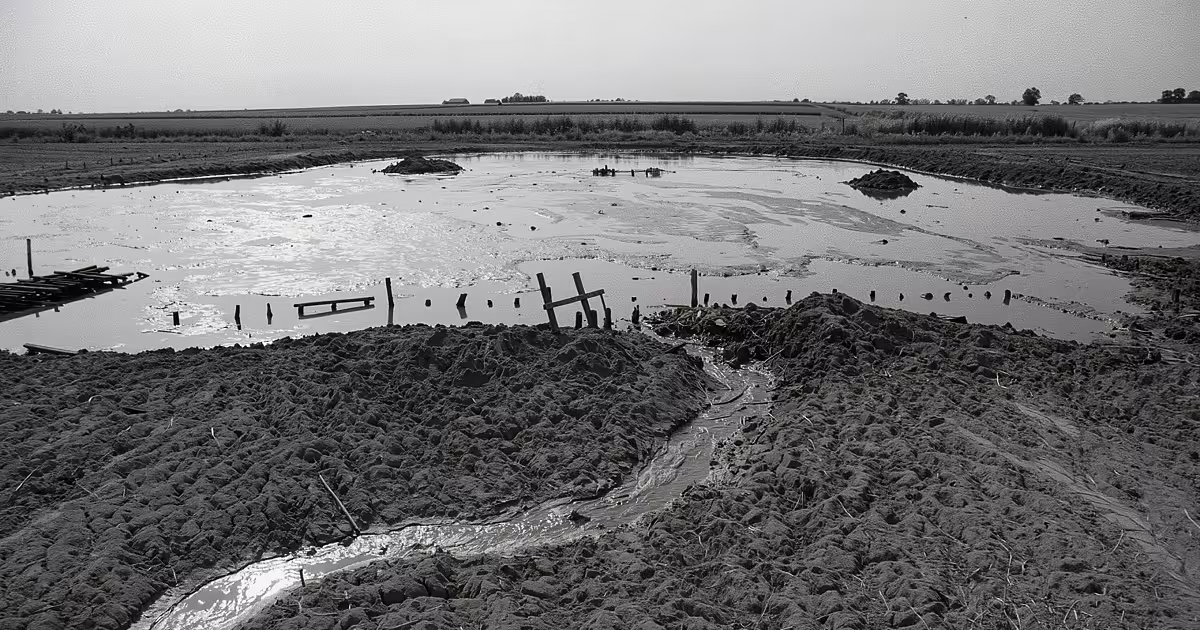
A muddy pond being drained, in black and white.
Illustration, not a period photograph.

Opening
The Beast of Busco is a giant turtle said to live in Fulk Lake, a lake of about seven acres on a farm near Churubusco, Indiana. The farmer Oscar Fulk claimed to have seen it in 1898, and the turtle took his first name. In July 1948 two locals fishing the lake, Ora Blue and Charley Wilson, said they saw it again: a snapping turtle with a spiked shell the size of a large dining table, weighing more than 500 pounds.
The farm's owner, Gale Harris, saw it himself in March 1949 and spent the rest of the year trying to catch it, with traps, nets, divers, a female sea turtle as bait and finally pumps to drain the lake. The hunt drew thousands of sightseers and national press. In late November, after a bout of appendicitis, Harris gave up. No turtle was found.
Timeline
1898Oscar Fulk reports a huge turtle in the lake on his farm. Nothing comes of it.
July 1948Ora Blue and Charley Wilson, Harris's brother-in-law, report a giant turtle while fishing. "We saw the big waves a-rolling and up came that turtle," Blue said.
March 1949Harris and the Reverend Orville Reese see the turtle while repairing Harris's barn roof, then chase it in a rowboat. A United Press reporter in Fort Wayne puts the story on the wire. Crowds block the roads, and the police chief asks for state police help with traffic.
13 March 1949The Indianapolis Star runs Victor Peterson's account of going out on the lake with Harris.
March 1949A Fort Wayne diver, Woodrow Rigsby, goes down but surfaces when his helmet leaks. A second diver, Walter Johnson, searches for two and a half hours and finds nothing.
Spring 1949Traps, nets and night searches with lights fail. Professional turtle trappers from Tennessee fail too. Harris releases a 200-pound female sea turtle as a lure and removes her by mid-May.
September to November 1949A tractor pumps the lake into a drainage ditch. Contemporary reports say a dam broke when the lake was nearly empty and let water back in.
Late November 1949Harris is hospitalised with appendicitis and ends the hunt.
1950Churubusco holds its first Turtle Days festival.
Key figures
Oscar Fulk, the farmer whose 1898 story started the legend and whose name the turtle carries.
Ora Blue and Charley Wilson, who made the 1948 sighting.
Gale Harris, the farmer who owned the lake by 1948 and led the 1949 hunt.
Orville Reese, the minister who saw the turtle with Harris in March 1949.
Victor Peterson, the Indianapolis Star reporter who covered the hunt.
Physical and documentary trail
The evidence is 1949 newspaper coverage, photographs of the hunt and the townspeople's accounts, collected later by the Churubusco History Center and by the folklorist John Gutowski in a 1977 Indiana University dissertation on Turtle Days. There is no turtle, shell, bone, track cast or clear photograph. The history center keeps one of the spotlights used during the hunt, and a net said to have been used is stored in a local funeral home.
Peterson's own sighting shows what the evidence was like. Through Harris's homemade viewer he saw a pattern of dark squares on the muddy bottom, and Harris told him that was the turtle.
He got excited. In time Mr. Harris got to seeing it. So did a lot of other people. I saw it too. I think.
Corrections to the earlier version of this report. Harris was not one of the July 1948 witnesses: Ora Blue and Charley Wilson were. Harris's own sighting came in March 1949, with Orville Reese. The shell "the size of a dining table" was Blue and Wilson's description. His hunt ended after appendicitis, with the costs having brought him close to bankruptcy.
Things you might not know
- The name came from a columnist. "Beast of Busco" was coined by Cliff Milnor, a columnist for the Fort Wayne Journal-Gazette.
- The turtle viewer was a downspout. Harris searched the bottom with a length of downspout fitted with glass, a soldered handle and a piece of red inner tube as an eyepiece.
- Harris said he grabbed its tail. He told the Star the turtle towed him out of his boat before he let go, and that the moss on its back was at least two inches thick.
- Rumours outran the turtle. In March 1949 people said it was 500 years old, ate cattle and had the explorer La Salle's name carved on its shell in French. Harris dismissed the cattle story: "Whoever heard of a turtle eating a cow?"
- Harris did catch a turtle. It weighed 14 pounds. He told reporters it must be a descendant of the monster, whose head had been "as big as three fists."
- Harris nearly died. In a 1971 interview he said that lying in hospital "on the verge of death" was when he decided "this thing was gonna stop."
Competing explanations
A common snapping turtle, misjudged. Snapping turtles live in Indiana lakes and spend most of their time on the bottom. "A really big snapping turtle might be around 30 pounds," the Purdue Fort Wayne biologist Bruce Kingsbury told Smithsonian in 2024, adding that frightened people routinely overestimate a reptile's size.
An alligator snapping turtle. The species has a spiked, three-ridged shell that fits Blue and Wilson's description and can reach about 250 pounds. Some naturalists think it once reached far south-western Indiana, but state and university herpetologists say there are no reliable records of it in the state, and it needs swamps and large rivers, not a seven-acre farm lake.
A giant unknown turtle. Several people over fifty years said they saw it, including two men in a boat who each saw it on their own side. No trap, net, diver or pumping turned up anything to support it.
Excitement feeding on itself. The reporter who went looking for the turtle saw a pattern on the lake bottom and called it a sighting, "I think." Once the press arrived, every disturbance in the water became the turtle. Harris's near-bankruptcy argues against a planned publicity stunt.
Later life of the case
Churubusco calls itself "Turtle Town, USA". Turtle Days, held every June since 1950, features a parade, a carnival and turtle races, and Oscar appears on the town's signs and on a statue in the community park.
Finding
The 1949 hunt was real, public and thorough, and it found nothing. The best explanation is a large snapping turtle in a small lake, grown in the telling to several hundred pounds by excited witnesses and the national press.
What still will not resolve: what Blue, Wilson, Harris and Reese actually saw. The lake was never fully emptied and searched, so the size of the turtle behind the story cannot be known.
Evidence signature
5/9 Solid
- Witnesses
- several people
- Instruments
- photo, film or physical traces
- Paper
- official records at the time
How well documented the case is, not whether it's true. A strong record can still have an ordinary answer, and a thin one can still be real.
You decide · BEAST OF BUSCO
What do you think happened?
One vote per case, anonymous. You'll see how other readers voted once you've voted.