THREE MILE ISLAND
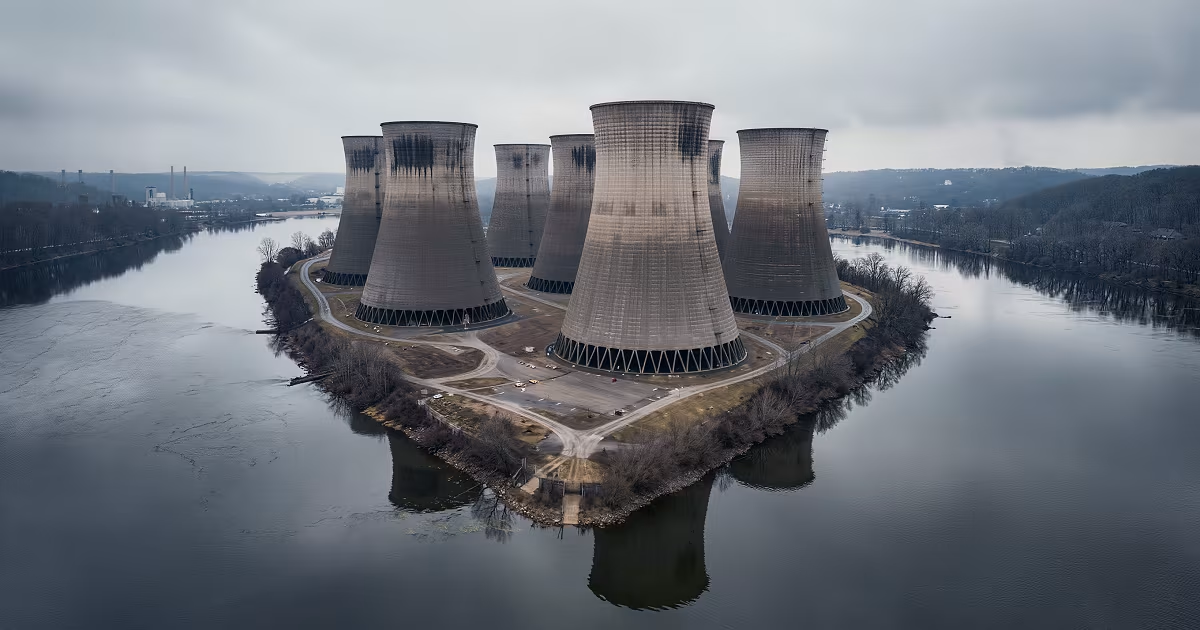
The Three Mile Island cooling towers reflected in the river.
Illustration, not a period photograph.

Archive / Conspiracy / BOT313-0284
CON-197928 MAR 1979ConspiracyDOCUMENTED
THE PARTIAL MELTDOWN NEAR HARRISBURG
Fig. 01 The Three Mile Island cooling towers reflected in the river. Illustration, not a period photograph.
Opening
At 4am on Wednesday 28 March 1979, a problem in the feedwater system shut down the turbine at Unit 2 of the Three Mile Island nuclear plant, on the Susquehanna River near Harrisburg, Pennsylvania. A relief valve opened to vent pressure and then stuck open. A light in the control room told the operators it had closed.
Believing the reactor had too much water, the operators throttled back the emergency cooling. Coolant kept draining through the open valve, and about half the core melted. It remains the worst accident in the history of American commercial nuclear power, and for several days nobody outside the plant knew how bad it was.
Timeline
15 March 1979The film The China Syndrome, about a cover-up at a nuclear plant, opens in cinemas.
28 March, 4:00amTurbine trip and reactor shutdown. The pilot-operated relief valve sticks open. The indicator shows only that the signal to close was sent, not that the valve actually closed.
28 March, 6:45am to 6:56amRadiation alarms sound, and a site area emergency is declared.
28 March, afternoonA hydrogen burn occurs inside the containment building, nearly ten hours into the accident.
30 MarchOn the advice of the Nuclear Regulatory Commission chairman, Governor Dick Thornburgh advises pregnant women and preschool children within five miles to leave. About 140,000 people leave the area over the following days.
30 March to 1 AprilA hydrogen bubble in the reactor vessel raises fears of an explosion. Officials later conclude there was no oxygen in it, so it could not burn.
1 AprilPresident Jimmy Carter tours the plant, including the control room, with Thornburgh and the NRC's Harold Denton.
31 October 1979The presidential commission chaired by John Kemeny publishes its report.
August 1979 to December 1993Cleanup of Unit 2 runs for 14 years at a cost of about $1 billion.
Key figures
The control room operators made the decisions that turned a valve fault into a meltdown, following procedures that the Kemeny Commission later found inadequate.
Governor Dick Thornburgh issued the evacuation advisory and became the public face of the state's response.
Harold Denton of the NRC was sent to the site to speak for the federal government and steady the information coming out of it.
Jimmy Carter, the only president trained as a nuclear engineer, helped dismantle the damaged Chalk River reactor in Canada as a young naval officer in 1952. His visit was credited locally with calming the region.
John Kemeny, president of Dartmouth College, led the inquiry that put the blame on organisations and attitudes rather than equipment alone.
Physical and documentary trail
What exists: the Kemeny report, the NRC's Rogovin report, the plant's instrument records, and the long cleanup record. Official figures put the release at up to 13 million curies of noble gases and 13 to 17 curies of iodine-131. The Rogovin report estimated an average dose of 1.4 millirem to about two million people nearby, less than a chest X-ray. How much of the core had melted was not known until years later, when cameras reached the inside of the reactor vessel.
fundamental changes will be necessary in the organization, procedures, and practices - and above all - in the attitudes
Things you might not know
- The film came first. The China Syndrome opened twelve days before the accident.
- The light told the wrong story. The control room indicator showed that a command to close the valve had been sent, not where the valve actually was.
- Nobody saw the core for six years. A television camera first looked inside the damaged reactor in 1985.
- Most people came back fast. A later survey found 98 percent of those who left had returned within three weeks.
- The twin reactor kept running. Unit 1, next door and undamaged, restarted in 1985 and generated power until 2019.
- And it is coming back. Unit 1 is being restarted as the Crane Clean Energy Center under a 20-year power deal with Microsoft, with a target of 2027.
Competing explanations
An accident made serious by people and procedures. This is the Kemeny finding: a mechanical fault became a meltdown because of misleading instruments, poor training and procedures that did not fit the situation.
A worse release than admitted. Some residents and researchers have argued that radiation exposure was higher than official estimates and that local cancer rates rose afterwards. Most large studies have not found a clear increase, but the dispute has never completely gone away.
An industry that got lucky. The containment building held, and the core stayed inside the vessel. Critics argue this showed how close the accident came to something much worse, while supporters say it showed the safety systems worked.
Later life of the case
Three Mile Island reshaped American nuclear regulation, operator training and emergency planning, and new reactor orders in the United States all but stopped for decades. Unit 2's ruined reactor remains on site in monitored storage while its owner, TMI-2 Solutions, works on decommissioning.
Finding
About half of a reactor core melted at Three Mile Island in March 1979, the containment held, and the official estimates of the radiation released are small. The Kemeny Commission's reading, that the deeper failure was in procedures and attitudes, is well supported by the record. The long-term health effects are the part still argued, and residents who doubt the official doses have not had a study that fully answers them.
What still will not resolve: an exposure record for individual residents during the first days, when no one was measuring at their homes.
Evidence signature
3/9 Thin
- Witnesses
- nothing on record
- Instruments
- nothing on record
- Paper
- formal investigation, court or declassified file
How well documented the case is, not whether it's true. A strong record can still have an ordinary answer, and a thin one can still be real.
You decide · THREE MILE ISLAND
What do you think happened?
One vote per case, anonymous. You'll see how other readers voted once you've voted.