BAY OF PIGS
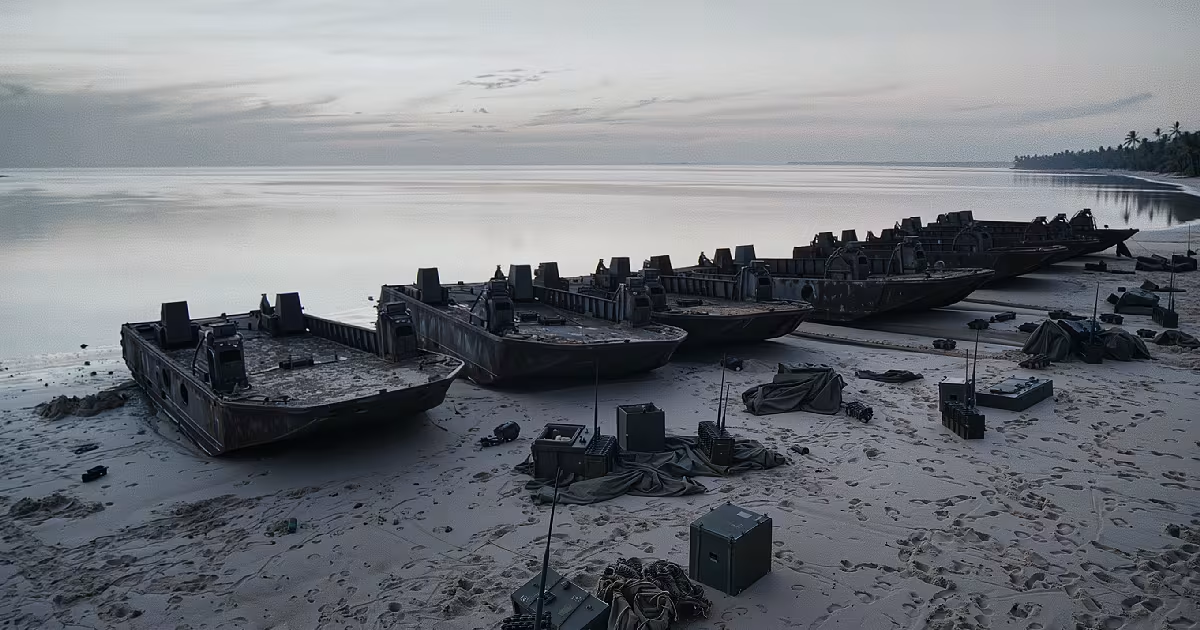
Brigade 2506 prisoners, Playa Giron, April 1961.
Illustration, not a period photograph.
Opening
At dawn on 17 April 1961, roughly 1,400 Cuban exiles, trained, armed, and transported by the CIA under a plan originally authorized by President Eisenhower and inherited by his successor, landed at a remote stretch of Cuba's southern coast known as the Bay of Pigs. Within three days, Fidel Castro's forces had killed or captured nearly the entire invading force. It remains, in the words of one historian, "that rarest of all things, a perfect failure," and it is one of the very few major Cold War covert operations for which the CIA's own scathing internal postmortem, the "holy grail" document historians spent decades trying to obtain, has since been declassified in full, along with a growing body of material suggesting the agency's own planners knew the operation was likely doomed months before it launched.
Timeline
March 1960. President Eisenhower authorizes the CIA to recruit and train Cuban exiles for a covert paramilitary operation against Castro's government, with training conducted at a facility in Guatemala.
15 November 1960. A CIA task force meeting to prepare a briefing for president-elect Kennedy concludes, per later-declassified internal notes, that the operation is "unachievable" as originally conceived, specifically stating that hoped-for internal Cuban unrest would not materialize and that Castro's actual defensive capability exceeded earlier planning assumptions. Historians examining the record have found it unclear whether this specific negative assessment was actually passed to Kennedy at his post-election national security briefing three days later, or whether the agency proceeded with the CIA-only version of the plan despite its own internal doubts.
January 1961. Kennedy takes office and inherits the already-developed plan, having used a hardline stance on Cuba as a campaign issue against Vice President Nixon.
February 1961. The Joint Chiefs of Staff review the CIA's invasion plan and give it general approval, a formal military endorsement that would later be cited, alongside the CIA's own internal assurances, as part of why Kennedy proceeded despite the earlier documented doubts.
Kennedy's modifications. Seeking to preserve at least a thin layer of plausible deniability regarding direct U.S. involvement, Kennedy and his aides relocate the planned landing site to the more remote Bay of Pigs and limit the scale of direct American military support.
15 April 1961. B-26 bombers, disguised to appear as defecting Cuban air force planes, conduct airstrikes intended to destroy Castro's air force on the ground ahead of the invasion; the strikes fail to fully disable it, leaving functioning aircraft available to oppose the coming landing.
Same day. Adlai Stevenson, U.S. Ambassador to the United Nations, having been deliberately misinformed by the White House about the true nature of the airstrikes, tells the UN they were carried out by genuinely defecting Cuban pilots. When Stevenson later learns the actual truth, he complains directly to Kennedy, reportedly furious at having been placed in the position of unknowingly lying to an international body.
14 April 1961, the day before the airstrikes, per later-declassified Soviet archival material. Soviet Ambassador S. M. Kudryavtsev and Ernesto "Che" Guevara discuss the coming operation, with Guevara predicting that any American-backed beachhead effort would be "doomed to failure," an assessment from the Cuban side that would prove accurate within days.
17 April 1961, early morning. Approximately 1,300 to 1,400 members of the CIA-trained Brigade 2506 land at the Bay of Pigs. Following Stevenson's complaint and the diplomatic fallout from the failed initial strikes, Kennedy cancels planned follow-up air cover for the following day.
17-19 April 1961. Facing a vastly larger and better-prepared Cuban defensive force than CIA planning assumptions had anticipated, the invasion collapses rapidly; by 2 p.m. on 19 April, the surviving invaders surrender. Some 114 exiles are killed and more than 1,100 are captured.
Following the failure. President Kennedy commissions a special investigative commission chaired by General Maxwell Taylor to examine what went wrong.
1961, internally. CIA Inspector General Lyman Kirkpatrick completes a scathing internal report placing primary responsibility for the failure on CIA officials themselves, specifically citing "failure at high levels to concentrate informed, unwavering scrutiny on the project and to apply experienced, unbiased judgment to the menacing situations that developed." The report is accompanied by a pointed written rebuttal from CIA Deputy Director Tracy Barnes, indicating the agency's own leadership did not uniformly accept Kirkpatrick's assessment even internally.
18 May 1961, shortly after the failure. White House aide Arthur Schlesinger Jr., tasked by Kennedy with studying the British intelligence oversight model, produces a memorandum concluding that large-scale covert operations of this kind cannot realistically remain deniable and that the American system lacked adequate political oversight of clandestine action, part of a broader internal debate, per later-declassified material, over whether to substantially restructure or even dismantle the CIA in the operation's aftermath.
16 April 1961, the day before the landing (announced separately from the operation itself). Castro publicly declares Cuba a "socialist" state, a declaration analysts connect directly to his calculation that surviving a potential American-backed attack would require securing Soviet support, itself requiring a clearer ideological alignment with Moscow.
Following the invasion's failure, longer-term consequences. Castro's position at home and internationally is significantly strengthened rather than weakened by the failed attempt; Cuba's deepening alignment with the Soviet Union accelerates, and the following year, in 1962, Nikita Khrushchev's decision to place nuclear missiles in Cuba, a decision analysts link at least partly to the Bay of Pigs episode's demonstration of American willingness to act against Castro's government, precipitates the Cuban Missile Crisis.
1998. Following a Freedom of Information Act effort spanning decades, Kirkpatrick's full internal CIA report, "the holy grail" for historians of the episode according to the New York Times, is formally declassified and published in full, alongside Barnes's rebuttal, giving researchers direct access to the agency's own internal self-assessment for the first time.
2001, fortieth anniversary. A joint conference in Havana, involving former Kennedy administration officials, CIA veterans, Brigade 2506 survivors, and Cuban government and military officials, coincides with an unprecedented Cuban government declassification of roughly 480 pages of its own records on the invasion, including intelligence reports on U.S. preparations and Castro's own wartime directives.
2026, sixty-fifth anniversary. Newly declassified documents, examined by the National Security Archive, add further detail to how seriously the Kennedy administration considered restructuring or dismantling the CIA following the failure, centered on the Schlesinger memorandum and related internal material, deepening the documented record of the operation's institutional aftermath even six and a half decades later.
Key figures
Kennedy is the operation's final decision-maker, having inherited rather than originated the plan, and his specific modifications, relocating the landing site, limiting direct American air support, reflect a documented effort to preserve deniability that many historians argue instead undermined the operation's actual military viability without achieving genuine deniability either.
Kirkpatrick is the case's central internal accountability figure, whose scathing, ultimately declassified report placed direct blame on CIA leadership itself rather than external factors, a genuinely unusual level of internal self-criticism for an intelligence agency's own inspector general to commit to a document.
Stevenson is the case's most sympathetic casualty of the operation's own internal deception, a senior American diplomat placed in the position of unknowingly misleading the United Nations by his own government, a detail that illustrates how compartmentalized secrecy within the U.S. government itself contributed to the episode's broader diplomatic damage.
Schlesinger is the figure most directly responsible for translating the failure into lasting institutional reform debate, his memorandum on British-style oversight becoming a key document in the internal argument over whether the CIA's covert-action authority needed fundamental restructuring.
Guevara's own contemporaneous, accurately predictive assessment, preserved only through later-declassified Soviet archival material, offers a rare documented instance of the opposing side's own internal confidence being independently verified as correct after the fact.
Physical and documentary trail
On the paper, this file has an unusually complete multi-source documentary record: the CIA's own declassified 1961 internal history, Kirkpatrick's full Inspector General report and Barnes's rebuttal, the Taylor Commission's investigation, Schlesinger's oversight memorandum, declassified Soviet archival material capturing the Cuban and Soviet side's contemporaneous internal assessment, and, since 2001, roughly 480 pages of the Cuban government's own declassified intelligence and military records from the invasion itself.
What remains incompletely resolved even with this much material is the precise chain of responsibility for the November 1960 "unachievable" assessment: whether it reached Kennedy in any meaningful form before he gave final approval, or whether CIA leadership proceeded with a plan its own task force had already privately concluded could not succeed as designed.
Failure at high levels to concentrate informed, unwavering scrutiny on the project and to apply experienced, unbiased judgment to the menacing situations that developed.
Competing explanations
Institutional CIA failure, per Kirkpatrick's own internal report: inadequate scrutiny, faulty intelligence about Cuban popular support and military readiness, and a level of institutional overconfidence that persisted even after the agency's own task force had privately flagged the plan as unachievable months earlier.
Presidential decision-making failure, the reading Barnes's contemporary rebuttal and some later historians favor, centering on Kennedy's specific modifications, particularly the cancellation of follow-up air support after the Stevenson complaint, as having converted an already-difficult operation into a certain failure by removing planned support at a critical moment.
A plan doomed from its own original conception, given the documented November 1960 internal assessment predating either Kennedy's specific decisions or the operation's final execution details, suggesting the fundamental scale mismatch, a small exile force against a much larger and better-prepared Cuban defense, made failure likely regardless of how faithfully the plan was later executed.
A genuinely shared failure across multiple levels and institutions, the reading best supported by the full declassified record taken together: flawed original intelligence assumptions, inadequate escalation of internal doubts up the chain of command, and consequential last-minute presidential modifications each contributed distinct, documented, and mutually reinforcing causes rather than any single point of failure fully explaining the outcome.
Later life of the case
The Bay of Pigs remains one of the most thoroughly declassified and cross-nationally documented covert operations of the entire Cold War, with the 1998 release of Kirkpatrick's report and the 2001 Cuban government disclosure together giving historians access to both sides' internal contemporaneous records, an unusually complete evidentiary picture for an event of this sensitivity. Its consequences, Castro's consolidation of power, the acceleration of Soviet-Cuban alignment, and the direct causal line historians draw to the following year's Cuban Missile Crisis, make it one of the clearest documented examples of a failed covert operation reshaping the broader geopolitical landscape rather than merely embarrassing the government that launched it.
Finding
The Bay of Pigs invasion is among the most fully declassified failed covert operations in modern history, its own perpetrating agency's internal self-criticism, the target nation's own archival record, and the sponsoring government's institutional aftermath debate all now part of the public documentary record. Responsibility for the failure is genuinely distributed across CIA planning assumptions documented as flawed even before Kennedy's final approval, and presidential decisions made under the specific pressure of maintaining deniability, rather than resting cleanly on any single actor or decision.
What still will not resolve: definitive confirmation of whether the CIA's own November 1960 "unachievable" internal assessment was ever meaningfully communicated to Kennedy before he gave the operation his final approval, a gap in the documentary chain that would, if closed, settle much of the remaining dispute over where ultimate responsibility for one of the Cold War's most consequential failures actually lies.