BILDERBERG GROUP
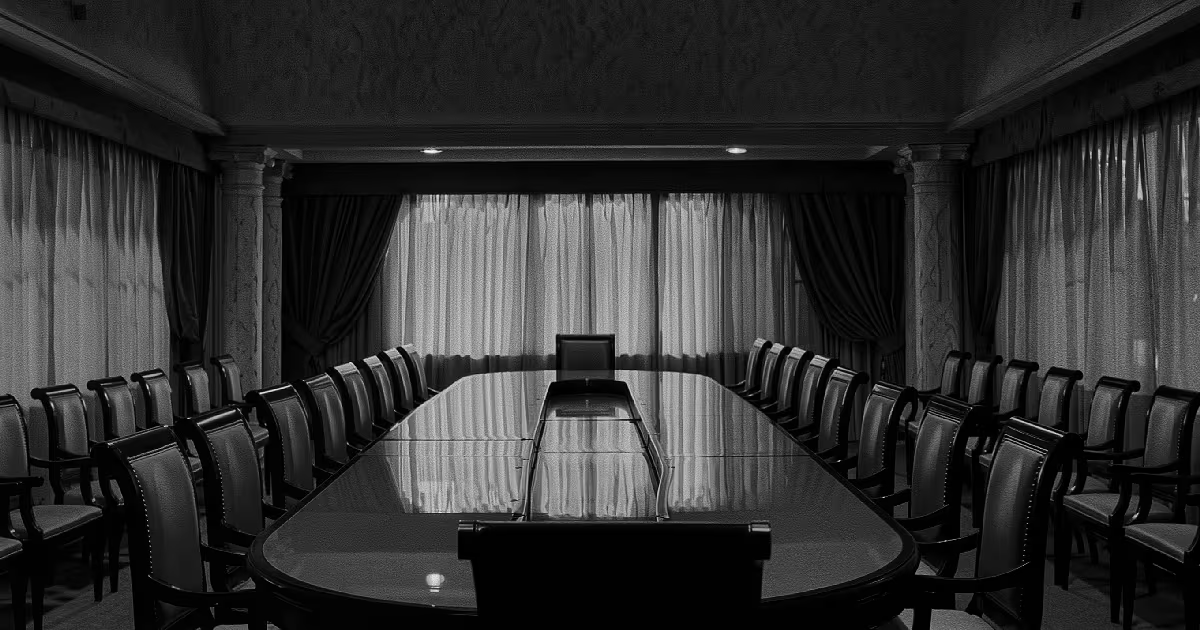
Hotel de Bilderberg, Oosterbeek, site of the 1954 founding meeting.
Illustration, not a period photograph.
Opening
From 29 to 31 May 1954, roughly fifty European and American political, business, and intellectual figures gathered at the Hotel de Bilderberg in Oosterbeek, Netherlands, for a closed-door, off-the-record conference aimed, according to its own stated purpose, at strengthening transatlantic understanding during the Cold War. The meeting has repeated annually almost every year since, always under the same strict confidentiality rule, always drawing a guest list of genuinely significant global figures, and always generating the same basic public reaction: intense secrecy paired with real institutional power is, whatever the actual content of the discussions, an almost perfect recipe for suspicion.
This is not a case where the group's existence, funding, or attendee list is in dispute. Those are documented facts. What remains genuinely, and probably permanently, contested is what actually happens inside the room, and how much real influence an off-the-record conversation between powerful people can be shown to exert on the world outside it.
Timeline
1952-1954. According to later historical analysis, including work by political scientist Richard J. Aldrich, an informal, secretive transatlantic council of key decision-makers develops during these years, aimed at facilitating candid, off-the-record discussion of European-American tensions during a period of genuine Cold War anxiety about Western unity.
29-31 May 1954. The first formal meeting takes place at the Hotel de Bilderberg, organized by Polish-born political adviser Joseph Retinger, Prince Bernhard of the Netherlands, and Belgian Prime Minister Paul van Zeeland. Responsibility for organizing the American side of attendance is given to C.D. Jackson, President Eisenhower's psychological warfare coordinator, and the meeting's initial funding comes from the Central Intelligence Agency, a fact later documented rather than merely alleged.
Following years. Continued funding shifts substantially to the Ford Foundation. The meeting becomes a genuine annual fixture, chaired by Prince Bernhard, drawing top political, financial, and industrial figures from Western Europe and North America under a strict confidentiality arrangement, participants may use information gained at the meeting but may never attribute a specific statement to a named speaker, a formal practice known as the Chatham House Rule.
Through the following decades. The meeting's stated agenda broadens from its original Cold War-unity focus into general discussion of major economic, political, and social trends affecting Western nations, with participants including sitting heads of state, central bank governors, media executives, and academics.
1976. Prince Bernhard, who had chaired every meeting since 1954, is implicated in the Lockheed bribery scandal, revealed to have accepted a substantial bribe from the American aerospace company in connection with military aircraft sales to the Dutch government. He resigns his public positions, including his Bilderberg chairmanship, and that year's meeting is canceled entirely, the only year besides the COVID-19 pandemic years of 2020-21 that the conference has not taken place since 1954.
Following decades. The chairmanship passes to a series of prominent European figures, including Belgian businessman Étienne Davignon and later French businessman Henri de Castries, with the group maintaining a small permanent office in Leiden, Netherlands, and continuing to rotate its annual venue among luxury hotels across Europe and, roughly once every four years, North America.
Ongoing. Named attendees across various years have included figures such as Henry Kissinger, David Rockefeller, King Juan Carlos of Spain, Queen Beatrix of the Netherlands, Bill Gates, Google's Eric Schmidt, IMF Managing Director Christine Lagarde, and numerous sitting cabinet ministers and central bankers, a documented guest roster rather than a speculative one, since the group's own website publishes attendee lists after the fact even while barring press coverage of the actual proceedings.
Recurring, annually. Journalists are formally barred from reporting on the meeting's substantive content, though the group does publicly confirm the meeting's occurrence, location, and attendee list. This partial transparency, full disclosure of who attended, total silence on what was actually discussed, has itself become a recurring point of both mainstream press criticism and more conspiratorial speculation.
Various years. Protests occur regularly outside meeting venues; the 2012 Chantilly, Virginia meeting draws sufficient protester attention that mainstream outlets including the Washington Post cover the gathering specifically because of the demonstrations rather than the conference's own substantive news value.
Journalists who have attended as invited observers, per multiple published accounts, have generally described the actual proceedings as comparatively unremarkable in format, closer to an upscale academic or policy seminar than any dramatic decision-making body, while still acknowledging that the specific influence and connections of the attendees themselves make the gathering's private, informal networking function genuinely significant regardless of its formal lack of voting or resolutions.
Key figures
Retinger and Prince Bernhard are the meeting's founding organizers, and Bernhard's own later documented corruption, the 1976 Lockheed scandal, is a genuine, confirmed instance of exactly the kind of elite malfeasance that fuels broader suspicion of the group he had chaired for over two decades, even though the scandal itself was unrelated to Bilderberg's own stated purpose or activities.
Jackson's specific role, organizing American participation as Eisenhower's psychological warfare coordinator, and the CIA's confirmed initial funding, are genuine, documented facts that place the group's earliest origins directly within active U.S. Cold War influence operations, a detail conspiracy-minded critics correctly identify as real rather than invented, even when their broader theories about the group's subsequent activities go well beyond what that origin alone establishes.
The group's own official communications represent a deliberately limited transparency strategy: full disclosure of attendance, complete silence on content, a strategy that satisfies neither committed critics demanding full openness nor, obviously, those inclined toward more dramatic conspiratorial readings of what the silence might be concealing.
Journalist-observers who have attended and later written about the experience represent the case's most direct, if necessarily limited, firsthand check on the more extreme claims about the meeting's actual proceedings, generally describing a format closer to elite networking and informal policy discussion than any depicted secret-government-formation scenario.
Physical and documentary trail
On the paper, this file has a genuinely well-documented organizational history: confirmed CIA seed funding, a confirmed subsequent shift to Ford Foundation support, publicly available historical and current attendee lists, a formally structured confidentiality rule (Chatham House Rule) rather than simple undocumented secrecy, and a real, well-reported corruption scandal (Bernhard's Lockheed bribery) directly involving the organization's own founding chairman.
What it lacks, by design and by the group's own explicit operating rule, is any recorded or attributable account of the meeting's actual substantive discussions, a total absence of primary content documentation that is the single fact driving nearly every subsequent theory, mainstream and conspiratorial alike, about what the gathering actually accomplishes.
There is no detailed agenda, no resolutions are proposed, no votes are taken, and no policy statements are issued.
Competing explanations
An informal, genuinely influential elite networking and policy-discussion forum, exactly as its own official description and journalist-observer accounts suggest, whose real significance lies less in any formal decision-making and more in the private relationships and shared understanding it fosters among people who separately hold enormous individual institutional power. This reading treats the group's actual format, an off-the-record conference with no votes or resolutions, as accurately described rather than as a cover story.
A genuine instrument of coordinated elite policy influence, wielded informally rather than through any formal voting mechanism, given the group's documented CIA origins, its consistent roster of genuinely powerful attendees, and the real historical correlation some researchers draw between Bilderberg discussions and subsequent major policy developments, such as European integration efforts in the years following its founding. This reading does not require any dramatic conspiracy theory, only that informal consensus among powerful people, built at exactly this kind of gathering, can meaningfully shape subsequent formal decisions made elsewhere.
A shadow world government coordinating global events including wars, financial crises, and the selection of national leaders, the most extreme popular conspiracy framing. This reading has never been supported by any surfaced document, defector testimony, or verified account from the numerous journalists who have actually attended as observers, and it requires treating the group's confirmed, comparatively mundane organizational history, CIA seed funding for anti-communist transatlantic coordination during an active Cold War, as a cover story for something categorically larger and never actually demonstrated.
Later life of the case
Bilderberg remains one of the most durable subjects in modern conspiracy culture specifically because its basic secrecy practice has never changed across seven decades, giving each new generation of critics and theorists fresh, undiminished raw material to work with regardless of how many journalists have attended and reported back a comparatively unremarkable account of the actual proceedings. Its persistence as both a real, functioning elite institution and a symbol onto which considerably larger conspiratorial narratives get projected makes it a genuinely useful case study in how documented secrecy, even when limited to content rather than existence or attendance, reliably generates suspicion disproportionate to what has ever actually been confirmed.
Finding
The Bilderberg Meeting is a real, continuously operating organization with a confirmed CIA-funded Cold War origin, a formally structured confidentiality rule rather than blanket secrecy, and a publicly disclosed, genuinely powerful attendee roster spanning seven decades. Its founding chairman was later confirmed to have accepted bribes in an entirely separate matter, a real scandal that nonetheless says nothing definitive about the organization's own core activities. What remains completely undocumented, by the group's own explicit design, is the actual substantive content of any single meeting's discussions.
What still will not resolve: any verified account of specific policy outcomes traceable directly to a Bilderberg discussion, as opposed to the far more modest and better-supported claim that the meeting facilitates informal relationship-building among people who separately go on to make consequential decisions elsewhere. Until the group changes its own operating rule, that gap between confirmed organizational fact and unconfirmed substantive influence will remain exactly as wide as it has been since 1954.