FAMILY JEWELS
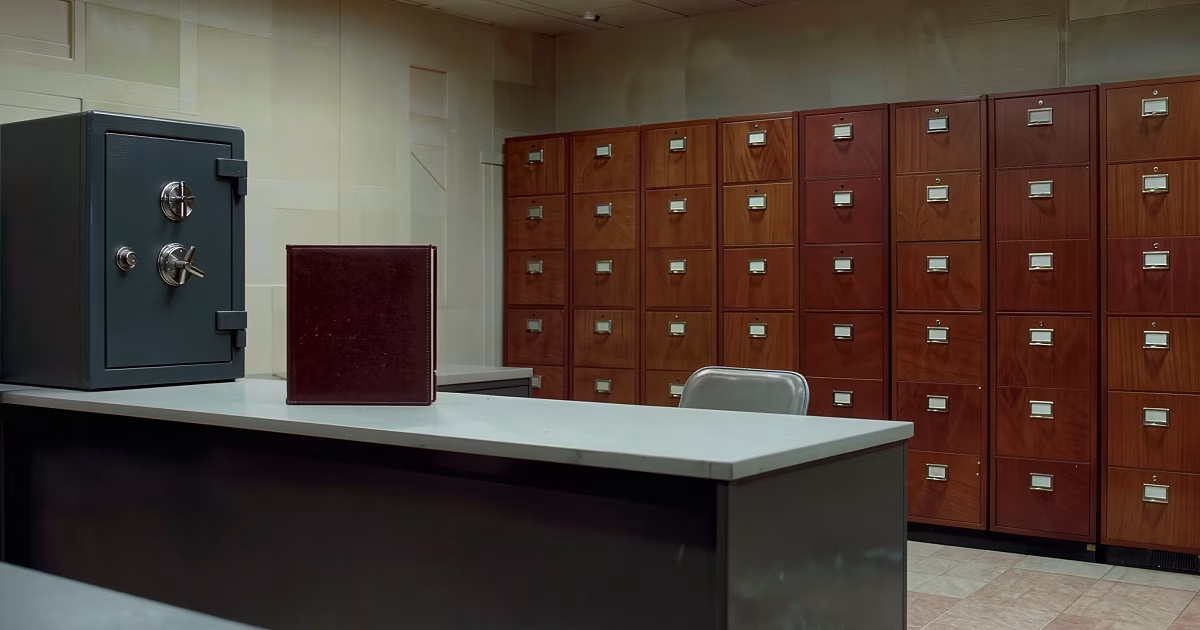
1970s office safe. Loose-leaf binder, no readable text.
Illustration, not a period photograph.
Opening
On 9 May 1973 CIA Director James Schlesinger, after Watergate weather inside the Agency, ordered every office to list activities that might fall outside the charter. The take came back as the Family Jewels: 693 pages in the inventory that later became public, a catalogue of domestic taps, mail opening, surveillance of journalists and dissidents, drug tests, and plots the Agency had preferred to keep in the building. William Colby inherited the pile. The Rockefeller Commission and then Church and Pike walked parts of it into daylight.
A redacted set was released in 2007. Project Mockingbird the tap sits in it. MHCHAOS sits near it. Assassination sketches and the other captions the later books love sit in the same dump without each caption being a completed job. The Jewels are an inventory ordered from above, not a memoir and not a single program name.
The spine of the file is a director's order and 693 pages. Family Jewels is a list the Agency made of itself. It is not a novel about one rogue desk.
Timeline
Early 1973 Schlesinger's order. Offices type. The pile becomes the Jewels.
Colby holds it through the commissions. Church and Pike put selected facts out in 1975-76. The Agency fights scope, not the existence of a pile.
June 2007 a redacted release. Captions the public already knew sit next to pages that were only rumoured.
Later books treat the Jewels as a bible. That use is later life. May 1973 is first.
Schlesinger had been at the Agency weeks, not years. The order is a new director cleaning house after Watergate had already taught Washington what a hidden shop costs. Offices that typed returns were not volunteers. They were answering a memo that could end a career if they hid the wrong caption.
Key figures
James Schlesinger owns the order that forced the list.
William Colby owns the inheritance and the briefings.
Office chiefs who typed the returns own the captions they confessed.
Church, Pike and Rockefeller staff own the public table. The 2007 release owns the pile as a readable object.
Physical and documentary trail
On the paper, 1973-2007 give you four hard objects and no claim the pile was empty.
One: Schlesinger's 9 May 1973 order.
Two: the returned inventory, 693 pages in the later public count.
Three: commission and committee use in 1975-76.
Four: the 2007 redacted release. CIA Family Jewels compilation following the Schlesinger order, 1973, is the originating tray.
There is no unredacted public set everyone agrees is complete. There is no page that makes the order a prank. There is no single caption that eats the whole pile.
An internal inventory is a different object from a committee leak. This pile was requested from the seventh floor. That is why the 2007 release still matters: it is the Agency's own list, cut, but theirs.
List all activities that might be outside the Agency's charter.
Competing explanations
A confession of a criminal agency. This is the shocked reading. It has 693 pages. It has redactions still.
A damage-control inventory after Watergate. Also true. An inventory can be both self-protection and evidence.
A stack of proposals never run. Weak against taps and mail opening that did run.
Hybrid caution. A director asked for sins. Offices typed. The pile exists. Not every caption is a completed crime.
Later life of the case
The 2007 dump and every later caption list. I keep those on the later-life shelf. The May order stays first.
Finding
James Schlesinger ordered the Agency in May 1973 to list what might be outside the charter, and the offices sent back hundreds of pages the public now calls the Family Jewels. Believe the pile. A director does not invent a 693-page inventory for a later documentary.
What still will not resolve: an unredacted complete set, or a page that shows a caption was only a wish. Either one would finish the scale. The proving object is still those unredacted lines, held in the building, not in the 2007 cuts.