ECHELON
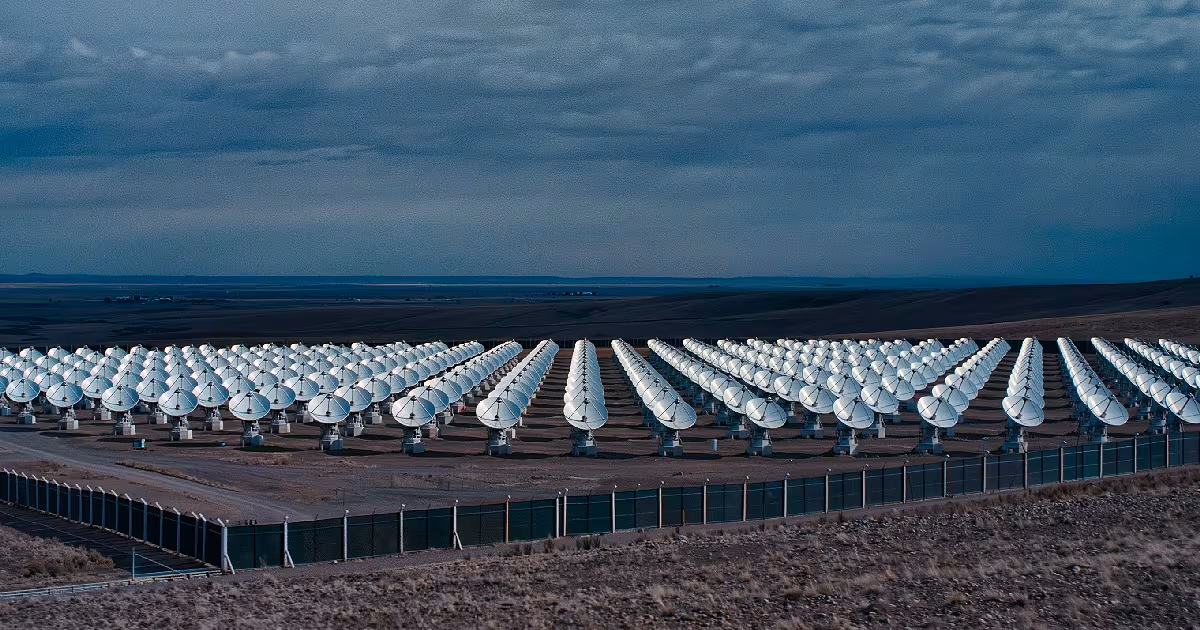
RAF Menwith Hill radome array.
Illustration, not a period photograph.
Opening
ECHELON is a real signals intelligence collection network, operated jointly by the United States, United Kingdom, Canada, Australia, and New Zealand under the 1947 UKUSA Security Agreement, the same five-nation partnership now commonly known as "Five Eyes." Built in the late 1960s and formally established in 1971 to monitor Soviet and Eastern Bloc military and diplomatic communications during the Cold War, the network expanded dramatically by the century's end into something considerably broader: a European Parliament investigation formally concluded it was capable of intercepting telephone calls, faxes, emails, and other data traffic worldwide via satellite, undersea cable, and microwave links. The most contested part of that finding was not that ECHELON existed, both the U.S. government and Australia had by then publicly acknowledged the underlying UKUSA relationship, but what it was actually being used for once the Cold War that justified its creation had ended.
Timeline
1947. The United States, United Kingdom, Canada, Australia, and New Zealand sign the UKUSA Security Agreement, a classified signals intelligence-sharing partnership whose existence would not be publicly confirmed by any of its own signatories for over five decades.
Late 1960s. The system that will become known as ECHELON begins development, aimed specifically at Soviet bloc military and diplomatic communications interception.
1971. ECHELON is formally established as a distinct program within the broader UKUSA framework.
Through the remaining Cold War decades. The network grows to include ground stations positioned to intercept satellite communications globally, including the well-known RAF Menwith Hill facility in England and Germany's Bad Aibling station, expanding well beyond its original Soviet-focused mandate as satellite and digital communications infrastructure itself expanded.
1994. According to intelligence subsequently cited in a European Parliament report, the NSA intercepts phone calls between the French firm Thomson-CSF and Brazilian government officials discussing a $1.4 billion Amazon satellite surveillance contract, revealing what the intercepted communications indicated was bribery of Brazilian officials. Washington shares this finding with the Brazilian government; the contract is subsequently awarded instead to Massachusetts-based Raytheon.
Same year, separately. U.S. intelligence reportedly obtains information indicating Airbus Industrie agents were offering bribes to a Saudi official in connection with a roughly $6 billion aircraft sale; the contract goes instead to Boeing.
January 1995. Then-CIA Director James Woolsey states publicly, "We are not in the business of spying for private firms. We assess international economic trends... and support trade negotiations," a carefully worded denial that does not address the specific bribery-related intelligence-sharing cases directly.
February 1995. French authorities expel several CIA agents from Paris, alleging they had been seeking information on France's negotiating position ahead of international telecommunications talks, an incident occurring within weeks of Woolsey's public denial.
March 1999. Australia becomes the first UKUSA signatory nation to publicly confirm the underlying agreement's existence, with Defence Signals Directorate director Martin Brady telling an Australian television network the agency "does co-operate with counterpart signals intelligence organisations overseas under the UKUSA relationship."
2000. The European Parliament forms a temporary committee to investigate ECHELON's existence, capabilities, and use, following growing concern, particularly from European industry, about potential economic espionage. James Woolsey, no longer CIA director but still holding security clearances, publicly defends the program's use in the two specific bribery cases (Thomson-CSF and Airbus) at a Council on Foreign Relations seminar and a Foreign Press Center briefing, stating plainly that American intelligence had targeted bribery rather than technical or engineering information, and that the U.S. government's practice was to inform the government being bribed rather than tip off the competing American corporation directly.
17 March 2000. Woolsey publishes an opinion piece in the Wall Street Journal titled "Why We Spy on Our Allies," writing directly and provocatively, "Yes, my continental European friends, we have spied on you... we have spied on you because you bribe," an unusually blunt public defense of economic-adjacent intelligence collection from a former head of the CIA.
2001. The European Parliament's temporary committee publishes its final report, concluding that ECHELON's technical capabilities were probably not as extensive as some media coverage had assumed, while still affirming the network's basic existence and its documented capability for global interception of telephone, fax, and data traffic transmitted via satellite. Investigative journalist Duncan Campbell's own detailed reporting, cited extensively within the parliamentary process, becomes one of the report's key sourced components. Separately, when a parliamentary delegation travels to the United States seeking meetings with the CIA, NSA, and Department of Commerce specifically to discuss the findings, all scheduled meetings are canceled by the U.S. government, and the delegation's visit ends prematurely.
2013. Edward Snowden's disclosures about separate, more modern NSA programs including PRISM renew public and academic interest in ECHELON as an earlier chapter of the same broader Five Eyes surveillance infrastructure, though the two programs are technically and operationally distinct.
2015. Public reporting further documents specific ECHELON-linked interception activity, adding to the body of confirmed, non-speculative material available about the network's operational history.
Key figures
Woolsey is the case's most consequential named figure specifically because he chose public, on-the-record candor rather than the usual "neither confirm nor deny" posture, directly defending the program's use in two specific commercial-bribery cases while drawing a careful, and disputed, line between intelligence used to counter corruption and intelligence used to directly benefit a competing American company.
Brady is the case's key confirming official, whose 1999 statement to Australian media represented the first time any UKUSA signatory government had publicly acknowledged the underlying intelligence-sharing relationship after more than five decades of official silence.
Campbell is the case's most significant independent investigative journalist, whose detailed technical reporting on ECHELON's capabilities and specific case histories formed a substantial evidentiary basis for the European Parliament's own formal investigation and final report.
The European Parliament's temporary committee represents the most rigorous formal, multinational government investigation ECHELON has received, notable both for its measured conclusion, that some media speculation had overstated the system's technical capabilities, and for the American government's decision to cancel all scheduled meetings with its investigators rather than engage directly.
Physical and documentary trail
On the paper, this file has an unusually well-documented history for a signals intelligence program: the underlying 1947 UKUSA Agreement's existence confirmed by multiple signatory governments, a formal, published European Parliament investigative report, named and dated commercial cases (Thomson-CSF and Airbus) discussed on the public record by a former CIA director rather than only alleged by outside critics, and independent journalistic investigation feeding directly into the parliamentary process.
What remains genuinely unresolved is the scope question the European Parliament's own report explicitly flagged: whether the system's actual global interception capability matches the more expansive claims found in some media coverage, or whether, as the report's own more measured conclusion suggested, popular understanding had outpaced the documented technical reality.
Yes, my continental European friends, we have spied on you. And it's true that we use computers to sort through data by using keywords... we have spied on you because you bribe.
Competing explanations
A legitimate Cold War-origin military and diplomatic intelligence network, later legitimately expanded to address genuine corruption and bribery in international commercial contracts, exactly as Woolsey's own public defense describes. This reading is bolstered by the fact that Woolsey named specific cases and specific mechanisms (informing the bribed government, not the competing company) rather than offering only a vague denial, a genuinely unusual level of official candor for this kind of program.
Systematic economic and industrial espionage conducted under the cover of anti-corruption justification, with the two publicly acknowledged cases representing a small, defensible sample of a much larger pattern of commercial intelligence-gathering that primarily benefits American companies' competitive position. This reading is the European Parliament committee's own underlying concern, and it is difficult to fully resolve given that only two specific cases have ever been publicly discussed by name, an evidentiary base too narrow to confidently generalize from in either direction.
A real, significant capability whose actual scope has been genuinely overstated in popular and media coverage, per the European Parliament's own careful final assessment. This reading treats ECHELON as neither the all-seeing global surveillance apparatus of some popular imagination nor a narrowly targeted anti-corruption tool, but something in between whose precise boundaries remain incompletely documented in the public record even after the most serious formal government investigation it has received.
Later life of the case
ECHELON remains one of the foundational case studies in the modern history of government surveillance disclosure, predating and in some ways setting the template for the far larger 2013 Snowden revelations about PRISM and related programs. The American government's decision to cancel all meetings with the European Parliament's own investigators, rather than the underlying intelligence activity itself, is frequently cited as one of the more telling diplomatic details in the entire case, a concrete, documented refusal to engage rather than a mere assertion of secrecy.
Finding
ECHELON is a real, multinational signals intelligence network with a confirmed Cold War origin, formally investigated by the European Parliament, and its use in at least two specific commercial bribery cases has been openly defended on the public record by a former CIA director rather than merely alleged by critics. What remains genuinely open is the scope question the parliamentary investigation itself could not fully close: how much broader the network's actual commercial and economic intelligence-gathering extends beyond the small number of cases ever publicly acknowledged by name.
What still will not resolve: a complete accounting of ECHELON's commercial intelligence use beyond the Thomson-CSF and Airbus cases, and full technical confirmation or refutation of the more expansive interception capabilities some media coverage has attributed to the system, a gap the European Parliament's own report explicitly acknowledged rather than definitively closed.