HANGAR 18
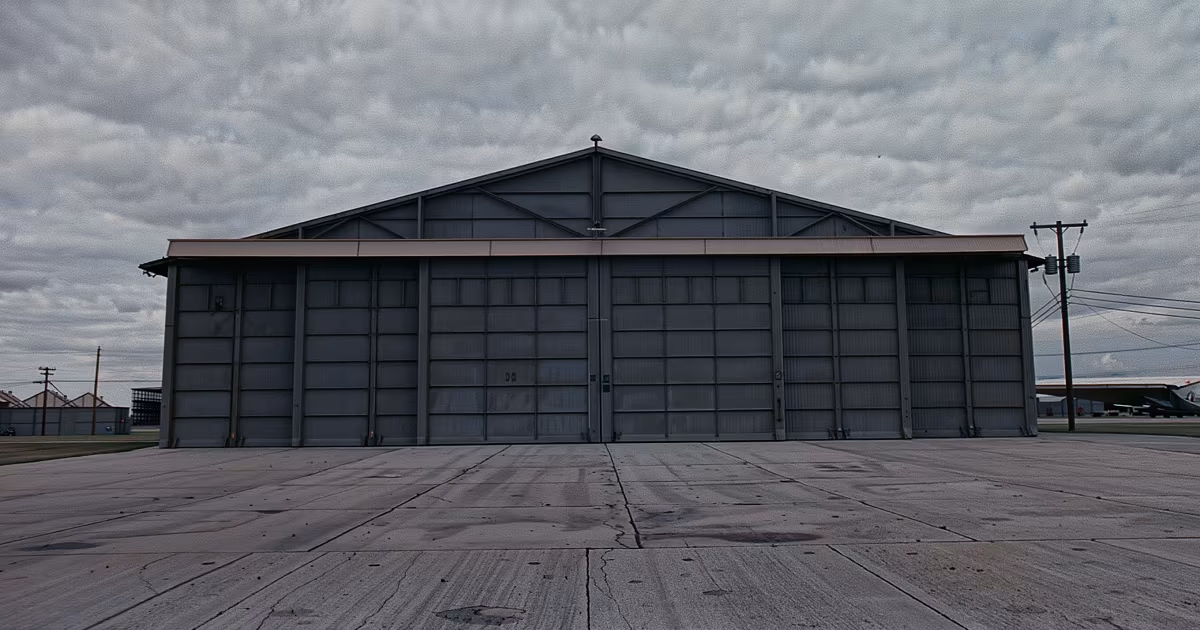
A large closed aircraft hangar under a cloudy sky.
Illustration, not a period photograph.

Archive / Conspiracy / BOT313-0303
CON-1974ConspiracyFOLKLORE
THE BUILDING AT WRIGHT-PATTERSON
Fig. 01 A large closed aircraft hangar under a cloudy sky. Illustration, not a period photograph.
Opening
"Hangar 18" is the name attached since the mid-1970s to a supposedly sealed, heavily guarded building at Wright-Patterson Air Force Base near Dayton, Ohio, said to hold recovered UFO wreckage, extraterrestrial bodies and reverse-engineered alien technology, in some retellings inside an inner chamber called "the Blue Room". The story predates the Roswell revival of the late 1970s and was later folded into it.
The name traces to one man, the science-fiction writer Robert Spencer Carr, in 1974. There is a real Building 18-A at Wright-Patterson, and in 1980 its longtime manager told a television crew on camera what its freezing cells were really used for. The gap between that checkable answer and the legend's long life is the real story.
Timeline
July 1947After the Roswell incident and its same-week weather-balloon retraction, claims later circulate that debris and bodies went not only to Fort Worth but on to Wright Field, Wright-Patterson's predecessor, in Ohio. They rest on later, secondhand pilot accounts, not any 1947 document.
1966John G. Fuller's book Incident at Exeter includes a single sentence about a rumored crashed-saucer tale with alien bodies in an Air Force morgue at Wright-Patterson. That passage inspired a late-1960s science-fiction novel, The Fortec Conspiracy, about an Air Force UFO cover-up.
January 1974Newspapers carry a story attributed to Carr that two flying saucers are stored in "Hangar 18" at Wright-Patterson.
11 October 1974In a live radio interview, Carr claims that alien bodies from the 1948 Aztec, New Mexico, crash story, itself a known hoax, are kept at Hangar 18. Press accounts that month describe the bodies in his telling as three to four feet tall, white-skinned, light-haired and blue-eyed: human-like, not the later "grey" image. The Air Force replies that there is no Hangar 18 on the base.
1978 and 1979Leonard Stringfield, a committed investigator of crash-retrieval stories, speaks on the subject at the July 1978 MUFON symposium in Dayton and follows with a series of status reports compiling anonymous testimony about bodies and debris studied at Wright-Patterson, including accounts of small, four-foot-tall beings. By September 1979 Carr's claims include a surgical nurse who witnessed an alien autopsy.
1980Charles Berlitz and William Moore's book The Roswell Incident sets much of the modern Roswell narrative and helps fuse older, separate crash-retrieval tales, Wright-Patterson storage among them, into the Roswell story.
1980The feature film Hangar 18, loosely based on Carr's stories, is released. Folklorist Thomas E. Bullard later called it "nascent Roswell mythology", and director James L. Conway described it as "a modern day dramatization of the Roswell incident".
1980, separatelyThe television series In Search Of... films at Building 18-A. The building's manager, in the post since 1942 and so present for the whole period in question, says its freezing cells were never used to store alien bodies; they were used to test aircraft parts in cold conditions.
Pilot testimony cited by proponents. Oliver Henderson, a former military pilot, reportedly told his wife he had flown a plane carrying debris and several small alien bodies from Roswell to Wright Field, and children of another pilot have offered similar family accounts. None of these is a document or formal testimony from someone who saw the remains.
1990Megadeth releases the song "Hangar 18" on Rust in Peace, a sign of how far the legend had moved into mainstream culture.
1994 and 1997In reports on Roswell, the Air Force says the 1947 debris came from Project Mogul, a classified surveillance balloon program, not a weather balloon as first stated. Its later attempt to explain the "bodies" with 1950s anthropomorphic test dummies from high-altitude parachute research is widely seen as weaker, because the dates do not match 1947.
Recent coverage. History.com and Higgypop, among others, note that the name "Hangar 18" appears in no 1947-era document and that no record of a Roswell-to-Wright Field transfer has surfaced despite decades of searching.
Key figures
Carr gave the legend its name and form. His story grew more elaborate over the years, from stored saucers in January 1974 to Aztec bodies in October and an autopsy nurse by 1979, a pattern common to tales built on secondhand telling.
Stringfield is the leading compiler. His late-1970s collection of crash-retrieval testimony gave the story its fullest written form, but it rests largely on anonymous sources.
The Building 18-A manager interviewed in 1980 is the most direct rebuttal on record: someone with continuous personal knowledge of the building since 1942, answering the core claim himself rather than through an institutional denial. I have not found his name in the sources that report the interview.
Berlitz and Moore did most to fuse Hangar 18 into the Roswell narrative, which has made the two stories hard to separate in popular retellings ever since.
Henderson and the other pilot-family sources form the testimonial layer: sincere-seeming but unverifiable, because they are relatives' memories of private remarks.
Physical and documentary trail
The record has a real building at Wright-Patterson designated 18-A, an on-camera statement from its long-serving manager addressing the alien-storage claim, the Air Force's 1974 denial that any Hangar 18 exists, newspaper coverage of Carr's claims as they developed, and the absence, noted by several later researchers, of the name "Hangar 18" in any surviving 1947-era record.
It lacks any formal document, chain-of-custody record or first-hand witness who testified on the record to seeing alien remains or wreckage inside the building. Every supporting account traces to family recollection, anonymous testimony gathered by researchers, or claims that grew in the retelling.
Things you might not know
- A novel got there first. When Carr went public in 1974, the Air Force pointed out how closely his tale matched The Fortec Conspiracy, a novel that had itself grown out of the one-sentence mention in Incident at Exeter.
- Barry Goldwater was dragged in. Carr said the senator had been refused access to a restricted area. Goldwater confirmed he had once asked for a tour and been turned down, but said he had never heard any rumors of alien bodies.
- "Professor Carr" had no degree. His son later wrote that his father "never went to college or got any kind of advanced degree", yet was called Professor Carr throughout the UFO literature.
- He also befriended an alligator. The son recalled his father telling strangers he had befriended a giant alligator in the Florida swamps and shared philosophical ideas with porpoises in the Gulf of Mexico.
- Carr started young. He sold his first story to Weird Tales at 15, and at 17 his novel The Rampant Age was a success that earned a movie contract.
- Star Trek locked Quark in it. In the Deep Space Nine episode "Little Green Men", the Ferengi crew travel back to 1947 and end up held in Hangar 18.
Competing explanations
A modern legend built from three things: the base's genuinely secretive reputation for classified aerospace and intelligence work, one popularizer's 1974 elaboration of a rumor faintly present since 1966, and a direct rebuttal from the person best placed to know how the building was used. This reading needs no cover-up beyond the base's well-documented secrecy about unrelated programs.
A genuine storage site for recovered extraterrestrial material, as Carr, Stringfield and the pilot-family accounts describe. This reading requires dismissing the manager's on-camera account as mistaken or a cover story, with no document or formal testimony ever surfacing to support that.
Narrative conflation: separate, individually weak claims, the Roswell transfer rumor, the unrelated 1948 Aztec hoax and generic Wright-Patterson secrecy, merged into one story that looks more substantial than its parts. Carr's October 1974 version, which put Aztec bodies in Hangar 18, shows the merging already under way before Berlitz and Moore.
Later life of the case
Hangar 18 became one of the most pervasive UFO legends because it fused with the far better-known Roswell story instead of staying a separate claim. It spawned a feature film, a famous metal song and decades of television speculation after the one direct rebuttal from someone who worked there. It is a useful example of how a vivid, well-named claim can outlast the most direct refutation available.
Finding
A real building at Wright-Patterson matches the general description in the legend, and its long-serving manager explained on camera in 1980 that its freezing cells were for cold-testing aircraft parts, not storing aliens. The Air Force said in 1974 that no Hangar 18 exists. Every account supporting the alternative traces to Carr's claims, which grew with each telling, to secondhand or anonymous testimony gathered later, and to a 1980 book that fused the story into Roswell.
What still will not resolve: any 1947-era document recording a Roswell-to-Wright Field transfer under any name, and any first-hand witness who testified on the record to seeing the claimed contents. Until either surfaces, Hangar 18 is a legend whose direct rebuttal is already on record, and the story's popularity has outrun it rather than overcome it.
Evidence signature
5/9 Solid
- Witnesses
- several people
- Instruments
- photo, film or physical traces
- Paper
- official records at the time
How well documented the case is, not whether it's true. A strong record can still have an ordinary answer, and a thin one can still be real.
You decide · HANGAR 18
What do you think happened?
One vote per case, anonymous. You'll see how other readers voted once you've voted.