DIE GLOCKE
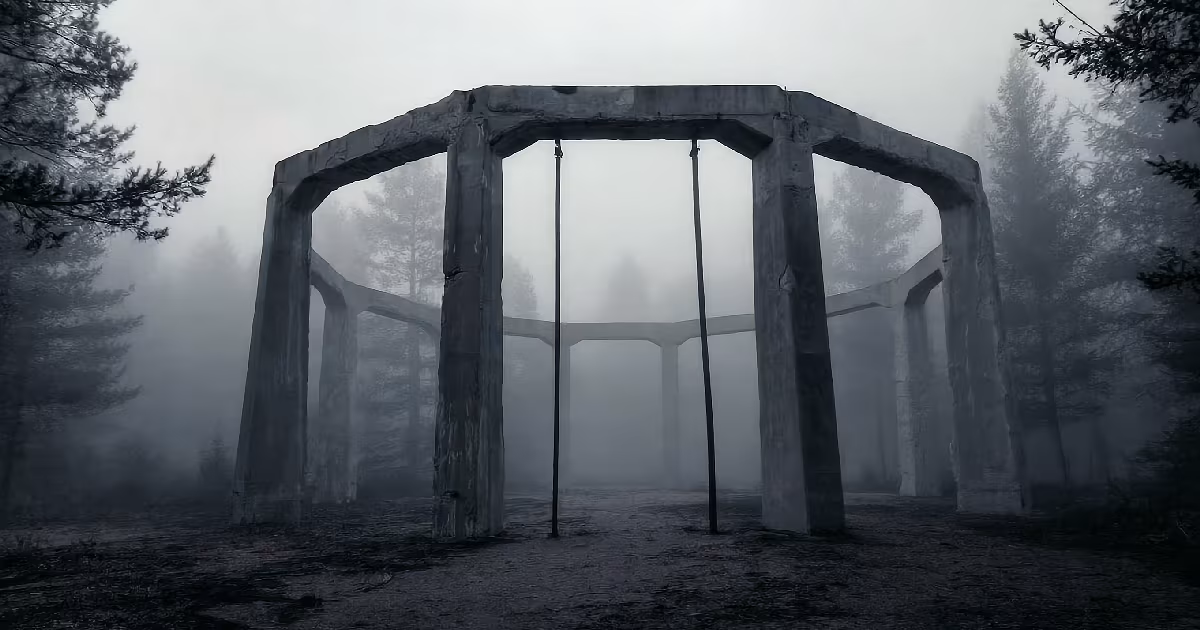
Concrete ring in trees. No machine and overcast.
Illustration, not a period photograph.
Opening
The file on Die Glocke has no 1945 paper trail. That is the first thing to say about it, and the thing most retellings skip. There is no wartime memo, no Allied technical intelligence report, no captured requisition form that names a device called "the Bell." The entire case rests on one man's account of documents he says he was shown once, in the early 1990s, and never showed anyone else.
That man is Igor Witkowski, a Polish military journalist. In 1997 he says a Polish intelligence contact let him read transcripts of a 1949 or 1950 Soviet-era interrogation of Jakob Sporrenberg, an SS police general who had commanded in occupied Poland. Witkowski took notes, the contact took the file back, and no version of it has surfaced since. Everything downstream — the bell shape, the purple liquid, the dead scientists, the antigravity claim — traces to that one unrepeatable reading.
The site is real. A concrete ring stands in the hills above Ludwikowice Kłodzkie, Poland, part of the wartime "Riese" tunnel complex the Germans dug into the mountains there. What was built in that ring, and what if anything ran inside it, is the whole argument.
Timeline
1943-44. The Organisation Todt and camp labor from the nearby Gross-Rosen subcamp system dig an extensive tunnel and bunker complex under the code name Riese ("Giant") in the Owl Mountains of Lower Silesia, then part of Germany. Documented purpose: unclear even to postwar Polish surveyors, who have found no completed installation matching any single stated use — command bunker, factory, and Hitler headquarters have all been proposed and none confirmed.
Wenceslas Mine, near the Riese site, gets a poured-concrete ring structure with pillars, later nicknamed "the Henge." Local wartime records describe an unusual power draw and a fenced, guarded footprint. That much is in the documentary record independent of Witkowski.
Early 1945. Soviet forces overrun Lower Silesia in the last months of the war. SS-Obergruppenführer Hans Kammler, the engineer-general running the V-2 program and several other black-budget projects, is in the region and then is not. Kammler's own movements after March 1945 are poorly documented; postwar Allied debriefs could not fix his location or fate with confidence.
1949-50 (claimed). Sporrenberg, captured and tried by Polish authorities for wartime atrocities, is interrogated. Witkowski says this is where a device called "the Bell," a special access program, and the execution of the technical staff who worked on it first appear on paper.
1997. Witkowski visits the Wenceslas site and the Henge ring in person and begins compiling his account.
2000. Witkowski publishes Prawda o Wunderwaffe ("The Truth About the Wonder Weapon") in Poland, the first public description of Die Glocke.
2001. British aerospace journalist Nick Cook, formerly of Jane's Defence Weekly, publishes The Hunt for Zero Point, which carries Witkowski's account to an English-language audience and adds Cook's own reporting and speculation, including a theory that Kammler traded the technology to the United States for his freedom.
Key figures
Witkowski is the sole originating witness. He is a real, working military historian with other, uncontested books on Polish and German hardware to his name — he is not a hoaxer by trade. But on this one claim he is also the only person who has ever seen the source document, and he has not produced it. Everything that follows him is secondhand from a source that is itself unverified.
Sporrenberg is the alleged origin of the story, filtered twice: once through a Soviet-era interrogation record Witkowski says he read, and again through Witkowski's own notes and memory of it. Sporrenberg was executed by Poland in 1952 for police-unit massacres in Belarus and occupied Poland. He left no known independent account of any bell.
Kammler is the project's alleged commander. He is the least disputed part of the story in one sense — he really did run compartmented weapons programs, really did have the rank and reach to command a black site, and really did vanish from the documentary record in the war's last weeks. Postwar rumors attached him to jet engines, the V-2, and eventually the Bell because he is a plausible blank space for any of them, not because a document names him.
Cook is the popularizer, not a second source. He is candid in his own book that he could not independently confirm Witkowski's account, and he has said in later interviews that his own best guess is that whatever was tested at Wenceslas belonged to Germany's isotope-separation and nuclear research effort, not an antigravity program. That walk-back gets far less circulation than the original claim.
Later writers — Joseph P. Farrell, Henry Stevens, and others — add detail with no new sourcing: a mercury-based rotating core code-named Xerum 525, a viewing mirror, plant and animal die-off near the ring, a scientist body count that varies by book. None of them cite a document Witkowski has not already cited, and several add claims Witkowski himself never made.
Physical and documentary trail
On the ground, the file gives you one hard object: the ring at Wenceslas Mine itself, still standing, photographed many times by researchers and tourists. It has pillars, niches, and a drainage channel to a shaft below. What it powered, if anything, is not written on the concrete.
There is a real, documented unusual electrical demand tied to wartime construction in that district, cited by several Polish local historians independent of the Bell story — consistent with heavy machinery, a large refrigeration or pumping load, or an electrolysis or centrifuge process, among other draws that era's industry used.
There is no captured German drawing of a device called "die Glocke." There is no Allied technical intelligence file on it from 1945, at a time when British and American teams were actively hunting and cataloguing every credible piece of advanced German hardware they could find, jet engines and guided weapons included. There is no surviving execution order for the alleged staff. There is no chain-of-custody trail for the interrogation transcript Witkowski describes — Polish state archives have not produced it on request from other researchers, and Witkowski's own account of how he saw it does not include a document reference number.
Cook's book description of the device — bell-shaped, roughly four meters high, two counter-rotating cylinders around a violet metallic liquid — is Witkowski's secondhand description as Cook understood it, not a specification sheet. No photograph, blueprint, or component of the device itself has ever been produced by anyone.
I was left with more questions than answers. But I did feel I now had a technical basis for believing that the Bell was real, even if I still had no proof of what it was for.
Competing explanations
Isotope separation or heavy-water research. Nazi Germany ran a real, compartmented nuclear program, and centrifuge and separation apparatus of the period could plausibly involve rotating cylinders, unusual shielding, and hazardous byproducts — a technical profile that overlaps with the secondhand Bell description without requiring anything exotic. Cook himself later favored a version of this reading. It accounts for secrecy, for a remote site, and for sourced deaths from radiation or chemical exposure, without requiring a new physics.
Torpedo or gyroscope test rig. Some researchers have proposed the ring housed conventional spin-stabilization or centrifuge testing tied to naval ordnance, a mundane but classified wartime program that would still explain guards, secrecy, and an odd power draw.
Ventilation, cooling, or pumping structure for the Riese tunnel complex. The simplest reading: the ring is infrastructure for the unfinished underground works around it, and its shape and power needs are architectural rather than experimental. This does not require a program named "the Bell" to have existed at all.
Antigravity or free-energy device. This is Witkowski's original framing as Cook popularized it, later inflated by Farrell, Stevens, and others into a fuller mythology involving time effects and off-world contact. For this reading to hold, a wartime German program has to have achieved and then completely lost a physics breakthrough that no fragment, patent, personnel record, or postwar debrief has ever confirmed — a large claim resting on one man's memory of one unproduced document.
Fabrication or honest misreading. It remains possible that Witkowski saw a real but mundane interrogation record and reconstructed a more dramatic device from fragments, or that no such transcript exists in the form he describes. This is not an accusation of bad faith; unverifiable secondhand testimony degrades the same way whether the witness is lying, mistaken, or accurate but unable to prove it.
Later life of the case
The story stayed largely within Polish military-history circles from 1997 to 2000. Cook's 2001 book, aimed at a much larger English-language market and mixing the Bell material with his separately reported (and separately disputed) work on classified American aerospace projects, is what made Die Glocke internationally known.
Farrell's books through the 2000s and Stevens's 2007 Hitler's Suppressed and Still-Secret Weapons added the details that now circulate as settled fact in most retellings — the Xerum 525 name, the viewing-mirror claim, specific death counts — none of them traceable to a document beyond Witkowski's original account, and some contradicting it outright.
The Bell has since become a stock prop in genre fiction — novels, a television series, and multiple video games use a version of it — which has looped back into the nonfiction discourse, where believers now sometimes cite the fictional treatments as if they carry independent corroboration. They do not; they are downstream of the same one unproduced transcript.
Polish heritage authorities maintain the Wenceslas ring and the Riese complex as a documented wartime industrial and forced-labor site. Their own materials do not endorse the Bell claims, and they have not reported finding equipment, waste, or contamination consistent with either an advanced propulsion experiment or a nuclear one at that specific ring.
Finding
A concrete ring was built at Wenceslas Mine under wartime secrecy, by forced labor, drawing power the surrounding district's own records call unusual. That much sits outside dispute. Everything else in the file — the name "die Glocke," the shape, the liquid, the deaths, the antigravity claim — descends from a single interrogation transcript that one journalist says he read once in the 1990s and that no institution has produced since.
What still will not resolve: the Sporrenberg transcript itself, or its absence. If it exists and can be located in a Polish or Russian archive, it either backs Witkowski's account or shows where it drifted from the source. Until that document surfaces, the proving joint is not the ring — the ring is real and unremarkable on its own — it is the one interrogation file nobody but Witkowski has ever seen.