WINDSCALE
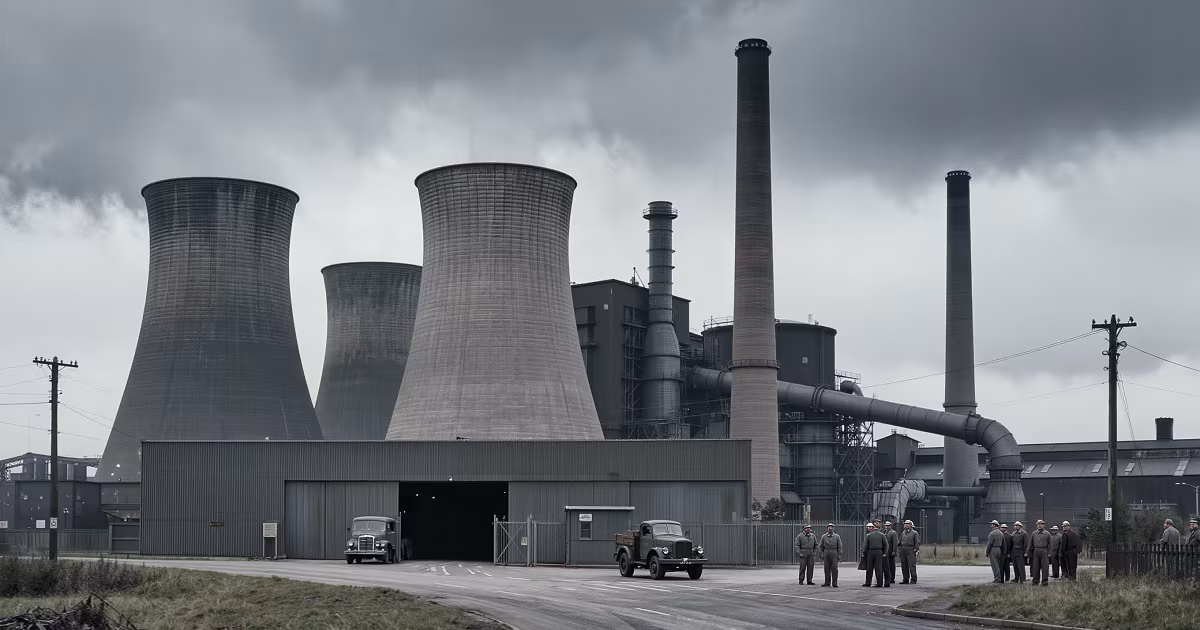
The Windscale cooling towers and chimney under a grey sky.
Illustration, not a period photograph.

Archive / Conspiracy / BOT313-0283
CON-195710 OCT 1957ConspiracyCOVER-UP CONFIRMED
THE REACTOR FIRE BRITAIN BURIED
Fig. 01 The Windscale cooling towers and chimney under a grey sky. Illustration, not a period photograph.
Opening
On 10 October 1957, the uranium core of Pile No. 1 at Windscale, on the Cumbrian coast of north-west England, was found to be on fire. The reactor existed to make plutonium for Britain's atomic bombs. For two days, radioactive material, mostly iodine-131, poured from its 400-foot chimney and drifted across Britain and Europe.
The fire was put out by flooding the reactor with water, a gamble that might have caused an explosion. Milk from farms across about 200 square miles was poured away for weeks. Then the government buried the full report for thirty years. It remains the worst nuclear accident in British history.
Timeline
1947 to 1951Britain builds the two Windscale piles in a hurry to make its own bomb, after the United States ended wartime nuclear cooperation with the McMahon Act of 1946. Late in construction, physicist John Cockcroft insists on adding filters to the tops of the chimneys. They are mocked as "Cockcroft's Folly".
7 to 8 October 1957Operators carry out a routine "Wigner release", heating the graphite core to release stored energy. Readings suggest it is not working, and they apply a second burst of heat.
10 OctoberRadiation alarms sound at the chimney top. Workers looking through an inspection hole see fuel channels glowing red. The core is on fire.
10 to 11 OctoberAttempts to push burning fuel out and to smother the fire with carbon dioxide fail. On the morning of the 11th, deputy general manager Tom Tuohy orders the core flooded with water, then shuts off the air, and personally climbs the reactor to watch the flames die. The fire is out by the next day.
12 October onwardsMilk from farms in a band about 200 square miles around the site is banned and poured away, because iodine-131 collects in milk and in children's thyroids. The ban lasts about a month.
Late October to November 1957Sir William Penney's inquiry reports within weeks. Prime Minister Harold Macmillan orders it held back, and in November only a shortened account is published, which leans on operator error and plays down the design flaws.
1981The site is renamed Sellafield.
1988Under the thirty-year rule, the full Penney report and Macmillan's cabinet papers are released, showing the decision to suppress it was political: he feared it would damage Britain's bid to renew nuclear cooperation with the United States.
Key figures
Tom Tuohy took the decision to use water, knowing the risk, and stayed at the reactor through the night. He lived to 90. John Cockcroft's mocked chimney filters are credited with trapping much of the radioactive dust that would otherwise have escaped. William Penney led the inquiry. Harold Macmillan decided what the public would be told.
Physical and documentary trail
The record is unusually complete, because it was eventually released: the Penney report, the cabinet papers, the milk restriction orders and decades of studies. What it does not settle is the exact human cost. The release has been estimated several times with different methods, and a 2007 study estimated around 240 extra cancer cases over the long term, many of them thyroid cancers. Other estimates are lower. Because cancer has many causes, the true number can never be counted precisely.
Things you might not know
- It is rated level 5. On the 7-point international scale for nuclear events, Windscale counts as an accident with wider consequences.
- Eleven tonnes of uranium were burning. At 01:30 on 11 October, about 11 tonnes of fuel were alight, and the fire burned for three days in all.
- The main release was iodine. An estimated 740 terabecquerels of iodine-131 escaped, plus a smaller but significant amount of polonium-210.
- The full report was hidden for 30 years. Harold Macmillan had it heavily censored for fear of harming nuclear ties with the United States. It came out in full in 1988.
- The man who put it out was never honoured. Tom Tuohy died in 2008, aged 90, without public recognition.
- The fuel is still there. The sealed reactor still holds about 15 tonnes of uranium, and final decommissioning is planned for 2037.
Competing explanations
An honest accident, politically managed. The fire came from a rushed design and a poorly understood procedure. The cover-up came afterwards and was about diplomacy. The released papers support this.
Worse than admitted. Some researchers argue the release and its health effects were understated for decades, beginning with the shortened report of 1957.
Smaller than its reputation. Others argue that the measured harm, while real, was modest, and that the fire's fame comes from being Britain's first and only serious reactor accident.
Later life of the case
Windscale shaped how later nuclear accidents were handled, from milk and food bans to iodine tablets for children. Pile No. 1 was sealed with damaged fuel still inside, and decommissioning work at Sellafield continues today. The name change in 1981 is widely seen as an attempt to leave the fire behind.
Finding
The fire, the milk bans and the cover-up are all confirmed. Britain's government knowingly held back the full story for thirty years to protect its relationship with the United States.
What still will not resolve: how many people it harmed. The estimates differ, and the cancers can't be traced one by one back to the cloud that left the chimney in October 1957.
Evidence signature
5/9 Solid
- Witnesses
- several people
- Instruments
- nothing on record
- Paper
- formal investigation, court or declassified file
How well documented the case is, not whether it's true. A strong record can still have an ordinary answer, and a thin one can still be real.
You decide · WINDSCALE
What do you think happened?
One vote per case, anonymous. You'll see how other readers voted once you've voted.