JONASTAL
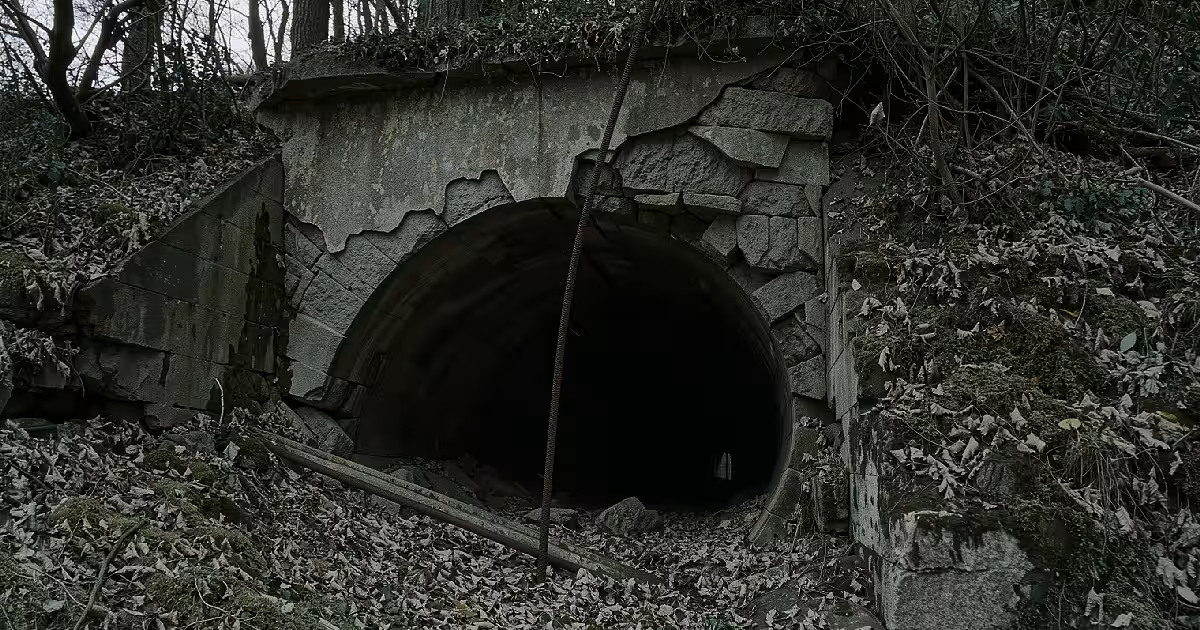
Thuringian hillside tunnel mouth. No machine.
Illustration, not a period photograph.
Opening
Between November 1944 and April 1945, thousands of prisoners from the Buchenwald concentration camp system, working under the same SS-Obergruppenführer Hans Kammler who oversaw Die Glocke and the V-2 program, dug twenty-five tunnels into a hillside above the Jonas Valley (Jonastal) in Thuringia, southeast of Gotha. The project never finished. Its purpose was never written down in any document that survives. The Soviets blasted most of the tunnel entrances shut after the war, and what the site was actually for remains formally unresolved seventy years later.
This case sits at the intersection of documented, unremarkable fact, forced-labor tunnel construction under a named commander was routine practice in the collapsing Reich, and one genuinely serious, still-contested historical claim: that somewhere near this valley, Nazi scientists detonated some form of nuclear device in March 1945.
Timeline
2 November 1944. SS Reichsführer Heinrich Himmler arrives by personal train with Kammler and Führer Headquarters chief Gustav Streve to personally inspect the site, a level of high-command attention that argues against the project being a minor one.
November 1944-April 1945. Forced laborers from Buchenwald, working under multiple code names for parts of the project, Siegfried, Jasmin, Olga, Burg, and the umbrella designation S III, dig the tunnel network into the hillside between Crawinkel and Arnstadt. The scale and secrecy of the operation matches other Kammler-run underground projects of the same period.
3 March 1945 (disputed). According to later testimony gathered by historian Rainer Karlsch, a device is detonated at the nearby Ohrdruf military training and concentration camp area, producing two large explosions or a single bright flash and rising column reported by witnesses, followed by nosebleeds, headaches, and nausea among people nearby in the following days. A witness later described burning heaps of hairless corpses with raw, red skin at the site the following day.
4 April 1945. American forces, the 4th Armored Division and the 89th Infantry Division, liberate Ohrdruf and its camp, the first Nazi concentration camp reached by the U.S. Army, and take control of the surrounding area including the Jonastal tunnels.
1945, following weeks. Allied ALSOS teams, the joint intelligence effort specifically tasked with assessing the German atomic program, investigate underground facilities and a nuclear reactor site at a school building in nearby Stadt-Ilm, under physicist Kurt Diebner's team, before the area is handed to Soviet forces.
Postwar. The Soviet Army classifies the site as restricted, blasts most tunnel entrances, and uses the area as a military training ground through the Cold War. Access to what Karlsch later identifies as the likely test site remains barred for decades, initially by Soviet restriction and later by unexploded ordnance.
Early 1960s. East German authorities interview local witnesses about the reported 1945 event, generating the testimony Karlsch draws on decades later.
2005. Karlsch publishes Hitlers Bombe, arguing from postwar witness testimony, Soviet military intelligence documents, and 2004-2005 soil samples showing above-background levels of cesium-137 and cobalt-60 that a crude fission or radiological device was tested near Ohrdruf on 3 March 1945, killing several hundred prisoners of war and camp inmates. He explicitly does not claim Germany was close to a full working atomic weapon.
Key figures
Kammler is the project's overall commander, the same figure whose own postwar fate remains unresolved and who connects this site to Die Glocke and the broader pattern of secretive, forced-labor underground programs under his authority in the war's final year.
Diebner, a physicist on the periphery of Germany's mainstream nuclear research effort led by Werner Heisenberg, is the scientist Karlsch identifies as leading whatever experimental work happened at Stadt-Ilm and, in his theory, Ohrdruf.
Karlsch is a professional economic historian, not a physicist, and built his case on three legs: postwar East German witness testimony, Soviet-era intelligence documents including a wartime message to Stalin describing two large explosions on the reported date, and his own commissioned 2004-2005 soil analysis. He has been consistent in stating he lacks direct documentary proof and hopes the book will spur further research rather than settle the question.
Gerald Holton, a Harvard physicist and historian of science, represents the strongest scientific pushback, noting that the physicists who actually led Germany's nuclear program, including Walther Gerlach, never mentioned a test blast or a working reactor even in the Farm Hall recordings, where Allied intelligence secretly recorded German scientists' private conversations after the war and where such a result would plausibly have come up.
Michael Schaaf, a German physicist, offered a measured middle assessment: that Karlsch had genuinely shown German uranium research went further than previously credited, while maintaining there was no German atom bomb in the full sense.
Physical and documentary trail
On the paper, this file has two separate tiers that should not be merged. One tier, the tunnel construction itself, forced labor, Kammler's command, the November 1944 Himmler inspection, is solidly documented and undisputed. The other tier, the alleged nuclear test, rests on witness testimony collected roughly seventeen years after the fact, Soviet intelligence reports that are themselves secondhand, and modern soil samples showing elevated but not conclusively dated radioactive isotopes.
The soil sample finding is the piece most often oversimplified in retelling: cesium-137 and cobalt-60 above natural background levels are consistent with a nuclear or radiological event, but both isotopes are also produced by decades of Cold War atmospheric nuclear testing worldwide and by the Chernobyl fallout that reached parts of Europe in 1986, meaning elevated readings at a Cold War Soviet training ground do not by themselves date to March 1945.
There is no German wartime document describing a test. There is no Allied wartime intelligence report confirming one, despite ALSOS teams actively investigating the German nuclear program in this exact region within weeks of the alleged event. Access to the specific ground zero Karlsch identifies has been blocked for decades, first by Soviet restriction and then by unexploded ordnance, meaning the most direct physical test, dated radiological analysis of an undisturbed site, has never been conducted.
Hitler's Bomb, a tactical nuclear weapon with a potential for destruction far below that of the two American atomic bombs, was tested successfully several times shortly before the end of the war.
Competing explanations
An unfinished wartime headquarters or communications facility. This is the most conservative reading of Jonastal itself: a last-resort relocation site for Hitler and senior staff, or a hardened communications bunker (the "Olga" and "Amt 10" designations point this direction), abandoned unfinished as the front collapsed. It requires no exotic weapons program at all and fits the tunnel network's incomplete state.
V-2 or long-range rocket production and testing. Given Kammler's simultaneous authority over the V-2 program, an underground production or testing facility tied to rocket work is plausible and does not depend on Karlsch's nuclear claim being true.
A genuine, small-scale nuclear or radiological test at nearby Ohrdruf. Karlsch's case is taken seriously enough to have prompted real scientific engagement rather than dismissal, but it remains unconfirmed by direct documentary or dated physical evidence, and the era's leading experts on the actual German nuclear program's capabilities argue the underlying physics and the silence of the program's own senior scientists both weigh against it.
A radiological accident or conventional explosive test misremembered and inflated. Given the seventeen-year gap before witness testimony was collected, and the general condition of a warzone in its final collapsing weeks, some researchers hold that a conventional explosion, possibly involving stored chemical or explosive material, could have generated symptoms and reports later reinterpreted through a nuclear lens once the postwar atomic age gave that framework cultural weight.
Later life of the case
Jonastal has become, separately from the Ohrdruf nuclear question, a recurring subject in Nazi-superweapon literature generally, sometimes labeled "S III" by enthusiasts drawing explicit parallels to Die Glocke's secrecy and Kammler's involvement; historians researching the site's actual wartime function treat this labeling as a later overlay rather than a period-accurate name.
Karlsch's book prompted formal scientific responses, including discussion at American Physical Society meetings, treating it as a serious if unresolved historical claim rather than fringe material, a notably different reception than Die Glocke received in the same general literature.
Finding
The tunnels themselves, and Kammler's command over their construction by forced labor, are established fact. Whether something detonated at nearby Ohrdruf in March 1945 that involved nuclear or radiological material remains a genuinely open historical question, argued in good faith by credentialed researchers on both sides, resting on secondhand witness testimony, intelligence reports, and soil data that does not by itself fix a date.
What still will not resolve: dated, uncontaminated radiological analysis of the actual site Karlsch identifies as ground zero, still inaccessible after decades of restriction and unexploded ordnance. Until that becomes possible, this stays one of the few Nazi-superweapon claims taken seriously by mainstream historians of science without being confirmed by them.