UTSURO-BUNE
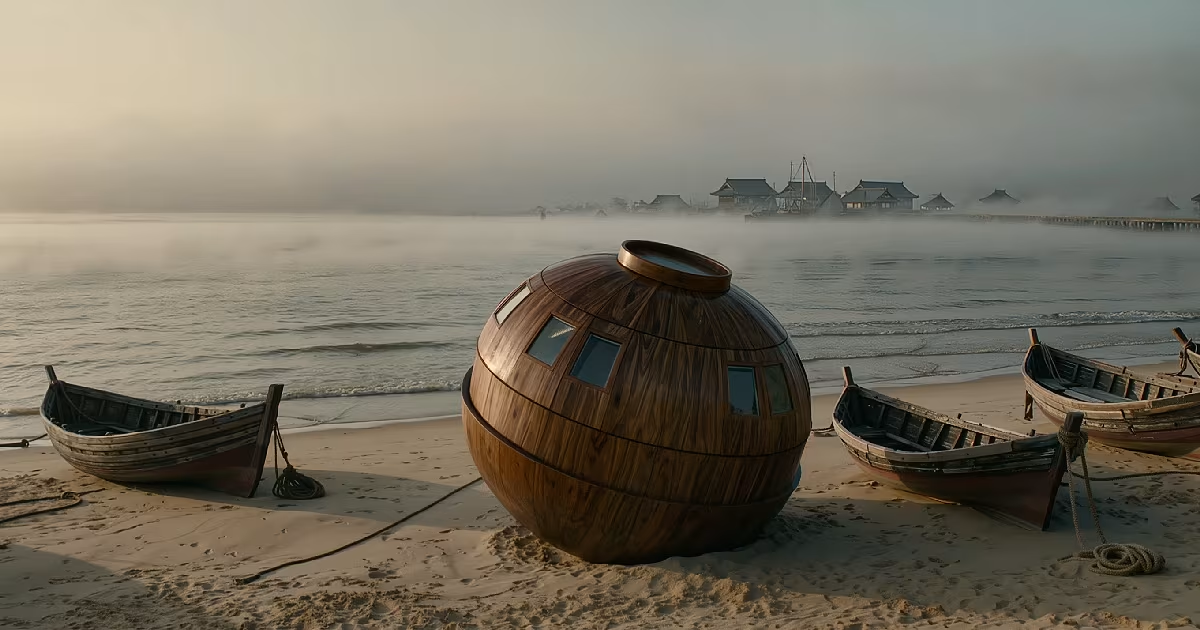
A round wooden vessel with small windows washed up on a beach at dawn.
Illustration, not a photograph.

Opening
In 1803, according to several Japanese manuscripts, fishermen on the coast of Hitachi Province, in what is now Ibaraki Prefecture north-east of Tokyo, saw a strange vessel drifting offshore and towed it in. It was round, about three metres high and five and a half wide, lacquered red above and plated with metal below, with windows of glass or crystal. Inside was a young woman with red hair and very pale skin, who spoke no language they knew, and who would let no one touch the box she held in her arms.
Unable to understand her, and afraid of what she might be, the fishermen put her back in her boat and pushed it out to sea. The story of the utsuro-bune, the "hollow ship", is often called Japan's first UFO case. Historians read it as something else: a folk tale, written down at a time when Japan was closed to the outside world and afraid of foreign ships.
Timeline
1698A similar story of a strange boat is recorded at Toyohashi, in a collection called Hirokata Zuihitsu.
22 February 1803The date given in the best-known account for the vessel's arrival at Harayadori beach in Hitachi Province. Another account gives 24 March 1803, at a place called Harato-no-hama.
About 1815The first written version, in Oushuku Zakki by Komai Norimura.
1825The novelist Kyokutei Bakin includes the most detailed version in Toen Shōsetsu, a collection of strange tales, with an illustration of the vessel and the woman.
1835 and 1844Two more versions appear, in Hyōryū Kishū, by an unknown author, and in Ume-no-chiri by Nagahashi Matajirō.
1997Kazuo Tanaka, a professor at the University of Electro-Communications in Tokyo, studies the original texts and concludes the tale is a literary blend of folklore and imagination. He finds that the places named do not appear in official records or old maps.
2010 and 2012Two rare printed sheets of the story are found.
2014Tanaka finds a manuscript naming the place as "Hitachihara Sharihama", which matches a real beach, Sharihama, at Hasaki in Kamisu, Ibaraki.
Key figures
The woman of the hollow ship is unnamed in every version. The fishermen are unnamed. Kyokutei Bakin, one of the most famous writers of the Edo period, gave the story its lasting form. Kazuo Tanaka is the scholar who has done most to trace it, and who considers comparisons with UFOs far-fetched.
Physical and documentary trail
The record: four main manuscripts written between about 1815 and 1844, with illustrations, plus later printed sheets and the 2014 manuscript naming a real beach. The accounts agree on the round vessel, the windows, the woman and her box, and differ on the date, the place, the colour of the boat and whether she was sent back to sea or stayed ashore and grew old. Several show the same strange writing said to have been found inside. There is no official record of the event, no physical object, and no contemporary report from 1803 itself.
The descriptions grow more detailed from one version to the next. In Bakin's, the upper part of the boat is red-lacquered rosewood and the lower part is covered in metal plates; in Ume-no-chiri the boat is painted black and the plates are brass or iron of fine Western make. The windows are barred and sealed with tree resin, several in one account and four in another. The woman has red hair and eyebrows, lengthened with white extensions of what may have been fur or powdered cloth, a style no known source describes, and long, smooth clothes of a fabric nobody recognised. The surviving manuscripts are held in Japanese libraries, including that of Tenri University in Nara Prefecture.
Things you might not know
- The boat had supplies. The accounts list bedding, a water bottle, cake and kneaded meat inside.
- The box was never opened. She held a box about 60 centimetres long and let no one touch it.
- The writing inside is a puzzle. Symbols drawn from the vessel appear in several manuscripts; one is said to look like a symbol on South Korea's flag.
- Round boats weren't strange in Japan. The folklorist Yanagita Kunio noted that round, tub-like boats were common in Japanese tradition.
- Bakin thought she was a foreigner. He suggested she might be Russian, British or American, based on a book about Russian customs.
- There may be a real beach. Sharihama, in Kamisu, matches the place named in the manuscript Tanaka found in 2014.
- The villagers had a darker theory. One account has an elder suggest she was a foreign princess exiled for an affair, and that the box held the head of her lover, who had been killed.
- The symbols may be alchemy. The researcher Hideki Satō compared the strange characters to European alchemical signs, which turn up in at least one Edo-period document from scholars of Dutch learning.
Competing explanations
A folk tale of the closed country. In 1803 Japan was largely closed to foreigners, and foreign ships were appearing more often off its coasts. Tanaka and Yanagita read the story as a familiar folklore pattern (a mysterious woman arriving in a sealed boat) shaped by that fear. Other Japanese legends tell of girls found in drifting boats, some of them credited with bringing silk to Japan. Only the Dutch were allowed to trade in 1803, from the tiny island of Dejima at Nagasaki, and red hair marked a figure as foreign, the "red-haired barbarians" of the time. Yanagita argued that the metal plates and glass windows were later additions, put in to answer anyone who doubted a wooden boat could survive the open sea.
A real foreign shipwreck. A European woman, cast adrift or shipwrecked, washing up in a small boat. Tanaka thought it possible that something real lay behind the story; its details, from the windows to the writing, have grown in the retelling.
An encounter with something from elsewhere. The modern ufological reading, which sees the round, windowed craft as a flying saucer and the woman as a visitor. Nothing in the accounts says the vessel flew, and it arrives by sea.
Later life of the case
The hollow ship has become a favourite of UFO books and Japanese pop culture. In 2017 one of the manuscripts was shown at the Mori Art Museum in Tokyo in an exhibition on the universe and art, and in 2023 a museum in Mito, Ibaraki, held an exhibition devoted to the story. For another tale of mysterious strangers who spoke an unknown language, see the Green Children, whose story has the same mixture of record and folklore.
Finding
The utsuro-bune is a story, not a sighting: it survives only in manuscripts written years after the date it gives, by authors collecting strange tales, and it fits a pattern found elsewhere in Japanese folklore. A shipwrecked foreigner could lie behind it, but nothing in the record shows a craft that came from anywhere but the sea.
What still will not resolve: whether anything washed up in Hitachi in 1803 at all, since no record from the time itself has been found.
Evidence signature
2/9 Thin
- Witnesses
- one person, or a tradition
- Instruments
- nothing on record
- Paper
- press and later accounts
How well documented the case is, not whether it's true. A strong record can still have an ordinary answer, and a thin one can still be real.
You decide · UTSURO-BUNE
What do you think happened?
One vote per case, anonymous. You'll see how other readers voted once you've voted.