BALTIC SEA ANOMALY
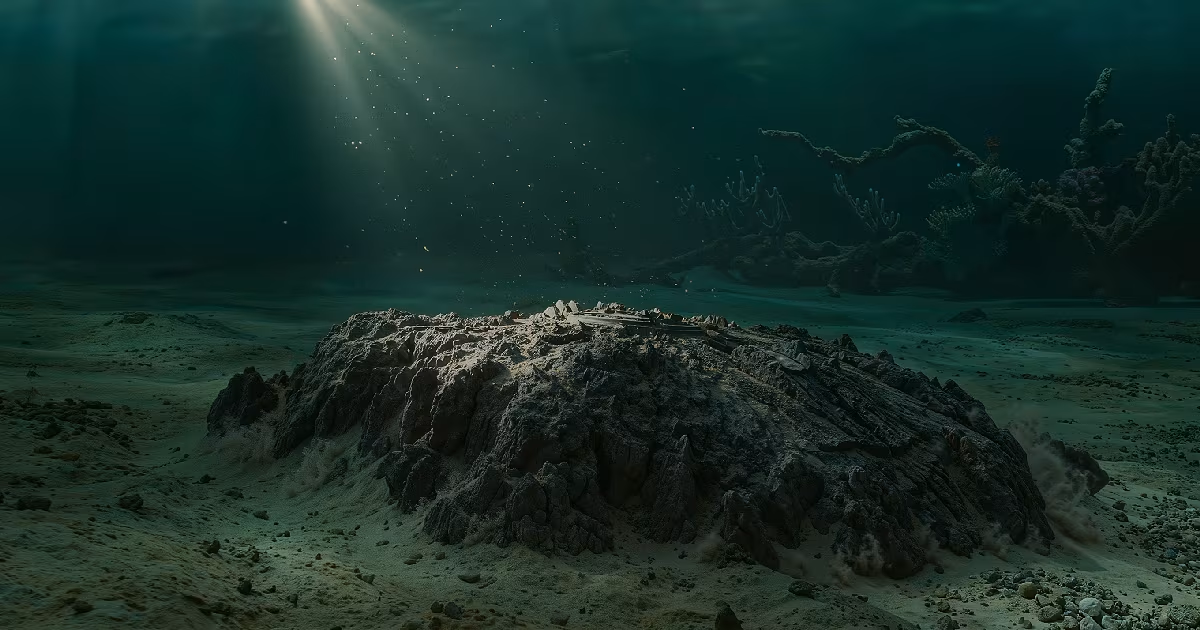
A dark rocky mound on a murky seabed under shafts of light.
Illustration, not a photograph.

Opening
In June 2011 a Swedish team of treasure hunters called Ocean X, led by Peter Lindberg and Dennis Åsberg, were searching the floor of the northern Baltic Sea, in the Gulf of Bothnia between Sweden and Finland, for shipwrecks with valuable cargo. Their side-scan sonar picked up something they had not expected: a round object about 60 metres across, with a long trail behind it and what looked like straight edges.
The image went round the world. People compared it to the Millennium Falcon from Star Wars, and theories ranged from a crashed spacecraft to a sunken Nazi installation. Divers went down. The rock they brought up was rock. Most geologists think the "anomaly" is a natural formation left by the last Ice Age, made strange by a poor sonar picture.
Timeline
June 2011Ocean X records the sonar image during a wreck search in the Gulf of Bothnia. The team describes a circular object about 60 metres in diameter with what may be man-made features.
Summer 2011The image is published and goes viral. Ocean X says it will go back.
June 2012The team returns for more detailed sonar scans and dives. A June 2012 story in the British Daily Mail spreads the most dramatic theories. The team also reports that its electronics, including a satellite phone, stop working when the boat is directly above the object and start again about 200 metres away. The claim comes from the diver Stefan Hogerborn and has never been independently tested.
2012Samples brought up from the site are examined. Volker Brüchert, an associate professor of geology at Stockholm University, finds mostly granite, gneiss and sandstone, the ordinary rocks of the region, and says they were likely carried there by glaciers. One loose basaltic rock is out of place on that seabed, he notes, but not unusual for the area. The geologists Fredrik Klingberg and Martin Jakobsson find that the chemistry resembles the nodules that form on the seabed, and that the iron minerals limonite and goethite in the samples can form naturally. Another claim, attributed to a geologist named Steve Weiner, that the samples contained metals nature could not produce, has not been backed by any published analysis.
LaterOcean X announces plans to take paying tourists down to the site by submarine. Documentaries follow.
2018A Swedish documentary, The Mystery Beneath, revisits the find.
2019Lindberg talks of a new expedition linked to a television production.
Key figures
Peter Lindberg and Dennis Åsberg are the treasure hunters who found it and promoted it. Volker Brüchert, Fredrik Klingberg and Martin Jakobsson are the geologists who looked at the samples. Hanumant Singh of the Woods Hole Oceanographic Institution and Charles Paull of the Monterey Bay Aquarium Research Institute are the sonar and seabed specialists who explained why the image looks the way it does. Jonathan Hill of Arizona State University's Mars Space Flight Facility, who studies planetary images, questioned the team's motives, pointing to the plan to take wealthy tourists to the site, and noted that breaking off a piece for testing would have been simple. Göran Ekberg, a marine archaeologist at the Maritime Museum in Stockholm, said a natural geological formation could not be ruled out.
Physical and documentary trail
The record: the original 2011 side-scan sonar image, the 2012 follow-up scans and dive footage, and the rock samples examined in Stockholm. The geologists had only samples from the seabed near the object, not from inside it, and the team has not released its full data for independent analysis. Hanumant Singh said distortions in the image made it nearly useless for identifying a seabed formation, and blamed a cheap, poorly set-up sonar.
Things you might not know
- It was found by treasure hunters. Ocean X was searching for shipwrecks with valuable cargo, not for anything strange.
- Sonar is not a photograph. Side-scan sonar builds a picture from echoes as the instrument is towed. Speed, angle and calibration can stretch and distort shapes.
- The rocks were ordinary. Granite, gneiss and sandstone are the everyday bedrock of the Scandinavian shield.
- One expert called it fun. Charles Paull of MBARI called the story "curious and fun, but much ado about nothing".
- The likeliest shape is a drumlin. The Finnish geomorphologist Jarmo Korteniemi thought it most likely a drumlin, a smooth mound shaped by moving ice. Seabed maps show its "runway" lies among similar mounds in the Bothnian Sea.
- There are no volcanoes to explain it. Korteniemi also ruled out hydrothermal vents: the bedrock there has had no active volcanism for more than 500 million years.
- The spaceship outline may have been drawn on. An MSNBC report suggested the crisp saucer edges in widely shared versions were added by tabloids, perhaps to look like the Millennium Falcon.
- The phones-dying story is the team's own. The claim that electronics failed above the object came from the Ocean X divers and has never been measured by anyone else.
Competing explanations
A glacial formation. The view of the geologists who studied the samples: a mound or outcrop shaped and left by the ice sheet that covered the region until about 10,000 years ago, made stranger by the sonar.
A sonar artefact. Singh's view: a poorly calibrated instrument turned an ordinary feature into an extraordinary picture. Charles Paull added other ordinary candidates: a rock outcrop, sediment dumped by a fishing trawler, or even a school of fish.
Something made. The view of Ocean X and many online: a crashed craft, an ancient structure or a wartime installation. The divers' footage and the samples show nothing manufactured, and no part of an object has ever been recovered.
Later life of the case
The anomaly lives on in documentaries and on lists of underwater mysteries, often with the original sonar image and without the geology. For another sonar sound that turned out to be the planet itself, see the Bloop.
Finding
A treasure-hunting team found an unusual shape on the floor of the Baltic in 2011 and made it famous. The rocks from the site are ordinary, the experts who looked at the image blame the sonar, and the best explanation is a glacial formation. The team that found it still says it is something more.
What still will not resolve: exactly what the object is made of inside, since no one has drilled into it and Ocean X's full sonar data has not been released.
Evidence signature
4/9 Solid
- Witnesses
- one person, or a tradition
- Instruments
- radar or measured data
- Paper
- press and later accounts
How well documented the case is, not whether it's true. A strong record can still have an ordinary answer, and a thin one can still be real.
You decide · BALTIC SEA ANOMALY
What do you think happened?
One vote per case, anonymous. You'll see how other readers voted once you've voted.