NUREMBERG 1561
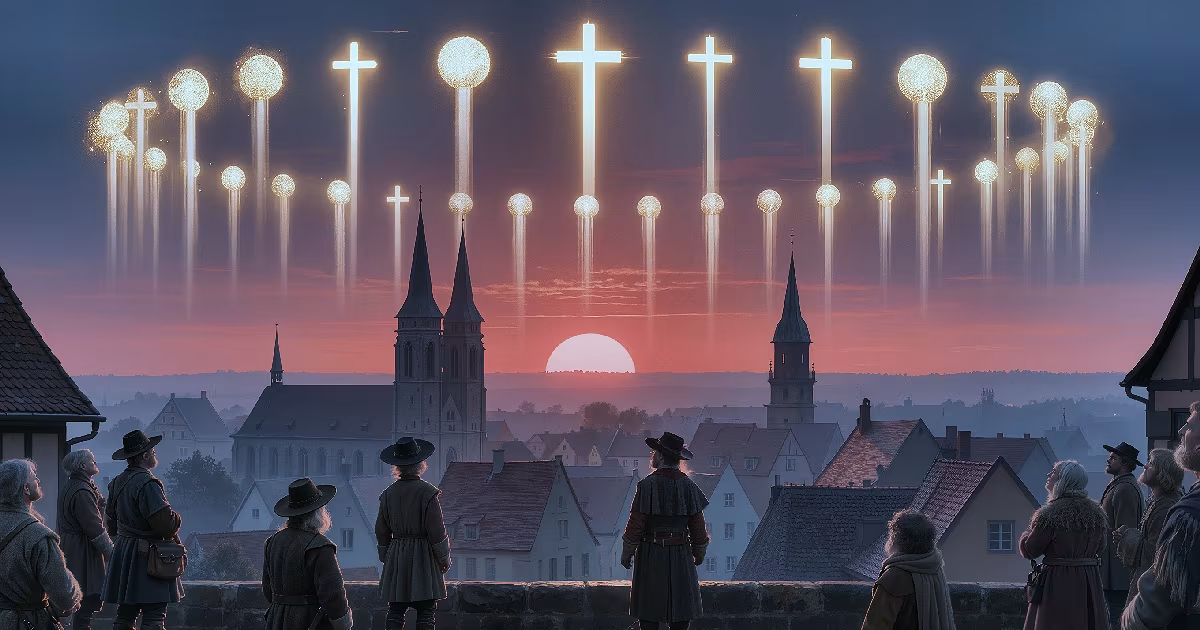
Old Nuremberg rooftops at dawn. Pale sky, bright sun.
Illustration, not a period photograph.
Opening
At dawn on 14 April 1561, according to a broadsheet printed in Nuremberg, the city's people saw the sky fill with strange objects: red, blue, and black spheres, crosses, and long tubes with more spheres inside, which seemed to fight each other for about an hour before falling to earth in smoke. A large black spear-shaped object appeared too. The broadsheet's woodcut, by Hans Glaser, is now one of the most shared "ancient UFO" images on the internet. It was published as a warning from God, in a genre that turned sky phenomena into sermons.
Timeline
14 April 1561, dawn. The event described in the broadsheet.
1561. Hans Glaser, a Nuremberg printer, publishes the broadsheet with its woodcut and text. The text calls on readers to repent.
7 August 1566. A similar broadsheet from Basel, by Samuel Coccius, describes large black spheres in the sky at sunrise.
20th century onward. The images are reprinted in UFO books as evidence of an aerial battle between spacecraft.
Key figures
Hans Glaser printed and sold the Nuremberg broadsheet. Printed sheets like this were popular news and moral warnings in 16th-century Germany.
Samuel Coccius described the Basel event of 1566.
Physical and documentary trail
On the paper: the Nuremberg broadsheet, which survives in the Zurich Central Library's Wickiana collection, and the Basel broadsheet. There's no independent account of the Nuremberg event.
Competing explanations
A sun halo display. At sunrise, ice crystals in the air can produce parhelia (mock suns), arcs, and pillars: bright spots, crosses, and bands of light around the sun. A strong display, described by people with no scientific framework and drawn by an artist working from reports, fits the spheres, crosses, and tubes.
A religious warning with dramatic art. The broadsheet's purpose was moral, and the woodcut is a stylised illustration, not a record.
An aerial battle between craft. This is the modern UFO reading. It takes a 16th-century woodcut literally.
Later life of the case
The Nuremberg woodcut is constantly shared online as evidence of ancient alien encounters, usually without the broadsheet's text or context.
Finding
A real 1561 broadsheet about a real sky event, most likely a spectacular halo display at sunrise, turned into a sermon and then, four centuries later, into a UFO battle. The woodcut is art, not a photograph.
What still will not resolve: exactly what Nuremberg saw that morning. No second account survives.