ROSENHEIM
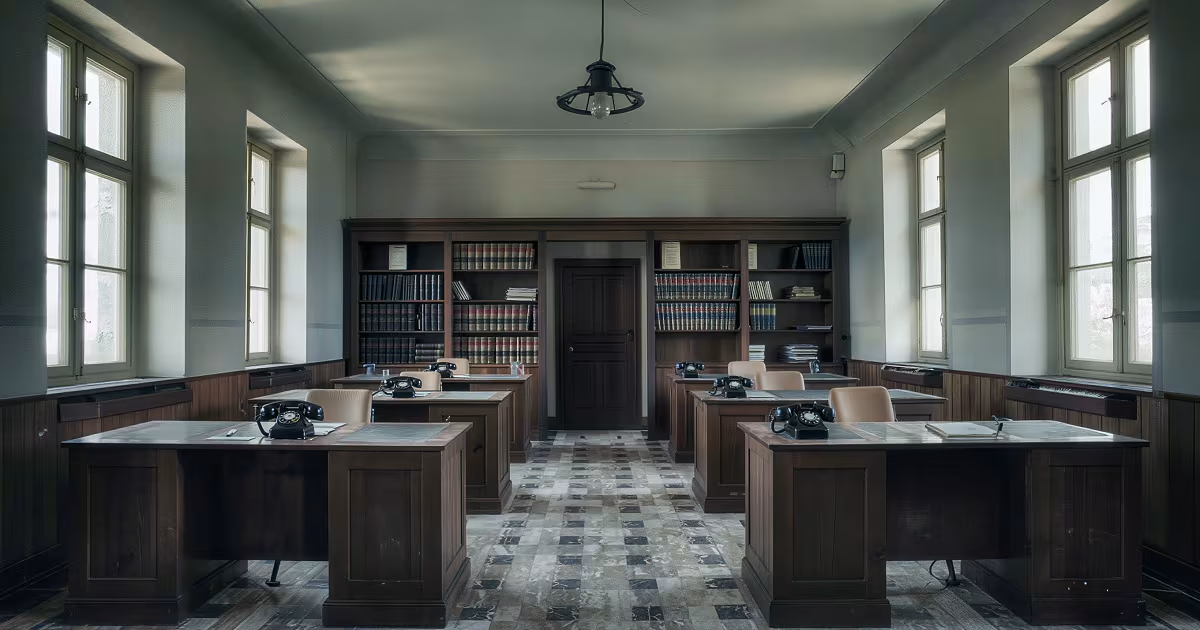
1960s German law office. Hanging lamp and rotary phones.
Illustration, not a period photograph.
Opening
In the autumn of 1967 the law office of Sigmund Adam in Rosenheim, Bavaria, began to misbehave. Lamps swung. Bulbs burst. Drawers opened. Copier fluid ran. Pictures turned on their hooks. The telephones were worse. Deutsche Post logged hundreds of calls to the speaking clock, number 0119, including forty-six in fifteen minutes, faster than a 1967 dial could honestly manage, and this after the handsets had been disabled and Adam held the only key.
Siemens spent weeks on the lines and found no fault. Stadtwerke put a voltage recorder on the supply. On 24 November, a Fohn day, Adam said it cracked about a hundred times. Police Kommissars Seitz and Wendl took a log. Physicists Friedbert Karger and Gerhard Zicha from the Max Planck circle looked. Hans Bender of the Freiburg chair arrived and tied the events to Annemarie Schaberl, nineteen, a secretary whose personal life had recently broken. Lamps, he said, moved when she walked under them. When she left the firm the office quieted.
The spine of the file is a law office and a speaking-clock tape. Rosenheim is instruments in a room. It is not a ghost in a Bavarian attic.
Timeline
Autumn 1967. First swings and bursts in Adam's office. Telephones start their private war with 0119.
Siemens and the Post work the lines. No fault they will sign. Voltage recorder on the supply. 24 November the recorder writes a rough day.
Police log. Max Planck visitors. Bender names Annemarie. She leaves. The office, in the telling, goes quiet.
Sceptics later argue fraud, wiring, and Bender's omissions. The speaking-clock count remains the part a wiring story has to stretch for. Later poltergeist textbooks start here. That rank is later life.
Adam's office was a working law shop, not a seance room. That is why Siemens and the Post matter. They had a commercial reason to find a fault and did not sign one. The speaking-clock bursts after the handsets were disabled are the part a joke at the switchboard has to stretch for.
Bender arriving with Annemarie already in frame is later method, not the first burst bulb. The quiet after she left is real in the telling. It is also the sentence sceptics use. Keep both. Keep the 24 November recorder day as an instrument day, not as folklore.
Key figures
Sigmund Adam owns the office and the key after the handsets were disabled.
Annemarie Schaberl is the secretary Bender tied to the lamps. She is nineteen and recently hurt. She is not a lecturer.
Deutsche Post and Siemens own the weeks of "no fault" on a line that still called 0119.
Bender, Karger, Zicha, Seitz and Wendl own the official looking.
Physical and documentary trail
On the paper, autumn 1967 gives you four hard objects and no spirit.
One: office events logged by staff and police: lamps, bulbs, drawers, copier.
Two: Post records of speaking-clock calls, including a burst faster than a honest 1967 dial.
Three: Siemens and Stadtwerke instrument work that found no ordinary fault.
Four: Bender's tie to Annemarie and the quiet after she left. Deutsche Post and police logs of the Adam office, Rosenheim, autumn 1967, are the originating tray.
There is no film of a lamp moving under her step that a lab still holds. There is no confession. There is no wiring close the Post would sign at the time.
A Post log and a voltage recorder are stay-behinds a kitchen ghost does not usually own. Fraud still has to explain locked keys and a count faster than a 1967 dial. Wiring still has to explain why the shop went quiet when one secretary left.
Forty-six calls to the speaking clock in fifteen minutes.
Competing explanations
A poltergeist tied to a secretary. This is Bender's reading. It has a quiet after she left. It has no filmed step.
Fraud at the board and at the lamps. Possible. Has to carry Siemens and a locked-key telephone count.
Wiring and a Fohn storm. The mundane door. Has to carry forty-six speaking-clock calls with the handsets dead.
Hybrid caution. An office misbehaved on instruments. A girl left and it quieted. Morning had no ghost in the files.
Later life of the case
Parapsychology chapters and fraud essays. I keep those on the later-life shelf. The Post tape stays first.
Finding
Sigmund Adam's Rosenheim office spent autumn 1967 bursting bulbs and ringing the speaking clock faster than a dial should, and the Post and Siemens could not find a fault they would sign. Believe the instruments. A law office does not invent forty-six calls for a professor.
What still will not resolve: a film of a lamp moving under Annemarie's step, or a wiring close the 1967 Post would have signed. Either one would pin the room. The proving object is still that telephone count, held by the tape, not by a later theory.