FATIMA 1917
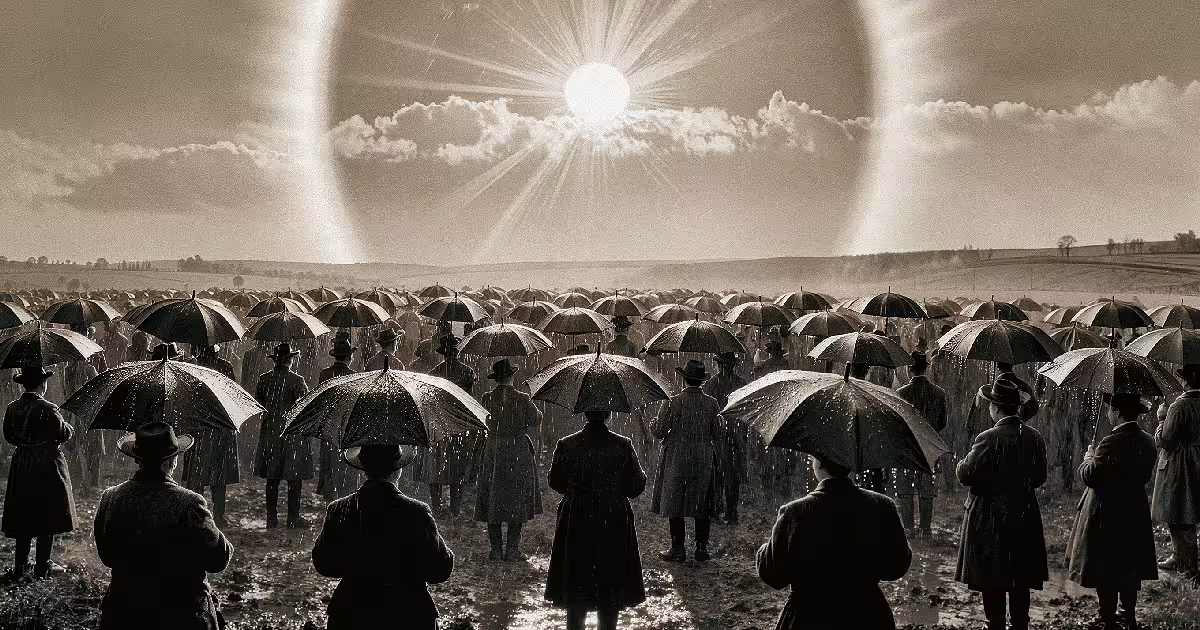
A crowd with umbrellas stares up at a blazing sun over a muddy field.
Illustration, not a photograph.
Opening
On 13 October 1917, a crowd estimated at anywhere from 30,000 to 70,000 people stood in a rain-soaked field called the Cova da Iria, near the village of Fátima in central Portugal. They had come because three shepherd children said a lady from heaven had promised a miracle that day. Around noon the rain stopped, the clouds parted, and thousands of witnesses said the sun began to spin, change colour and plunge towards the earth before returning to its place. Many said their soaked clothes were suddenly dry. The Catholic Church declared it worthy of belief. UFO researchers have argued about it ever since.
Timeline
13 May 1917. Lúcia dos Santos, aged 10, and her cousins Francisco and Jacinta Marto, aged 9 and 7, are grazing sheep when they say a brilliant lady appears above a small holm oak tree. She asks them to return on the 13th of each month for six months.
June and July. The crowds grow. In July the children say they are shown three secrets.
13 August. The local administrator, Artur Santos, takes the children into custody to stop them going to the field and threatens them, including with boiling oil, to make them reveal the secrets. They refuse. They report the apparition on 19 August instead.
September. The children say the lady has promised a miracle in October "so that all may believe".
13 October 1917. The "Miracle of the Sun". Newspapers across Portugal, including the anticlerical Lisbon daily O Século, report what the crowd saw.
1919 and 1920. Francisco and Jacinta die in the great influenza pandemic.
1930. The Bishop of Leiria declares the apparitions worthy of belief.
1941. Lúcia, by now a nun, writes down the first two secrets: a vision of hell, and a call for the consecration of Russia.
2000. The Vatican publishes the third secret, a vision of a "bishop dressed in white" shot down on a hill, which it links to the 1981 attempt on Pope John Paul II's life.
13 May 2017. Pope Francis canonises Francisco and Jacinta at Fátima, one hundred years to the day after the first apparition.
Key figures
Lúcia dos Santos was the eldest and the only one who spoke with the lady. She became a Carmelite nun and lived until 2005, dying at the age of 97, and wrote the main accounts of what happened. Francisco said he could see the lady but not hear her. Jacinta could see and hear her but did not speak.
Avelino de Almeida was the editor of O Século, a newspaper hostile to the Church. He came expecting to report a flop. His account of the crowd watching the sun "dance" helped make the event famous.
On the paper
What makes Fátima unusual is the scale of the witness record and its date: the event was predicted months in advance, tens of thousands came to see it, and journalists, including sceptical ones, wrote it up within days. Witness descriptions collected afterwards broadly agree on a silver or opaque disc that could be looked at without pain, that rotated, threw off coloured light and moved in a zigzag before seeming to fall towards the crowd. Some witnesses several kilometres away described the same thing.
There is also no record of anything happening to the sun itself: no observatory anywhere reported anything unusual that day, and not everyone in the crowd saw the same thing. Photographs from the day show the crowd looking up, but none shows the sun doing anything strange.
Things you might not know
- They were children threatened with boiling oil. The administrator who held them in August told them one by one that the others had been boiled alive, to break their silence. None of them talked.
- The newspaper was against them. O Século's report, which helped convince the country, came from an anticlerical paper that had mocked the apparitions beforehand.
- The bullet is in the crown. One of the bullets fired at Pope John Paul II in 1981 was later set into the crown of the statue of Our Lady of Fátima. The attack happened on 13 May, the anniversary of the first apparition.
- The youngest saints who weren't martyrs. Francisco and Jacinta, canonised in 2017, are the youngest people the Catholic Church has made saints who did not die as martyrs.
- Some people said things fell from the sky. Some accounts from the apparitions describe white petals or flakes drifting down and vanishing before they touched the ground, much like the "angel hair" later reported at UFO sightings.
- The UFO angle has a book. In Heavenly Lights (2005), Portuguese researchers Joaquim Fernandes and Fina d'Armada went back to the original witness records and argued that many details match modern UFO reports more closely than traditional visions of Mary.
Competing explanations
A miracle. The Church's position: a sign from God, foretold in advance, witnessed by tens of thousands.
An effect of the eye and the weather. Staring at a bright sun through thinning cloud can make it appear to spin, change colour and move, as the eye tires. Atmospheric effects such as sun dogs could add to it. Expectation in a huge, emotional crowd would shape what people reported.
An aerial phenomenon. Jacques Vallée and other researchers argue that the descriptions, a disc you could look at, colours, a falling motion, heat that dried clothes, read like a close encounter interpreted through the only language the witnesses had, which was religious.
Later life of the case
Fátima is now one of the largest Catholic shrines in the world, drawing millions of pilgrims a year. In UFO research it sits alongside Ezekiel's wheel and the 1561 Nuremberg sky battle as one of the great historic cases where the line between a vision and a sighting is impossible to draw.
Finding
Something happened at Fátima that tens of thousands of people saw and described in similar terms, after it had been predicted months ahead. The sun itself did not move, so whatever was seen was local: in the sky over the Cova da Iria, or in the eyes and expectations of the crowd.
What still will not resolve: how three children knew to name the day and the hour, months in advance, of an event that a crowd of tens of thousands then watched happen.