KYSHTYM
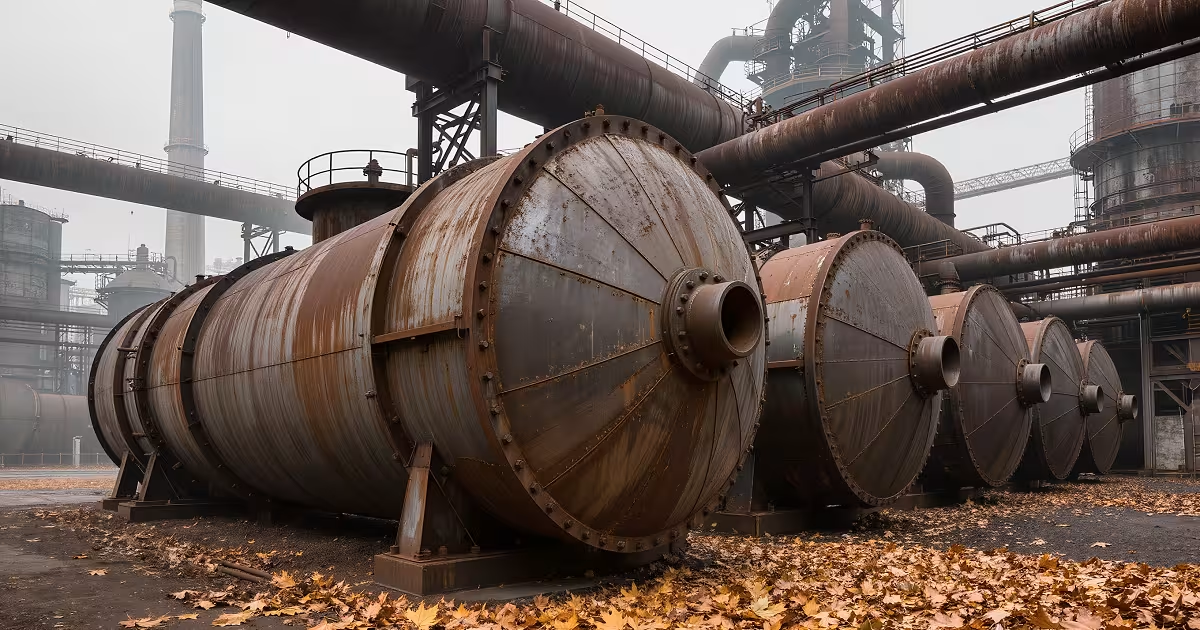
Rusting storage tanks and pipework at the Mayak nuclear plant.
Illustration, not a period photograph.

Archive / Conspiracy / BOT313-0274
CON-195729 SEP 1957ConspiracyADMITTED
MAYAK WASTE CLOUD AND EAST URALS TRACE
Fig. 01 Rusting storage tanks and pipework at the Mayak nuclear plant. Illustration, not a period photograph.
Opening
On the afternoon of Sunday 29 September 1957, a steel tank holding 70 to 80 tonnes of liquid radioactive waste exploded at Mayak, the Soviet Union's first plutonium plant, in the Ural Mountains. Its cooling system had failed, the waste dried out and heated up, and the blast was estimated at no less than 70 tonnes of TNT. It threw off a 160-tonne concrete lid.
The plant sat inside a secret city that appeared on no map, so the disaster took the name of Kyshtym, the nearest town that did. A radioactive plume spread north-east across hundreds of kilometres, more than 10,000 people were moved, and the Soviet Union said nothing about it for over 30 years.
Timeline
29 September 1957, about 4:20pmThe tank explodes. About 20 million curies of radioactivity are released. Most falls near the site, while about 2 million curies rise into a plume that drifts north-east.
6 October 1957Evacuations begin, a week after the blast. The regional newspaper Chelyabinsky Rabochy runs a report on an "aurora" seen in the area.
1957 to 1959More than 20 villages are emptied and demolished. Some residents are moved within a week, others not for almost two years. Farmers are ordered to slaughter livestock and bury crops.
18 March 1959The Austrian newspaper Die Presse publishes the first detailed Western report of a nuclear accident in the Urals.
1968The contaminated zone is closed off as the East Ural Nature Reserve.
1976Zhores Medvedev, a Soviet biologist living in exile in London, describes the disaster in New Scientist. Western nuclear industry figures dismiss his account.
1979Medvedev expands it into the book Nuclear Disaster in the Urals.
1989The Soviet government begins declassifying documents about the accident.
Key figures
The Mayak workers and plant management ran the tank farm. The official order blamed insufficient cooling of the container, and plant director M. A. Demyanovich took responsibility and was removed from his post.
The villagers on the trace were moved, often without explanation, and their homes destroyed.
Zhores Medvedev broke the story in the West, working from Soviet scientific papers about contaminated ecosystems that he recognised as describing the aftermath. The physicist Lev Tumerman, who had seen the area, later confirmed the core of his account.
The CIA knew. By 1960, according to historians of the period, informants and aerial photographs had given it a detailed picture of what happened, and it did not publicise it.
Physical and documentary trail
What survives: the declassified Soviet records from 1989 onwards, Medvedev's article and book, the 1959 Die Presse report, a 1982 Los Alamos study that examined the Western reports, and decades of contamination mapping of the East Urals Radioactive Trace. The full set of 1957 decisions on who was evacuated, when and why has not been published, and the death toll is still uncertain.
Things you might not know
- It was blamed on the northern lights. The glow over the region was explained in the local press as an aurora appearing unusually far south.
- It ranks second only to Chernobyl. Kyshtym is the only accident rated level 6 on the international scale, and the second-worst by radioactivity released.
- The city had a postcode for a name. The closed city was called Chelyabinsk-40, then Chelyabinsk-65. It is now Ozyorsk.
- The city was built upwind. Ozyorsk was placed upwind of the plant, which is one reason the plume blew away from the people who ran it.
- A nature reserve hid it. Fencing off the zone as a reserve kept people out without saying why.
- Nearby is a lake called the most polluted spot on Earth. Mayak also dumped waste into Lake Karachay, which earned that description in later studies.
Competing explanations
A waste tank explosion. This is the official account since 1989 and is supported by the contamination pattern, the declassified records and Medvedev's reconstruction. It is not seriously disputed.
A weapons test or reactor accident. Some early Western speculation, examined in the 1982 Los Alamos report, suggested a bomb test gone wrong. The declassified record does not support it.
An exaggerated Cold War story. When Medvedev first wrote about it, industry sources called it science fiction. Later Soviet admissions and the maps of the trace settled that argument in his favour.
Later life of the case
Kyshtym became a reference point in arguments about nuclear secrecy on both sides of the Iron Curtain, partly because the CIA's silence suggested Western governments had their own reasons to keep it quiet. Memorials were later put up in Kyshtym in 2007 and in Sysert in 2017.
Finding
A Soviet waste tank exploded at Mayak on 29 September 1957, contaminated a long strip of the Urals, and forced the evacuation of thousands of people, and the state kept it secret for three decades. That much is admitted. What is not settled is the human cost: estimates of deaths range from a few dozen linked cancer cases in recent studies to at least 200 deaths from radiation sickness in other accounts.
What still will not resolve: a full medical record of the people on the trace, and the CIA's own file on what it knew and why it stayed silent.
Evidence signature
2/9 Thin
- Witnesses
- nothing on record
- Instruments
- photo, film or physical traces
- Paper
- press and later accounts
How well documented the case is, not whether it's true. A strong record can still have an ordinary answer, and a thin one can still be real.
You decide · KYSHTYM
What do you think happened?
One vote per case, anonymous. You'll see how other readers voted once you've voted.