WAR OF THE WORLDS
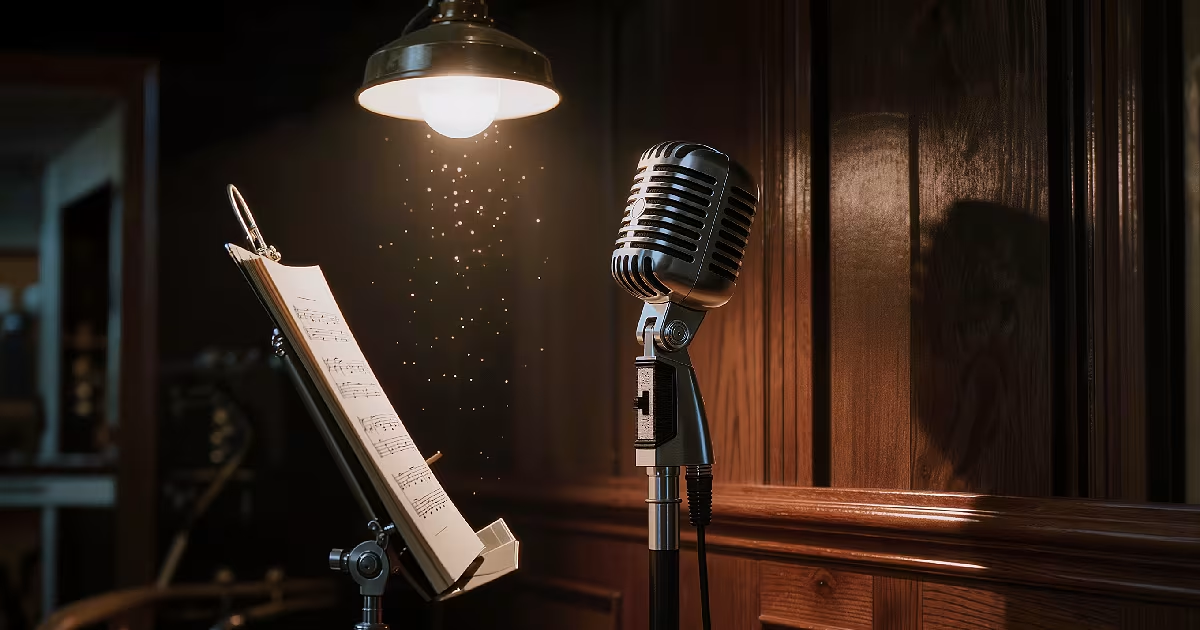
A 1930s radio microphone in a dark studio under one hanging lamp.
Illustration, not a photograph.

Opening
At 8 pm Eastern on Sunday 30 October 1938, the night before Halloween, CBS radio broadcast that week's episode of The Mercury Theatre on the Air: an adaptation of H. G. Wells's The War of the Worlds, directed and narrated by a 23-year-old Orson Welles. The writer Howard Koch moved the Martian landing from England to Grovers Mill, New Jersey, and told the story as a run of news bulletins breaking into an evening of dance music.
The next morning, newspapers across the country reported that the programme had sent listeners fleeing into the streets. That story, of a nation in panic, is still the one most people know. Historians who have gone back to the evidence think the panic was far smaller than the papers said, and that the newspapers had their own reasons for making it big.
Timeline
24 October 1938Koch is given the adaptation. The next day he tells producer John Houseman he can't make it work. He is told to keep going.
The week of the broadcastCBS lawyers and executives ask for about 28 changes to the script, mostly renaming real places such as the Hotel Biltmore and St. Patrick's Cathedral so that nothing real could be sued over.
30 October, 8 pmThe broadcast begins with an announcement that it is a play. Most of the national audience is listening to NBC's far more popular Chase and Sanborn Hour with ventriloquist Edgar Bergen. The first station break in the Welles show comes roughly half an hour in, later than usual, so anyone tuning in mid-way hears around 30 minutes of "news" before the next reminder that it is fiction.
That nightCallers jam some newspaper and police switchboards. In Concrete, Washington, a power cut happens to hit during the broadcast, and the local story is carried round the world by the wire services.
31 October 1938The New York Times runs "Radio Listeners in Panic, Taking War Drama as Fact" on its front page. Welles, after about three hours' sleep, gives an apologetic press conference.
The following weeksAt least 12,500 newspaper articles about the broadcast and its effects appear within three weeks. The Federal Communications Commission investigates and decides not to punish Welles or CBS.
8 November 1938Adolf Hitler cites the broadcast in a speech, as evidence of how easily the American public could be led.
1940Princeton psychologist Hadley Cantril publishes The Invasion from Mars, estimating that about six million people heard the show, 1.7 million believed it was news and 1.2 million were frightened or disturbed.
12 February 1949Radio Quito in Ecuador airs a Spanish-language version. When listeners learn it was fiction, a crowd sets fire to the building that houses the station, and at least seven people are killed.
Key figures
Orson Welles directed, narrated and played the astronomer Professor Pierson. He apologised the next morning and later in life told the panic story with obvious pleasure, as part of his own legend.
Howard Koch wrote the script and made the decision that mattered most: telling the invasion through fake bulletins in real places. John Houseman produced. Frank Readick, who played the reporter at Grovers Mill, prepared by listening over and over to Herbert Morrison's recording of the Hindenburg disaster.
Hadley Cantril's study gave the panic its numbers. Jefferson Pooley and Michael Socolow, and later the historian A. Brad Schwartz in Broadcast Hysteria (2015), went back to the evidence and argued those numbers do not hold up.
Physical and documentary trail
What survives is unusually good. The broadcast itself was recorded and is in the US National Recording Registry. The script survives, with the CBS changes. The newspaper coverage survives in bulk. So do nearly 2,000 letters sent to Welles and the FCC afterwards, which Schwartz read: about 27 per cent came from people who said they were frightened or had seen others frightened.
The audience figures are the weak link. A C. E. Hooper ratings survey of 5,000 households that night found only about 2 per cent listening to the Welles show at all. Cantril's larger estimates come from a later survey and counted people who said they were "excited" or "disturbed" as part of the panic. Claims of deaths in America were never verified, and one lawsuit against CBS was dismissed.
Things you might not know
- Welles was 23. He would make Citizen Kane less than three years later.
- Most of America was listening to a ventriloquist. On radio. The Chase and Sanborn Hour, starring Edgar Bergen and his dummy Charlie McCarthy, was the big Sunday show of the hour.
- The reporter studied the Hindenburg. Frank Readick played Morrison's 1937 recording again and again to get the sound of a man watching a disaster.
- Jack Paar was on the other end. The future Tonight Show host was an announcer at WGAR in Cleveland that night and tried to calm frightened callers.
- Welles and Wells met once. In San Antonio in 1940, on local radio. H. G. Wells doubted the panic had really happened.
- Grovers Mill has a monument to it. A bronze memorial to the fictional Martian landing was put up for the 50th anniversary in 1988.
Competing explanations
A real mass panic. Thousands of contemporary reports, Cantril's study, the letters, and the switchboard surges show that some people were genuinely frightened. The show was built to sound real, and it was not clearly labelled during its first half hour.
A panic made mostly by the newspapers. The argument of Pooley, Socolow and Schwartz. Very few people were listening, most of those who were knew it was a play, and the press, losing advertising to radio, had every reason to present the new medium as dangerous. Pooley and Socolow's 2013 article for Slate said that almost nobody was fooled.
Something in between. The letters suggest real fear in a minority of listeners, spread further by phone calls and rumour among people who never heard the show. That is a scare, and a real one for those caught in it, but not a nation in the streets.
Later life of the case
The broadcast became the standard example of media power in classrooms for decades, and the panic story became part of the play. The Ecuador riot of 1949 is the darkest proof that the format could work. A 1971 Portuguese-language version in Brazil led the military government to take the station off the air for a time.
Finding
The broadcast happened exactly as recorded, and it frightened some of the people who heard it. The best evidence says the national panic in the morning papers was mostly a newspaper story: the audience was small, and most of it knew what it was hearing.
What still will not resolve: how many people were truly frightened, since the only large count comes from a survey taken weeks later that counted "disturbed" listeners as panicked.
Evidence signature
8/9 Strong
- Witnesses
- several people
- Instruments
- more than one sensor agrees
- Paper
- formal investigation, court or declassified file
How well documented the case is, not whether it's true. A strong record can still have an ordinary answer, and a thin one can still be real.
You decide · WAR OF THE WORLDS
What do you think happened?
One vote per case, anonymous. You'll see how other readers voted once you've voted.