VILLISCA
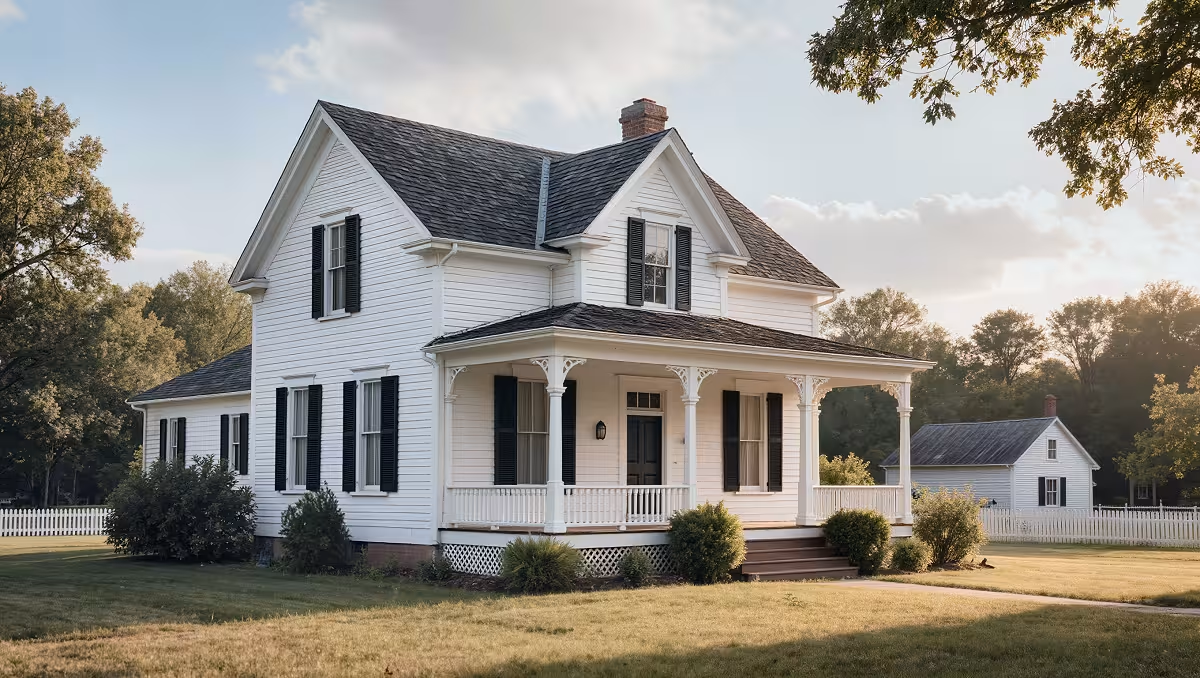
The white two-storey Villisca Axe Murder House in Iowa on a sunny day.
Illustration, not a period photograph.

Opening
In the early hours of 10 June 1912, someone entered the Moore family home in the small southwest Iowa town of Villisca and killed eight people with an axe: Josiah and Sarah Moore, their four children, and two young visiting Stillinger sisters who had asked to stay the night after a church program. A neighbor, growing concerned when no one emerged from the house the following morning, discovered the bodies.
Every ground-floor mirror and the one on the second floor had been covered with clothing, a slab of uncooked bacon sat near the murder weapon left leaning against a wall, and the killer had apparently spent considerable time inside the house without disturbing a locked cellar door or taking anything of obvious value. More than a century of investigation, one formally tried suspect, and a long list of circulated theories have never produced a conviction that held.
Timeline
9 June 1912, eveningThe Moore family attends a Children's Day program at the Presbyterian church; the two visiting Stillinger sisters, Lena and Ina, ask to stay overnight with the Moore children rather than return home, a routine, unremarkable arrangement.
Night of 9-10 June 1912Sometime after the household retires, the killer enters the home, most investigators believe through an unlocked door, and kills all eight occupants with an axe belonging to the household, striking each victim while they slept. The killer covers every mirror in the house with clothing and leaves a piece of uncooked bacon near the murder weapon, propped against a wall in an upstairs bedroom, two details that have never received a fully agreed explanation.
10 June 1912, morningA neighbor, Mary Peckham, alarmed that the household had not emerged by mid-morning, investigates and discovers the bodies, alerting authorities.
Following the discoveryIowa state investigators, alongside private detectives hired amid intense public pressure, pursue numerous leads. The locked cellar door, food apparently prepared and left inside the house by the killer during their time there, and a general absence of any obvious robbery motive all become recurring, unresolved features of the case's early investigation.
1916-1917The Reverend George Kelly, an itinerant minister who had also attended the Children's Day program and left town on an early train the morning of the killings, is arrested and tried, largely on the strength of a signed confession he later attempted to retract, claiming it had been coerced. His first trial ends in a hung jury; a second trial results in acquittal, and no conviction against him ultimately holds.
Contemporaneous alternative suspects. Local suspicion separately falls on William "Blackie" Mansfield, a man with a documented history of violence against family members, and on state senator Frank F. Jones, a local business rival of Josiah Moore's, though neither is ever formally charged in connection with the Villisca killings specifically, and both theories rest on circumstantial motive rather than direct evidence placing either man at the scene.
Later theory, developed by amateur researchers examining broader regional crime patterns. Some investigators have proposed a connection to a series of similar unsolved axe murders across the Midwest and South during the same general period, sometimes attributed to a single unidentified traveling killer, a theory that remains speculative given the absence of any confirmed individual link between the separate cases.
OngoingNo suspect has ever been convicted and had that conviction stand, and the case remains formally unsolved on Iowa's own historical record.
Modern era. The Moore house is restored and opened to the public as a museum and paid overnight "investigation" venue, drawing paranormal enthusiasts and true-crime tourists to the same rooms where the killings occurred, a commercial afterlife built directly on the case's continued unsolved status.
Key figures
The Moore and Stillinger families are the case's eight victims, and the sheer scale of the killing, an entire household plus two visiting children, in a small, close-knit town remains the case's central, defining horror regardless of which suspect theory one finds most persuasive.
Kelly is the case's only formally tried suspect, and the specific instability of the evidence against him, a confession he retracted as coerced, a hung jury followed by acquittal, means his prosecution represents the system's most direct attempt at resolution and its most direct documented failure to achieve one.
Mansfield and Jones represent the case's two most persistent alternative suspect theories, each resting on real, documented personal history (violence in Mansfield's case, business rivalry in Jones's) that nonetheless never produced formal charges specific to Villisca.
Peckham, the discovering neighbor, is the case's key initial witness, whose growing concern at the household's unusual silence is what actually brought the killings to light rather than any earlier alarm.
Physical and documentary trail
The case has a formal contemporary state investigation, a full criminal trial record for Kelly including his retracted confession and eventual acquittal, and well-documented, specific physical scene details (covered mirrors, the bacon, the murder weapon left at the scene) that remain part of the historical record independent of any particular suspect theory.
What it lacks is any conviction that survived appeal or retrial, any confirmed forensic link between the crime scene and any of the named suspects using techniques available at the time, and any modern forensic reexamination producing a definitive identification using contemporary methods.
Things you might not know
- A couple saved the house. In 1994 the house was in danger of being lost. It is now owned by Darwin and Martha Linn of Corning, Iowa, and is listed on the National Register of Historic Places.
- It is furnished as it was that night. Darwin Linn found period furniture and placed it in the spots where the original furnishings stood on the night of the murders.
- A suspect sent a shirt to the laundry. Reverend George Kelly, who was staying in Villisca that night, turned in an apparently bloodstained shirt to be laundered shortly after the murders.
- The victims' family had a business rival. Josiah Moore had once worked for Frank Jones, a banker and state senator, before leaving to set up in competition with him.
Competing explanations
Kelly as the killer, per the prosecution's own theory and his own later-retracted confession, a reading that requires explaining why that confession failed to produce a lasting conviction across two separate trials despite representing the state's best formal case.
Mansfield or Jones as the actual killer, per the two leading alternative local suspect theories, each resting on documented personal history and circumstantial motive without either man ever facing formal Villisca-specific charges.
An unidentified traveling killer connected to a broader regional pattern of similar unsolved axe murders, a reading that remains speculative given the absence of any confirmed direct evidentiary link between Villisca and the other cited cases.
A case that will likely never be resolved given the complete absence of modern forensic evidence and the deaths of every direct witness and suspect decades ago, a genuinely honest possibility no amount of continued amateur investigation has yet overcome.
Later life of the case
Villisca remains one of the most enduring unsolved mass killings in American history, its combination of a full scale, undisputed atrocity, a formally tried but acquitted suspect, and a house still standing and open to visitors giving it a continued cultural presence few comparable century-old crimes retain. Its modern commercial afterlife as a paranormal tourism site sits somewhat uneasily alongside the case's genuine, unresolved human tragedy.
Finding
Eight people were killed with an axe in the Moore house on the night of 9-10 June 1912, and no conviction against any of the several named suspects, Kelly chief among them, has ever held. The specific, well-documented scene details, the covered mirrors, the bacon, the murder weapon left behind, remain unexplained by any of the competing suspect theories in a way that fully accounts for the killer's apparent behavior inside the house.
What still will not resolve: any conviction that would stand, and any modern forensic technique capable of meaningfully re-examining evidence from a scene now well over a century old. Until either becomes possible, Villisca remains exactly what Iowa's own historical record still calls it: unsolved.
Evidence signature
5/9 Solid
- Witnesses
- several people
- Instruments
- nothing on record
- Paper
- formal investigation, court or declassified file
How well documented the case is, not whether it's true. A strong record can still have an ordinary answer, and a thin one can still be real.
You decide · VILLISCA
What do you think happened?
One vote per case, anonymous. You'll see how other readers voted once you've voted.