AMBROSE SMALL
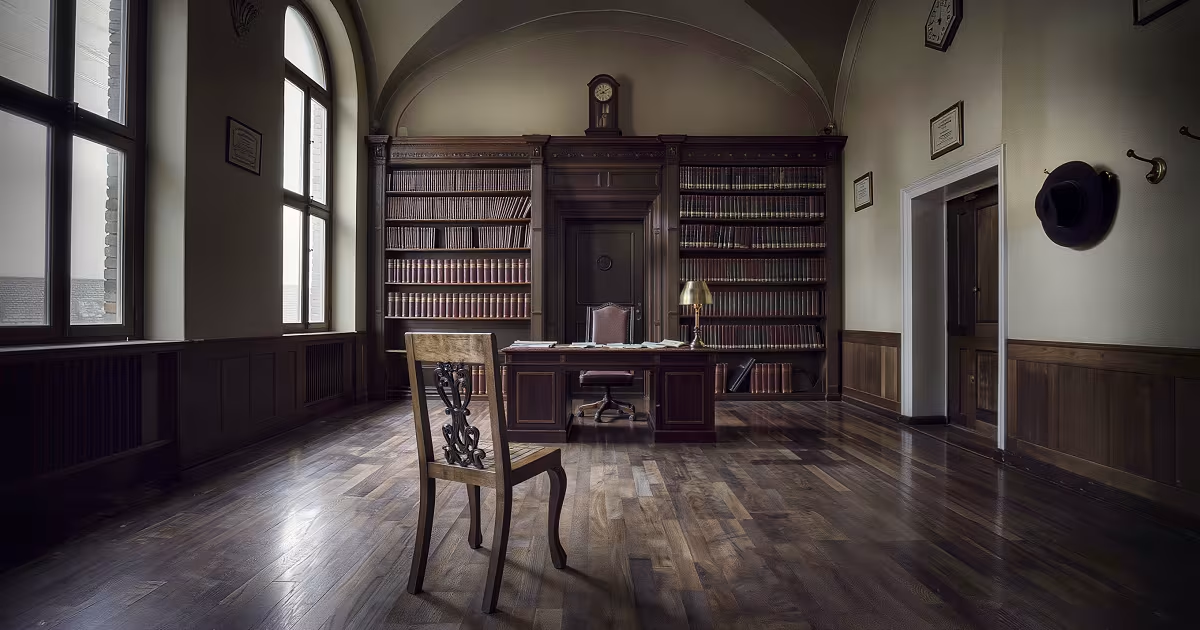
1919 theatre office. Empty chair and hat on a peg.
Illustration, not a period photograph.
Opening
On 2 December 1919 Ambrose Small, Toronto theatre magnate, left his office after settling a sale of his theatres, was seen about 5:30, and was not seen again. Money from the sale sat in the story. His wife and a secretary sat in later suspicion that never became a lasting conviction. In 1960 he was declared dead. No body has been signed as his. Toronto kept the 5:30 as a civic clock.
Ambrose Small is a last afternoon and an empty magnate. Keep paperback doors on the later shelf unless a chain holds.
The spine of the file is a theatre man who did not come to supper. Small is 2 December 1919. It is not a signed grave under a Toronto house.
Timeline
2 December 1919 sale weather and the 5:30 last look.
Search, suspicion, no body. 1960 legal death.
Later Toronto lists keep 5:30. Those lists are later life.
The afternoon is first.
Ambrose Small left a Toronto theatre fortune in 1919 and did not come back in a way the public file could close. Later lists hung other doors on the gap. This card keeps the missing man first.
A named disappearance with money on the table is already a thick file. Captions that arrive after do not replace the gap. They sit beside it.
2 December 1919 Ambrose J. Small left a Toronto theatre fortune on the table and did not come back in a way the public file could close. Reward paper ran. Later lists hung other doors on the gap. This card keeps the missing man and the dated disappearance. It will not walk a method.
Money on a table and a name that does not come home are already a complete public wound. Captions after 1919 sit on the later-life shelf.
Key figures
Ambrose Small owns the last afternoon.
Theresa Small owns the wait and the later shadow.
Toronto police own an open grave.
The theatres own the sale that made the day expensive.
Physical and documentary trail
On the paper, December 1919 gives you four hard objects and no body.
One: the theatre sale and the 5:30 last sighting.
Two: missing-person paper.
Three: the 1960 death declaration.
Four: the absence of signed remains. Toronto missing-person paper on Ambrose Small, December 1919, is the originating tray.
There is no remains chain. There is no lasting conviction. There is no second 5:30.
A 1919 disappearance and no public close are the stay-behinds. A last page both camps sign would finish Small. A caption that stamps another door would have to beat that gap.
A 1919 disappearance and no public last page are the stay-behinds. A signed close would finish Small. A caption that stamps another door would have to beat that gap.
He was seen at half past five and not after.
Competing explanations
Murder over a sale. This is the hard reading. It has money. It has no body.
A planned vanishing. Possible. A public man leaving a just-sold empire is expensive.
An accident that hid him. Weak against a search that large.
Hybrid caution. A magnate finished an afternoon. The city never signed a grave.
Later life of the case
Later Toronto lists. I keep those on the later-life shelf. The 5:30 stays first.
Finding
Ambrose Small was seen about 5:30 on 2 December 1919 after selling theatres and was not seen again. Believe the afternoon. A city desk does not invent a magnate for a later list.
What still will not resolve: remains with a chain, or a named door he reached after 5:30. Either one would pin the day. The proving object is still that body, held in a grave the city can open, not in another Toronto story.