THE SEEKERS
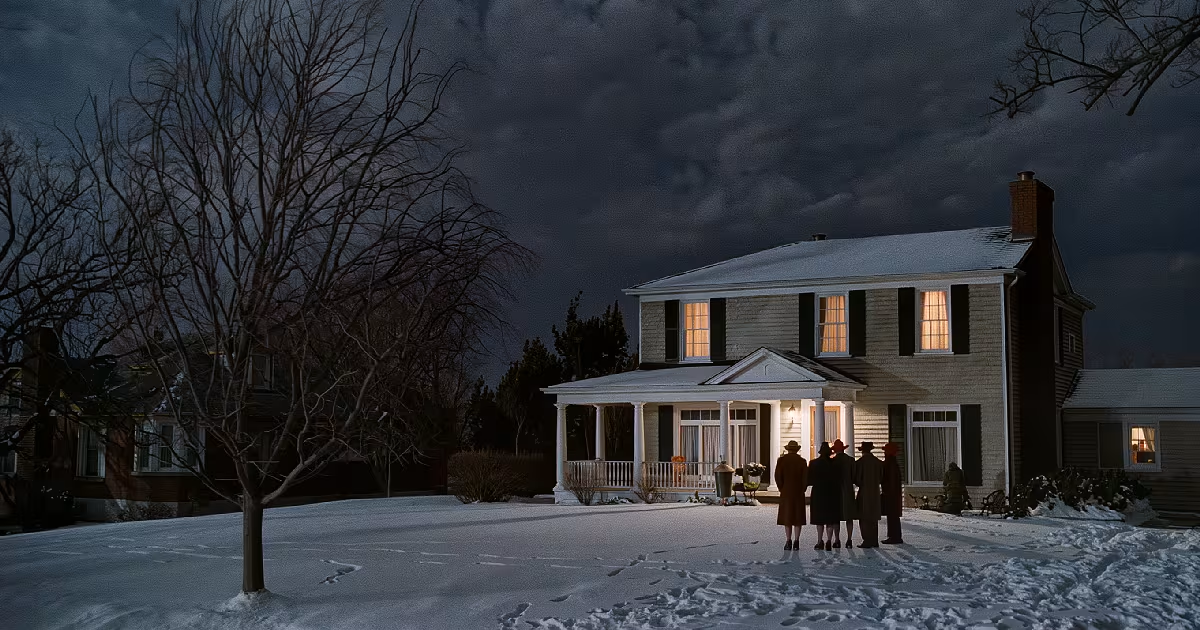
People waiting in the snow outside a lit house at night.
Illustration, not a photograph.

Opening
In December 1954 a small group of believers gathered at a house in Oak Park, outside Chicago, to wait for a flying saucer. Their leader, Dorothy Martin, had been receiving messages through automatic writing from beings on a planet called Clarion. The messages said a great flood would sink most of North America before dawn on 21 December, and that a spacecraft would come to take the faithful away first. Some of them quit their jobs and gave away their money. On the night, they took the metal out of their clothes, because the visitors had warned that metal was dangerous on board, and sat waiting for midnight.
Nobody came, and nothing flooded. Among the people in the room were undercover social scientists, sent in by the psychologist Leon Festinger. Their 1956 book, When Prophecy Fails, said that the believers had answered failure by believing harder, and it helped launch the theory of cognitive dissonance, one of the most famous ideas in modern psychology. Seventy years later, Festinger's own papers were unsealed, and a new study says the book got the story badly wrong.
Timeline
Early 1950sDorothy Martin, a woman in her fifties living in Oak Park, moves through esoteric and spiritualist circles and begins automatic writing. She says the messages come from the Guardians of Clarion, among them a being called Sananda.
1954Charles Laughead, a doctor at Michigan State College, and his wife Lillian become her most important followers. According to later research, the college dismissed Laughead for trying to convert student patients. A small circle known as the Seekers forms around Martin.
Autumn 1954Festinger, then at the University of Minnesota, and his colleagues Henry Riecken and Stanley Schachter read about the group and decide to study it from inside. They and paid observers join, posing as ordinary seekers interested in flying saucers.
17 December 1954The Chicago Tribune carries the prophecy through Laughead, quoted under the pseudonym "Dr. Thomas Armstrong": a flood stretching from the Arctic Circle to the Gulf of Mexico.
20 December 1954, nightThe group waits for a visitor at midnight. At 12:05 nothing has happened, but another clock in the room shows 11:55, so they decide it is not midnight yet. When the second clock reaches midnight, still nothing. Around 4 a.m. Martin begins to cry.
21 December 1954, 4:45 a.mA new message comes through her hand: the little group had spread so much light that God had spared the world.
21 to 24 December 1954The group calls the newspapers. On Christmas Eve, on a new instruction, they sing carols outside the house and wait to be collected, watched by some 200 unruly spectators and the press. Police are called.
26 December 1954A warrant is issued for Martin and Laughead. Facing arrest and the threat of being committed, Martin leaves Chicago.
1956When Prophecy Fails is published, with the members under false names. Martin is "Marian Keech".
16 June 1992Martin dies in Arizona aged 92, after decades as a New Age teacher known as Sister Thedra.
November 2025Thomas Kelly publishes "Debunking 'When Prophecy Fails'" in the Journal of the History of the Behavioral Sciences, drawing on Festinger's papers at the University of Michigan, unsealed earlier that year.
Key figures
Dorothy Martin believed she was a channel for higher beings. She lived another 38 years after the flood failed to come and kept receiving messages, though she later moved away from predicting dates.
Charles and Lillian Laughead gave up most of their ordinary life for the group. They had two children, and their family's worries about them became part of the story in a way the book never told.
Leon Festinger was one of the most influential social psychologists of the century. Henry Riecken became a trusted figure inside the group, called "Brother Henry". Stanley Schachter went on to his own distinguished career.
The observers, among them Liz Williams and Frank Nall, lived with the believers and took notes in bathrooms, on porches and in hotel rooms.
Physical and documentary trail
The sources: the 1956 book; the press coverage of December 1954; Martin's automatic writings; and now the researchers' own field notes and correspondence, in the Festinger papers at the University of Michigan and in collections at Michigan State and the Bentley Historical Library. Kelly has put redacted copies of his sources online for others to check.
The book's claim was that the Seekers, after the failure, became more committed and began trying hard to win converts, to make the belief feel true by spreading it. Kelly's reading of the notes is that this did not happen. He says members kept up their belief for a few days at most, that the group soon broke up, and that the Seekers had been eager to talk to journalists before the failure, which the book plays down. In 1955 Martin told the magazine The Saucerian that she "didn't really expect" to be picked up.
Kelly also says the researchers did not just watch. Riecken, as "Brother Henry", gained a special standing in the group. According to Riecken's own notes, at a key moment he told Laughead he was having doubts, Laughead answered with a speech about how he could not afford to doubt, and soon afterwards Martin wrote the Christmas message that sent the group out singing. The observer Liz Williams joined the Laugheads' household claiming psychic visions, and performed automatic writing of her own. And when a university social worker came to look into whether the Laugheads were fit to care for their children, two observers told her about the study and asked her not to interfere. She dropped the matter.
Things you might not know
- Two clocks bought them ten minutes. When nothing happened at 12:05, the group noticed a clock showing 11:55 and decided to keep waiting.
- Nearly a third of the group were researchers. The historian Fernando Bermejo-Rubio has pointed out that observers made up almost one-third of the membership, enough to shape what they were watching.
- Martin was born in Mount Shasta. The California mountain, long linked to Lemuria and ascended masters, was her birthplace, and her later movement was built around such masters.
- The last observers lived to see the debunking. Liz Williams died in June 2025 at 99. Frank Nall, now 100, has few memories of the study.
- A chatbot read one note. Kelly used ChatGPT to help decipher a single handwritten note in Martin's hand, the only place he says he relied on it.
- Not everyone accepts the debunking. The Berkeley scholar Poulomi Saha, a reviewer of the paper, said "I wouldn't have published this" and called it a narrow reading of limited archives.
Competing explanations
Believers who doubled down. This is the 1956 book's account: a disconfirmed prophecy, social support and a public commitment led the group to proselytise harder. It became a textbook case for seventy years.
Believers who fell apart, written up as believers who doubled down. This is Kelly's account: the group collapsed within days, the researchers helped steer the moments the book treats as natural, and the book's central claims do not survive the field notes. Kelly says this does not prove cognitive dissonance theory wrong in general.
Something in between. Some scholars accept that the researchers interfered and that the book overstated its case, while doubting that every claim is false. The archives are open now, and other historians have begun to read them.
Later life of the case
When Prophecy Fails became a staple of psychology courses and popular books, and "cognitive dissonance" passed into everyday speech. The Seekers became the template for how doomsday groups supposedly behave when the day passes. Dorothy Martin, as Sister Thedra, founded the Association of Sananda and Sanat Kumara and lived in Peru, Bolivia, Arizona and California, still channelling messages. The 2025 paper, covered by Mother Jones and the British Psychological Society, has reopened a case most psychologists thought was closed.
Finding
The flood did not come and the saucer did not land. That much has never been in doubt. What is now in question is the famous scientific account of what happened next. The researchers' own papers show that they were not invisible observers: one of them became a respected figure inside the group, observers faked psychic gifts, and two of them turned away a child welfare inquiry. Whether the Seekers really doubled down, or quietly gave up while the book said otherwise, now depends on a close reading of those notes.
What still will not resolve: what the believers themselves thought in the days after 21 December 1954, in their own words rather than through the notes of the people studying them.
Evidence signature
6/9 Solid
- Witnesses
- trained, independent witnesses
- Instruments
- nothing on record
- Paper
- formal investigation, court or declassified file
How well documented the case is, not whether it's true. A strong record can still have an ordinary answer, and a thin one can still be real.
You decide · THE SEEKERS
What do you think happened?
One vote per case, anonymous. You'll see how other readers voted once you've voted.