OPERATION HIGHJUMP
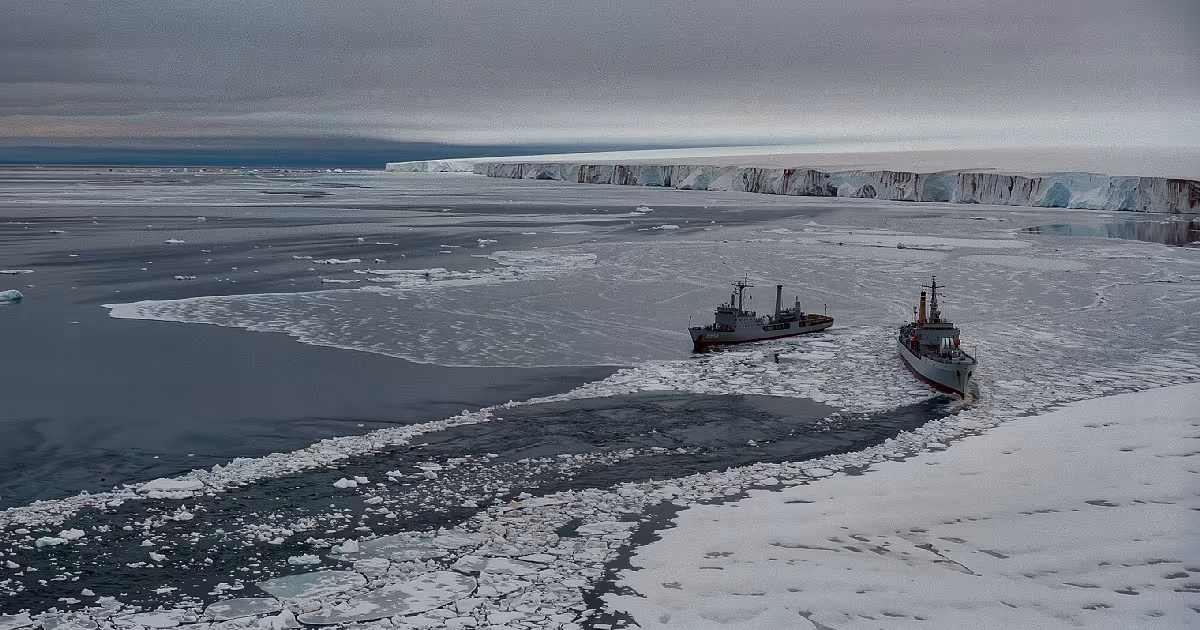
Two ships breaking through pack ice below an Antarctic ice shelf.
Illustration, not a photograph.

Opening
In the southern summer of 1946 to 1947, the United States Navy sent the largest expedition the Antarctic had ever seen: 13 ships, 33 aircraft and about 4,700 men, under the famous polar explorer Rear Admiral Richard E. Byrd. Its official name was the United States Navy Antarctic Developments Program. Everyone called it Operation Highjump. It was meant to run for months and to test men and machines in the coldest place on Earth.
It came home early, in late February 1947. Three airmen had died in a crash and a sailor in an accident, and winter was closing in. Days later, a Chilean newspaper quoted Byrd warning that America must guard against hostile aircraft coming over the poles. From those facts, decades of retelling built one of the great modern legends: that Highjump was a military assault on a secret base under the ice, Nazi or alien or both, and that the Navy had been beaten back.
Timeline
December 1938 to April 1939A German expedition aboard the ship Schwabenland, led by Alfred Ritscher, flies survey planes over part of Queen Maud Land and names it Neuschwabenland. It stays for weeks, not years, and builds no base.
July and August 1945Months after Germany surrenders, two German submarines, U-530 and U-977, give themselves up in Argentina. Their late arrival feeds rumours that they had carried Nazi leaders or treasure somewhere far south.
26 August 1946Operation Highjump officially begins. Its aims include training, testing equipment and aircraft in extreme cold, building a base, Little America IV, on the Ross Ice Shelf, and photographing and mapping huge areas of the coast from the air. Quietly, it also supports American claims to Antarctic territory.
December 1946The fleet arrives in three groups, east, west and centre, with seaplane tenders, icebreakers, a submarine and an aircraft carrier.
30 December 1946The flying boat George 1 crashes on Thurston Island in a whiteout. Ensign Maxwell A. Lopez, Wendell K. Henderson and Frederick W. Williams are killed. The six survivors are rescued thirteen days later.
1 January 1947Two divers make the first American dive under the Antarctic ice.
15 January 1947The Central Group reaches the Bay of Whales and starts building Little America IV.
21 January 1947Seaman Vance N. Woodall is killed in an accident while unloading a ship.
Late January 1947Six twin-engined transport planes fitted with skis take off from the deck of the carrier USS Philippine Sea with rocket boosters and fly hundreds of miles to Little America.
Late February 1947With worsening weather and winter approaching, the ships and men withdraw.
5 March 1947The Chilean newspaper El Mercurio publishes an interview in which Byrd warns that the United States must defend itself against hostile planes coming from the polar regions.
1948The Navy's documentary of the expedition, The Secret Land, wins the Academy Award for best documentary feature.
Key figures
Richard E. Byrd was America's most famous polar explorer, a naval aviator who claimed the first flights over both poles. He was officer in charge of Highjump, but the task force itself was commanded by Rear Admiral Richard H. Cruzen. Byrd died in 1957.
The four men who died, Lopez, Henderson, Williams and Woodall, are the real casualties of Highjump. They died in a crash and an accident, not a battle.
Colin Summerhayes of the Scott Polar Research Institute and Peter Beeching wrote the most thorough study of the legend, published in the journal Polar Record in 2007, tracing each part of it to its source.
Physical and documentary trail
The trail: the Navy's own reports and logs, the films and tens of thousands of aerial photographs, the crash and casualty records, newspaper coverage at the time, and the follow-up expedition, Operation Windmill, which went back in 1947 to 1948 to check the aerial maps on the ground. This is one of the best-documented Antarctic expeditions ever mounted.
The legend has a different paper trail. It runs through the 1938 to 1939 German expedition, the two U-boats in Argentina, Byrd's El Mercurio interview, post-war novels about secret polar bases, and later books on hollow earths and flying saucers. Summerhayes and Beeching found that each piece is real on its own, and that the myth comes from joining them together. They found no evidence of any German base in Antarctica at all.
The time has ended when we were able to take refuge in our isolation.
Things you might not know
- It won an Oscar. The Navy's film of the expedition, The Secret Land, narrated in part by Hollywood actors, won the 1948 Academy Award for best documentary.
- Byrd was talking about the Cold War. In context, his warning was that bombers could now reach America over the poles. Within a few years both superpowers were planning exactly that.
- The German "colony" was a few weeks of flying. The 1938 to 1939 expedition dropped marker darts from its aircraft to stake a claim, but nobody stayed on the ice.
- The hollow earth arrived later. A 1964 book by Raymond Bernard claimed Byrd had spoken of a mysterious "land beyond the Pole", and Ray Palmer's Flying Saucers magazine later ran Byrd as proof of an opening into the inner Earth.
- The "secret diary" is not his. A widely shared "lost diary" in which Byrd flies into an inner world and meets advanced beings appeared decades after his death. It has no link to his real papers.
- The U-boats were checked. U-530 and U-977 were interrogated by Argentine and American officers after they surrendered. U-977's captain later wrote a book about his long voyage.
Competing explanations
A large training and survey expedition that ended early. This is what the Navy's records show: an exercise in cold-weather logistics with a political aim, cut short by weather and season, with four deaths from a crash and an accident.
A failed attack on a hidden Nazi base. The best-known version of the legend. It depends on a base that no evidence shows was ever built, and on reading an expedition that left at the end of the season as a defeat.
A battle with flying saucers or a hidden inner world. The most dramatic version, built on Byrd's warning about hostile planes, later hollow-earth books and the fake diary. Nothing in the expedition's records supports it.
Later life of the case
Highjump has become a fixture of conspiracy books, documentaries and videos, usually combined with Nazi survival stories, flying saucers, the hollow earth and later claims about Antarctica as a forbidden continent. The real expedition, meanwhile, shaped American work in Antarctica for decades, and its aerial photographs mapped long stretches of coastline for the first time.
Finding
Operation Highjump was a real and enormous Navy expedition to Antarctica in 1946 to 1947. It mapped vast areas from the air, built a temporary base, lost four men in a crash and an accident, and left at the end of the season. The legend of a battle with a hidden base was assembled later from real but unrelated pieces, and the most careful study of it found no evidence that the base ever existed.
What still will not resolve: the full Spanish text of Byrd's El Mercurio interview, which has circulated mainly in translation, and exactly what he meant by it.
Evidence signature
8/9 Strong
- Witnesses
- trained, independent witnesses
- Instruments
- radar or measured data
- Paper
- formal investigation, court or declassified file
How well documented the case is, not whether it's true. A strong record can still have an ordinary answer, and a thin one can still be real.
You decide · OPERATION HIGHJUMP
What do you think happened?
One vote per case, anonymous. You'll see how other readers voted once you've voted.