ANDREASSON AFFAIR
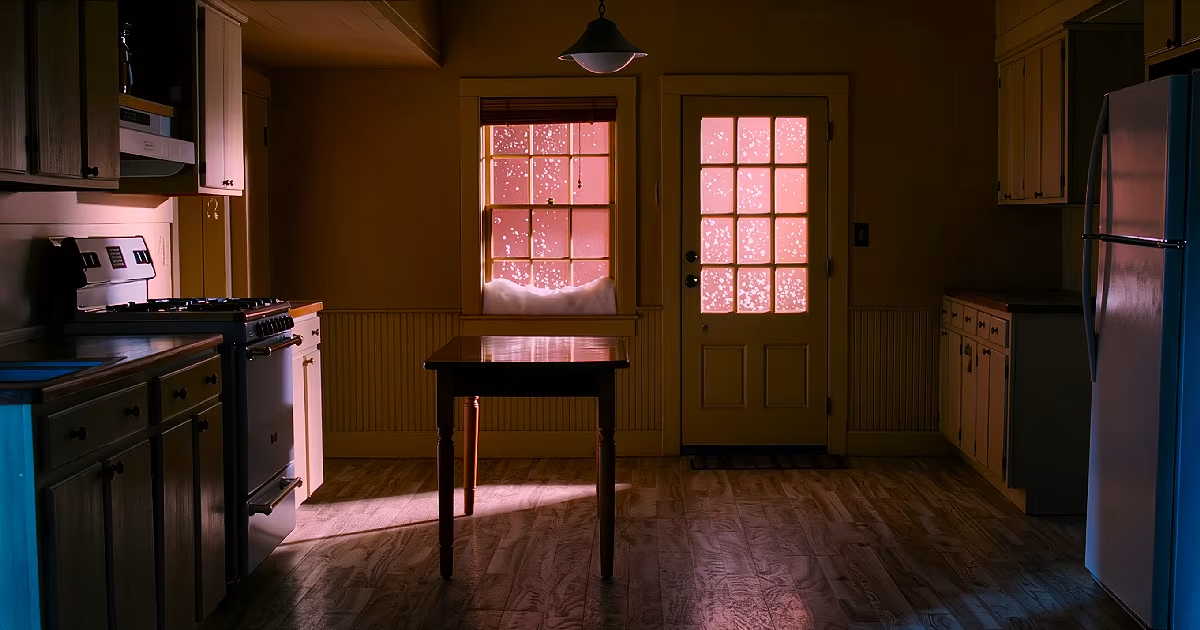
1960s New England kitchen at night. Orange glow at the window.
Illustration, not a period photograph.
Opening
On the evening of 25 January 1967, the lights in Betty Andreasson's home in South Ashburnham, Massachusetts, flickered and went out, and a pink-orange light shone through the kitchen window. Her parents and her seven children were in the house. According to her later account, small beings with large heads and wraparound eyes passed through the closed kitchen door, put most of the family into a kind of suspended state, and took her aboard a craft. There she was examined and shown a vision of a huge bird rising from fire. She remembered only fragments until hypnosis sessions ten years later. The investigation, led by Raymond Fowler, became one of the most detailed abduction studies ever made.
Timeline
25 January 1967, about 18:30. The house loses power and the light appears. Betty's father sees small figures outside. The beings enter. Betty is taken aboard. She is returned hours later.
1967 to 1975. Betty remembers only part of the evening. In 1975 she responds to an appeal by the astronomer J. Allen Hynek for UFO reports.
1977. A team from the Mutual UFO Network (MUFON), led by Raymond Fowler, begins a year-long investigation, including hypnosis sessions with Betty and her daughter Becky, and interviews and polygraph tests.
1979. Fowler publishes The Andreasson Affair. It includes Betty's drawings of the beings and the craft.
1980s and 1990s. Further books follow as Betty recalls more encounters throughout her life, with increasingly religious and mystical themes.
Key figures
Betty Andreasson (later Betty Luca) is the main witness. She was a devout Christian, and her account is full of religious imagery.
Becky Andreasson, her daughter, was aged 11 at the time and recalled parts of the evening under hypnosis.
Raymond Fowler led the investigation. He's also the investigator who took the Kingman 1953 affidavit.
Physical and documentary trail
On the paper: Fowler's detailed investigation report and books, hypnosis transcripts, polygraph results, and Betty's drawings. There's no physical evidence and no independent witness outside the family.
Competing explanations
A real abduction. The investigation was thorough, the witness passed a polygraph and a psychiatric review, and her daughter partly supported her account.
Memories shaped by hypnosis and belief. Hypnosis is known to produce vivid false memories, especially a decade later and in a researcher-led setting. Betty's strong religious faith runs through her account, from the beings' messages to the phoenix vision, which suggests her mind shaped much of what she recalled. Her daughter's memories, also under hypnosis, may have been influenced by the family's shared story.
Later life of the case
The Andreasson Affair is one of the foundational abduction cases, and its drawings are among the most reproduced images in the field. Betty's later accounts made it increasingly spiritual and less investigable.
Finding
A sincere witness, a serious investigation, and an account recovered largely through hypnosis ten years later. Hypnosis doesn't reliably recover memory, and nothing outside the family supports the craft. Unproven. The strange power cut at the start is the part that might have been real.
What still will not resolve: what happened in the house that evening before the story was shaped by hypnosis.