ALAN GODFREY
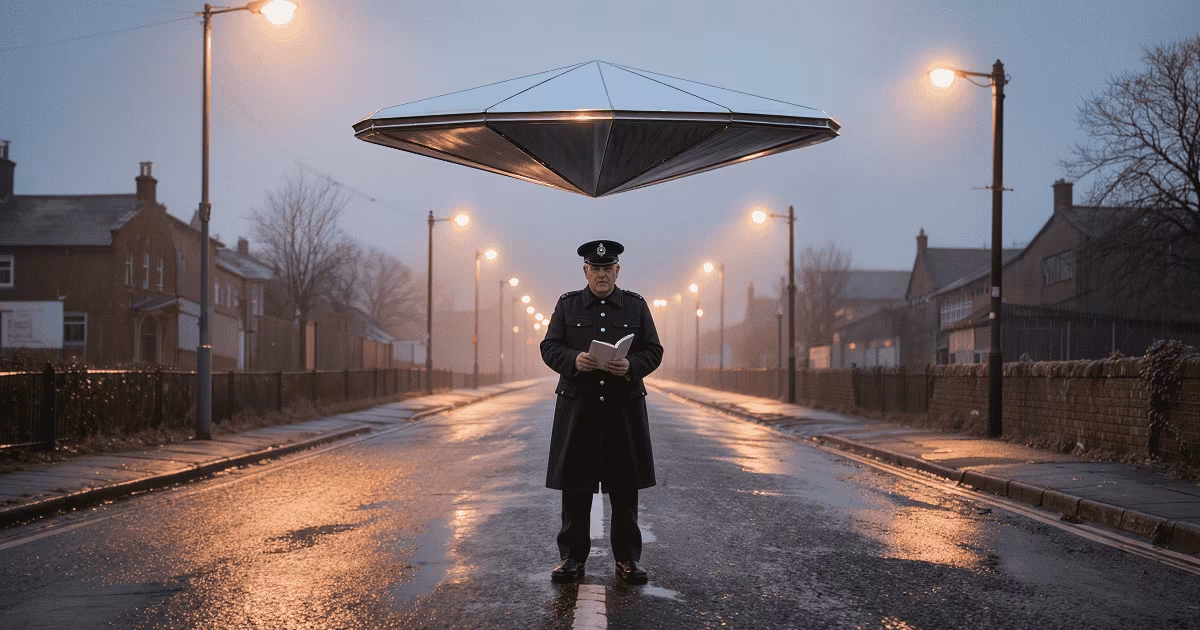
West Yorkshire road at dawn. Police notebook.
Illustration, not a period photograph.
Opening
In the first hours of 29 November 1980 Police Constable Alan Godfrey was driving a patrol car on Burnley Road in Todmorden, West Yorkshire, when a diamond-shaped object sat over the road ahead. He sketched it on the pad he had in the car. The engine and radio misbehaved. There was a pause he could not fill. He came back to himself further down the road with a split boot and a night that would not add up. Todmorden already had Zigmund Adamski on a coal heap that June. The town is small enough that the two files keep being introduced.
Godfrey reported it as a policeman. He was hypnotised later and a cabin entered the story. Keep that cabin on the later shelf. The sketch and the dead minutes are the 1980 paper. He did not ask to become a circuit speaker. He became one anyway.
The spine of the file is a constable and a diamond on a wet road. Godfrey is a sketch made in a patrol car. It is not a kept craft in a Halifax garage.
Timeline
28 November into the 29th, 1980. Godfrey on night duty, Burnley Road, rain, cows out in some tellings that he had already been dealing with. A diamond or a spinning top over the carriageway, lights, a size he put at a large vehicle. He draws. He thinks about reversing. Then the road is empty and he is not where the minutes say he should be.
He tells the station. A sketch goes into the book. Local papers take it because a policeman is harder to laugh out of the room than a motorist. Hypnosis in 1981 produces a figure and a table. That session is later. The sketch is the night.
Todmorden already carried Adamski. Writers weld the coal yard to the diamond. They are not the same hour. Godfrey himself said the coal yard was not his case in the way the road was.
He leaves the force in time and spends years repeating the diamond. The repetition is later life. Burnley Road is first.
Godfrey had already been dealing with cows on the road that night in some tellings, which is why he was on Burnley Road at all. The diamond sat on the carriageway. He drew. Radio and engine went wrong. He came back further down the tarmac with minutes he could not fill and a boot that had split.
Todmorden already carried Adamski from June. Writers weld the coal yard to the diamond because the town is small. They are not the same hour. Godfrey said as much. The sketch in the car book is the 29 November object.
Key figures
Alan Godfrey is the officer. A night-duty constable with a pad. His sketch is the exhibit.
The station that took the report owns the decision not to bin a policeman's diamond.
Later hypnotists own the cabin. That cabin is not the sketch.
Adamski sits in the same town file and must stay a neighbour, not a merge.
Physical and documentary trail
On the paper, 28-29 November 1980 give you four hard objects and no diamond in a yard.
One: Godfrey's same-night account of an object over Burnley Road and missing minutes.
Two: the sketch made in the car and entered in official paper.
Three: radio and engine trouble as he wrote them.
Four: the station report. Todmorden police report of PC Alan Godfrey, 29 November 1980, is the originating tray.
There is no photograph from the road. There is no second officer in that car. There is no landing mark logged at dawn.
A constable's sketch entered the same night is better paper than a later cabin. Hypnosis can wait on the shelf. The pad cannot.
It was on the road in front of me. I drew it as I sat there.
Competing explanations
A craft on a West Yorkshire road. This is Godfrey's night. It has a sketch. It has no machine.
Fatigue, a bus or a reflector, lost time from a doze. Possible on a night shift. Has to carry a constable who filed a drawing instead of a yawn.
A story grown to fit Adamski. The dates are months apart. The diamond does not need the coal.
Hybrid caution. A policeman drew what sat on his road. Morning had no guest on the tarmac.
Later life of the case
Hypnosis, documentaries, the Adamski weld. I keep those on the later-life shelf. The sketch stays first.
Finding
PC Alan Godfrey found a diamond over Burnley Road in the first hours of 29 November 1980, drew it in the car, and could not account for the minutes that followed. Believe the constable. A night-duty officer does not invent a sketch for the book.
What still will not resolve: a photograph from that road, or a second officer who saw the same diamond. Either one would pin the drawing to a machine. The proving object is still the thing on Burnley Road, held by someone who was not in that patrol car.