CHILLINGHAM
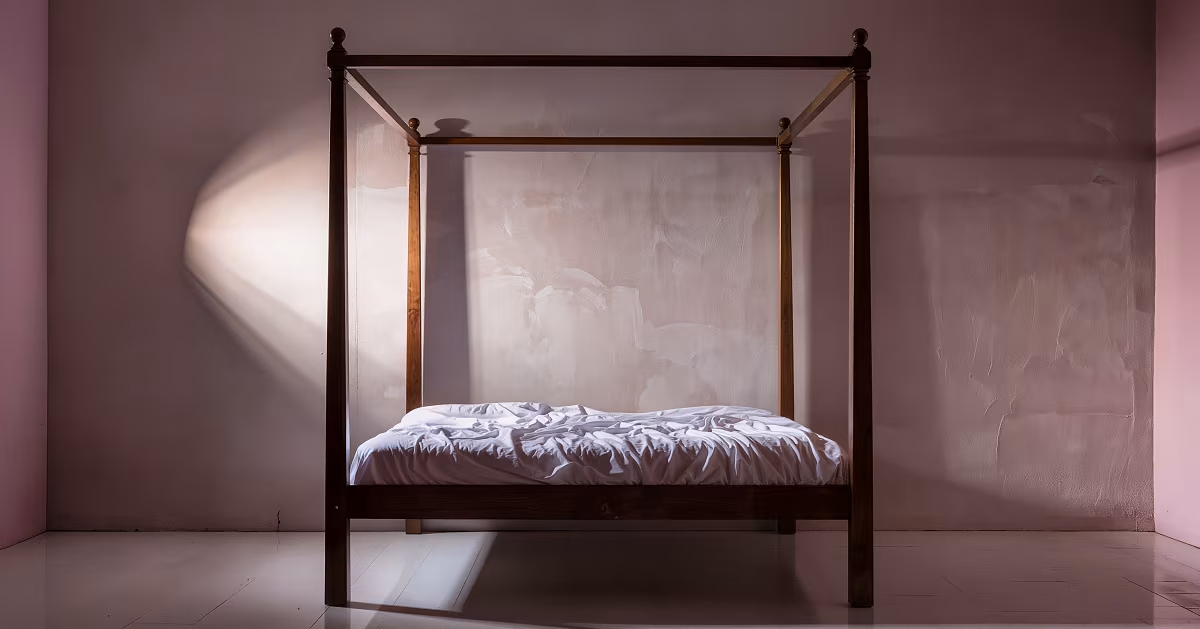
An empty four-poster bed in a bare castle room, light across the wall.
Illustration, not a period photograph.

Archive / Paranormal / BOT313-0220
PAR-1298ParanormalBLUE CLOTH
CASTLE WALL BONES AND BLUE FABRIC SCRAP
Fig. 01 An empty four-poster bed in a bare castle room, light across the wall. Illustration, not a period photograph.
Opening
Chillingham Castle, on the Northumberland border between England and Scotland, has marketed itself for decades as the most haunted castle in Britain, and its dungeon tour makes the claim easy to believe on its own: a rack, an iron maiden, and other period implements sit waiting in the chamber beneath the northeastern tower.
Its best-known ghost, the "Blue Boy" or "Radiant Boy," is said to have appeared at the stroke of midnight in the castle's Pink Room for generations, until, according to the story the current owners tell, twentieth-century renovation work found exactly what the haunting had been describing all along, bones and a scrap of blue fabric sealed inside a ten-foot-thick wall.
Timeline
Late 1100sChillingham begins as a single watchtower built near an existing monastery site. In 1298, King Edward I stays in the tower's uppermost room, now called the Edward I Room, on his way north to fight William Wallace's forces, and a window is specially installed for his visit, an unusual luxury for a fortification of that period.
1344King Edward III issues a license permitting battlements, formally upgrading the watchtower into a fortified castle. By 1348 it has become a square structure with corner towers, occupying a strategically important position directly on the border between two frequently warring nations.
1536The castle comes under cannon fire from the Percy family of nearby Alnwick during the Pilgrimage of Grace rebellion against Henry VIII, one of several documented border skirmishes and sieges in its working military history.
17th century, per the castle's own ghost traditionLady Mary Berkeley is said to haunt the corridors after her husband, Ford, Lord Grey of Wark and Chillingham, abandons her for her own sister during the reign of Charles II; her apparition is described as rustling silk moving through the halls in an endless search for him.
1925Leonora, Countess of Tankerville, publishes a pamphlet recording several of the castle's ghost stories in something close to their now-familiar form, the earliest specifically dated written source for much of the material still told on tours today.
1920s, per the Blue Boy legend's own climaxWorkmen cutting a new passage through the castle's ten-foot-thick wall into the adjoining tower are said to have found the bones of a young boy, dating to roughly the 1660s by the fragments of blue clothing found beside them. The remains reportedly receive a Christian burial, and, per the story, the Blue Boy's midnight appearances cease from that point on.
Later retellings of the discoverySome versions specify that a man's remains were found alongside the boy's, and that documents dating to the Spanish Armada period were recovered from within the same wall cavity, additional details that do not appear in the earliest tellings and that no single source in the available record traces to a specific dated inspection report or parish record.
1982The castle is given to Sir Humphry Wakefield, whose wife descends from the Grey family of Chillingham, and the couple begin a restoration effort that continues for over three decades, opening sections of the castle to the public alongside holiday apartment rentals.
Later 20th centuryA separate figure, John Sage, described in tour retellings as the castle's resident torturer during its border-conflict period, becomes attached to reports of foul smells, heavy footsteps, and oppressive atmospheres in the Great Hall and Edward I Room. Researchers examining the castle's ghost lore, including those behind a 2026 podcast episode on the case, specifically note that Sage himself appears to be a considerably more recent addition to the tradition than the Blue Boy or Lady Mary Berkeley stories, with no documented historical figure of that name confirmed in the castle's own records.
2013The castle is the subject and setting of the documentary A Blood Red Sky, part of a long line of television and radio productions to feature Chillingham, including Most Haunted, Scariest Places on Earth, and Ghost Hunters International.
2024YouTube paranormal investigators from the channel Project Fear film what they describe as human bone remains inside a box in the dungeon, a recent and specific claimed discovery, though its provenance, dating, and any formal archaeological assessment have not been independently confirmed in the available record.
Key figures
The Grey family, who held Chillingham from 1246 onward, are the castle's documented historical owners across the centuries the ghost stories are set within, giving the property a genuine, continuous ownership record independent of the specific ghost claims layered onto it.
Leonora, Countess of Tankerville, is the case's earliest specifically dated documentary source, her 1925 pamphlet representing the point at which several of the castle's oral ghost traditions were first committed to print in something like their current form.
Sage is the case's most recently invented major figure, and the absence of any confirmed historical record for a castle torturer by that name, despite his prominent place in current tour narration, is a specific, checkable gap between the modern commercial ghost tour and the castle's actual documented history.
Wakefield and his wife are the castle's modern custodians, whose deliberate marketing of the property as Britain's most haunted castle has shaped how the ghost stories are packaged and presented to visitors over the past four decades.
Physical and documentary trail
The record has a genuinely long and independently verifiable architectural and military history, a specifically dated 1925 pamphlet recording early versions of the ghost stories, and a specific claimed 1920s discovery of child remains and blue fabric behind a wall that gives the Blue Boy legend its central physical anchor.
What it lacks is any surviving dated inspection report, parish burial record, or newspaper account from the 1920s specifically confirming the wall discovery's details, its exact date, or the reported Spanish Armada-era documents said to have been found alongside it; the story exists in multiple, not fully reconciled retellings rather than in one primary source.
Things you might not know
- The walls were 12 feet thick. Some of the medieval fortifications were built to that depth.
- One family held it for 500 years. The Greys and Bennets, later Earls of Tankerville, owned it from the 15th century until the 1980s.
- It was rescued in 1982. Sir Humphry Wakefield bought the castle and began a careful restoration. His wife is descended from the Greys of Chillingham.
- Its cattle are a rare breed. About 130 white Chillingham cattle live in an enclosed park on the estate.
- The owners sell the ghosts. The castle markets itself as the most haunted in Britain, offers late-night ghost tours and has appeared on Most Haunted.
- There are bones in the dungeon. In 2024 a group of YouTube investigators filmed human remains kept in a box there.
Competing explanations
A genuine historical discovery, later folklorized: workmen in the 1920s did find human remains during structural work, a plausible and not uncommon occurrence in a building this old, with the specific ghost narrative built up around and predating the actual find rather than originating from it.
A story that predates any physical discovery entirely, with the 1920s "confirmation" added later specifically to give an already-circulating oral tradition, present in some form by at least 1925 per the Countess of Tankerville's pamphlet, a satisfying physical resolution it did not originally have.
A deliberately commercial embellishment, consistent with the castle's own explicit modern marketing as Britain's most haunted castle, in which later figures like John Sage are added wholesale to an older core of genuine local ghost tradition specifically to give tour guides fresh material.
Later life of the case
Chillingham remains one of the most heavily marketed haunted properties in Britain, its combination of a genuine, centuries-deep military history and a Blue Boy legend with an unusually satisfying physical "confirmation" story making it a natural draw for television paranormal programming across five decades. The clear layering visible in its own ghost roster, an 1925-documented core, and later, evidently more recent additions like Sage, makes it a useful case study in how a real historic building's ghost lore visibly accumulates over time.
Finding
Chillingham Castle's military and architectural history is genuine and independently well documented across seven centuries. Its most famous ghost story, the Blue Boy, has a specific claimed physical origin, a 1920s discovery of a child's remains and blue fabric inside a thick wall, that no surviving primary document in the available record confirms in detail, leaving the story's evidentiary weight resting on consistent retelling rather than a dated inspection or burial record.
What still will not resolve: any surviving 1920s report, newspaper account, or parish record specifically documenting the wall discovery's date and details, and confirmation of whether John Sage was ever a real historical figure at the castle at all. Until either surfaces, this report treats the castle's genuine architectural history and its commercially polished ghost roster as related but separately evidenced things.
Evidence signature
5/9 Solid
- Witnesses
- several people
- Instruments
- photo, film or physical traces
- Paper
- official records at the time
How well documented the case is, not whether it's true. A strong record can still have an ordinary answer, and a thin one can still be real.
You decide · CHILLINGHAM
What do you think happened?
One vote per case, anonymous. You'll see how other readers voted once you've voted.