BACHELOR'S GROVE
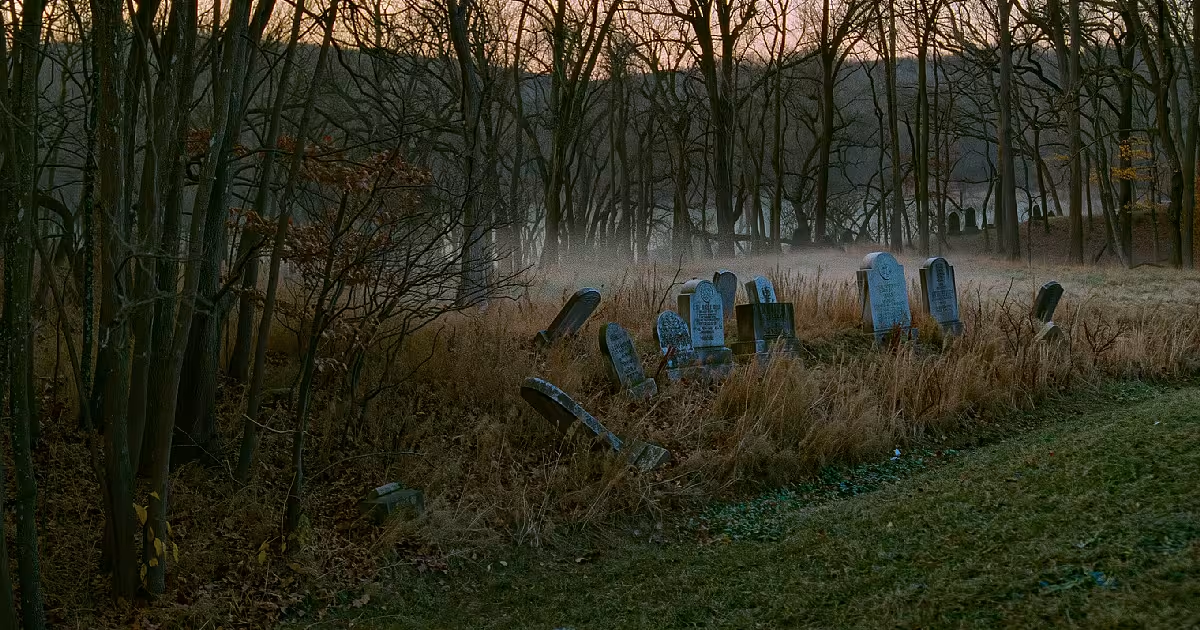
Tilted old headstones in a misty woodland cemetery at dusk.
Illustration, not a photograph.

Archive / Paranormal / BOT313-0438
PAR-199110 AUG 1991ParanormalONE PHOTO
THE MADONNA ON THE TOMBSTONE
Fig. 01 Tilted old headstones in a misty woodland cemetery at dusk. Illustration, not a photograph.
Opening
Bachelor's Grove Cemetery is a small, badly damaged graveyard in the Rubio Woods forest preserve, in Bremen Township, Cook County, between Midlothian and Oak Forest, Illinois. About 200 people are buried there. Since the 1970s it has also been one of the most talked-about haunted places in the Chicago area, with stories of blue lights, a vanishing house, phantom cars and a woman in white.
The story that left the cemetery has a date. On 10 August 1991 a group from the Ghost Research Society took infrared photographs there, and one frame, enlarged later, seemed to show a young woman in an old-fashioned dress sitting on a tombstone. It became known as the Madonna of Bachelor's Grove.
Timeline
1838 or 1844The earliest recorded burials are William B. Nobles in 1838 or Eliza Scott in November 1844, depending on the source.
1852The railroad bypasses the small settlement, and the community fades.
1864Edward Everden sells land to Frederick Schmidt and reserves one acre as a graveyard.
1960sThe Forest Preserve District buys the surrounding land. The Midlothian Turnpike is rerouted onto 143rd Street and the old road is blocked off, leaving the cemetery isolated and easy to reach from the woods.
1960s and 1970sStones are knocked over and spray-painted, and some graves are disturbed. Headstones are stolen and thrown into the nearby lagoon. The last private trustee, Clarence Fulton, chases trespassers off the grounds.
1975Cook County takes over maintenance.
1977Dale Kaczmarek founds the Ghost Research Society in the Chicago area.
1 May 1982The society makes its first investigation at the cemetery.
1989The last burial, Robert Shields, according to the Tinley Park Historical Society. The Ghost Research Society gives 1965.
10 August 1991On a follow-up visit, society member Judy Huff-Felz photographs a checkerboard tombstone with no name on 35mm black-and-white infrared film. The figure is noticed only when the print is enlarged.
1990sThe broken stone of infant Emma Fulton, who died in 1867, turns up near Harlem Avenue and 167th Street.
Key figures
Dale Kaczmarek has run the Ghost Research Society since 1977 and is the photo's chief defender. Judy Huff-Felz took it; some older accounts credit "Mari Huff", a name the society has since corrected. Brad Bettenhausen, president of the Tinley Park Historical Society, is the best source on the cemetery's ordinary history, and the Forest Preserve District of Cook County maintains the land.
Physical and documentary trail
The cemetery is real and public: the deeds, the burial records and the vandalism are documented in county records and local press. The 1991 frame is a black-and-white infrared photograph of a seated figure in a long dress beside a checkerboard stone, semi-transparent in the society's description, looking away in profile. It ran in the Chicago Sun-Times, the Chicago Tribune and the National Examiner, and on the Discovery Channel's Phantom Photographs. The society says Kodak staff in Rochester examined it. No written Kodak verdict has been published.
It was a woman in a long kind of Victorian gown, long brown hair, kind of staring away in profile.
Things you might not know
- The name is probably a family name. "Bachelor's" is most likely a corruption of Batchelder, a family associated with the land. The story that the cemetery was founded by bachelor settlers came later.
- There is a real infant's stone. Emma Fulton's marker, broken and carried miles away, was recovered in the 1990s. Another stone reads "Infant Daughter".
- A marker went to a museum. The Moss family marker was removed for safekeeping and given to the Tinley Park Historical Society.
- The legends started with the parties. As the Chicago Tribune told it in 2020, the stories grew out of teenagers drinking and partying in the abandoned cemetery, and Bettenhausen sees little fact behind them.
- The lagoon has legends of its own. Besides the stolen headstones really thrown into it, stories claim Capone-era gangsters dumped bodies there and that a two-headed creature lives in it.
Competing explanations
A ghost on film. The society's case is that nobody was sitting on the stone, that the figure was not seen until the negative was printed and enlarged, and that the dress and the semi-transparent body do not match anyone present. It attributes a dark area critics call a shadow to the trees.
A person who was really there. Critics point to the shadow and argue the frame shows a real person sitting on the stone. Without the negative and a documented chain of custody, that can't be tested from the prints alone.
A legend built on neglect. The blue lights, the phantom house, the cars and the two-headed creature in the lagoon have no photographs or named first witnesses. Bettenhausen's reading is that a sealed-off, vandalised cemetery invites exactly this kind of story.
Later life of the case
The photograph has been reproduced widely in ghost books and online, usually without its infrared context. Bettenhausen has argued that ghost tourism keeps the vandalism going. In 2024 he told WBEZ's Curious City: "As a sacred place of burial, it deserves some respect." He also called for a sign telling the cemetery's real history.
Finding
The haunting of Bachelor's Grove is a product of its history: an isolated cemetery, years of vandalism and a generation of teenagers using it as a party spot. The 1991 photograph is the one piece that can still be argued over, and it has not been settled. The society's account of how the frame was made is consistent, and the critics' reading of a real sitter is also consistent with what the print shows.
What still will not resolve: the original negative, and what the Kodak staff actually said. Until those are public, the Madonna stays an unexplained photograph rather than a proven ghost or a proven fake.
Evidence signature
4/9 Solid
- Witnesses
- several people
- Instruments
- photo, film or physical traces
- Paper
- press and later accounts
How well documented the case is, not whether it's true. A strong record can still have an ordinary answer, and a thin one can still be real.
You decide · BACHELOR'S GROVE
What do you think happened?
One vote per case, anonymous. You'll see how other readers voted once you've voted.