VAL JOHNSON
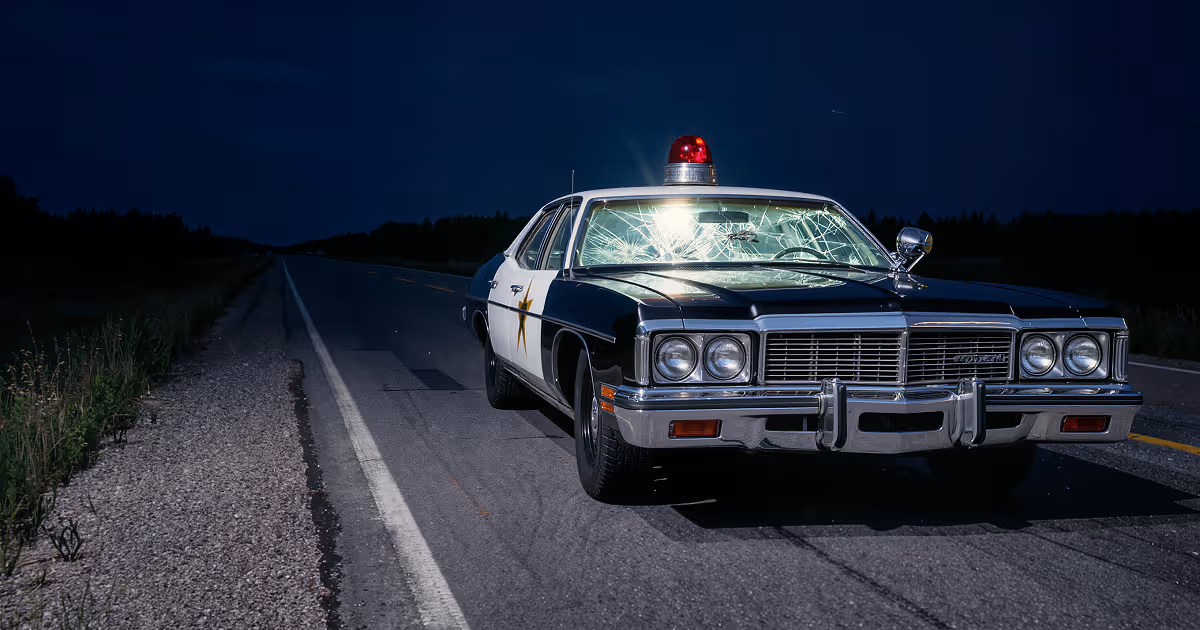
Minnesota county road night. Damaged patrol car glass.
Illustration, not a period photograph.
Opening
Just before 1:40 a.m. on 27 August 1979, Marshall County Deputy Sheriff Val Johnson was patrolling a remote stretch of Highway 220 near Stephen, Minnesota, when he spotted a bright light hovering low over the road roughly a mile and a half ahead. Thinking it might be an aircraft in distress, or possibly drug smugglers who had crossed the nearby Canadian border, he accelerated toward it. The light, by his account, closed the distance almost instantly, filled the car, and he heard glass breaking before losing consciousness. When he came to thirty-nine minutes later, his squad car sat skewed sideways across the road, its windshield shattered, a headlight and emergency light smashed, both antennas bent, and his own wristwatch and the car's dashboard clock both mysteriously running fourteen minutes behind. It remains, more than four decades on, one of the most physically documented and least explained UFO cases involving a professional, on-duty law enforcement witness.
Timeline
27 August 1979, approximately 1:39 a.m. Johnson radios in that he is investigating a light near the county line. Moments later dispatch loses contact.
Same night, 2:19 a.m. Johnson's voice returns over the radio, weak and disoriented. Asked his condition, he replies, "I don't know. Something just hit my car." Responding deputies find the vehicle stopped at roughly a ninety-degree angle across the northbound lane, having apparently traveled, by later measurement, somewhere between 100 and 854 feet after impact depending on which contemporary account is consulted, with the front end tilted toward the ditch.
Same night. Johnson is found with a bump on his head and significant eye pain; an examining physician later describes the eye injury as resembling "welder's burns," the kind of corneal irritation associated with exposure to an intensely bright light source at close range.
Same night, on-scene assessment. The squad car shows a dented hood, a shattered windshield, a broken headlight, a broken hazard light, and bent antennas at differing angles. Both Johnson's personal wristwatch and the car's electric clock are found to be running fourteen minutes slow, despite both having reportedly kept accurate time immediately beforehand.
29 August 1979. The local Warren, Minnesota, newspaper, the Sheaf, runs the story under the headline "Deputy Johnson Stunned by UFO Monday Morning," establishing a contemporaneous, dated local press record within 48 hours of the event itself.
Following days. The case draws rapid escalating attention; Johnson appears as a guest on ABC's Good Morning America on 11 September 1979, and later on the syndicated program That's Incredible, telling one studio audience that he had come to believe "the Creator has made other things we can't readily see or readily identify."
Following the publicity. Johnson tells reporters the sudden national attention has caused significant emotional strain for himself and his family.
Investigation phase. Allan Hendry, chief field investigator for the Center for UFO Studies (CUFOS), personally investigates, bringing in a metallurgical engineer from Honeywell, a glass-fracture specialist from Ford Motor Company, and a hyperspectral imaging consultant. The Ford glass expert specifically describes the windshield's fracture pattern as "extremely unusual," inconsistent with an ordinary frontal impact from a fist, a hammer, or a typical road-debris strike.
Same investigation period. Fellow deputy Herb Maurstad, examining the damage independently, notes that the crack pattern's position was inconsistent with Johnson's own head having struck the windshield, sitting notably lower on the glass than an occupant impact would typically produce.
Klass's parallel investigation. UFO skeptic Philip J. Klass concludes the entire incident was a hoax, arguing Johnson deliberately damaged his own patrol car, and characterizing the case in his own published work as ultimately explainable through ordinary means. Klass's own reported interviews with Johnson's acquaintances, however, produced no evidence supporting a motive or established pattern of dishonesty; one associate told him Johnson might "hide your coffee cup" as a prank but had, to his friends' knowledge, never told an actual untruth.
Regarding the polygraph. Contrary to a claim that circulates in some retellings that Johnson passed a lie detector test, the documented record indicates he in fact declined to take one, reportedly stating through UFO researcher Jerome Clark that doing so "would only serve to satisfy people's morbid curiosity" rather than settle anything evidentiary, a meaningful correction against the more common but inaccurate "he passed a polygraph" version of the story.
1980. Hendry and Klass debate the case directly and publicly at a symposium held at the Smithsonian Institution, a genuinely rare instance of the case's two most credentialed opposing investigators addressing each other's conclusions face to face rather than only in separate published accounts.
Hendry's own final assessment. Despite extensive technical investigation, Hendry states he could not identify a single explanation accounting for both Johnson's described experience and the specific physical damage pattern simultaneously, famously noting that the case's central difficulty was finding "one neat explanation for something that could behave the way he described yet create the kinds of damage that we discovered."
Decades later. Johnson relocates away from Warren and largely stops giving interviews on the subject. A 2021 follow-up by regional media locates him living quietly in Wisconsin, declining extensive further comment.
Key figures
Johnson is the case's sole direct witness, a professional, on-duty deputy with no prior documented interest in UFOs and, by his own acquaintances' account to Klass himself, a reputation for honesty rather than embellishment, a credibility profile that has made this case a frequent reference point in discussions of witness reliability.
Hendry is the case's principal formal investigator, whose CUFOS-led technical examination, bringing in independent industry specialists rather than relying solely on ufological analysis, represents an unusually rigorous evidentiary approach for a single-witness case, and whose own final conclusion was a candid admission of genuine puzzlement rather than either confirmation or dismissal.
Klass is the case's most prominent skeptical voice, and his specific hoax theory, that Johnson staged the damage himself, has never been supported by any confirmed motive, method, or corroborating witness beyond his own general skeptical framework; his own investigative interviews with Johnson's associates, by his own account, failed to turn up evidence of dishonesty.
Maurstad, a fellow deputy examining the physical damage independently, offers a specific, technical objection to any simple self-infliction theory: the windshield crack's position does not match where an occupant's own head would plausibly strike it.
Physical and documentary trail
On the paper, this file has a same-night dispatch recording, contemporary local press coverage within 48 hours, a formally documented multi-expert technical investigation involving specialists from Ford and Honeywell, a physician's contemporaneous eye-injury assessment, and a rare direct public debate between the case's leading proponent and its leading skeptic.
What it lacks is any conclusive account, from either side, of the specific mechanism behind the windshield's unusual fracture pattern; Hendry's team could propose no confirmed prosaic cause, and Klass's self-infliction theory was never supported by physical evidence matching how such damage would actually need to be produced by hand.
I don't know. Something just hit my car.
Competing explanations
A deliberate hoax, staged by Johnson himself, per Klass's conclusion. This reading requires Johnson to have both damaged his own vehicle in a highly specific and technically unusual pattern and self-inflicted a corneal injury convincing enough to fool an examining physician, without any confirmed motive, established prior dishonesty, or corroborated method ever being produced to support it.
A genuine but ultimately conventional physical cause, possibly an unusual meteorological electrical phenomenon or an unrelated ordinary object encountered at high speed, that produced the described light, the eye injury, and the vehicle damage through some as-yet-unidentified but non-anomalous mechanism. This reading is the most cautious position and is consistent with Hendry's own final stance: genuinely unexplained rather than confirmed unconventional.
A genuine unconventional aerial phenomenon, exactly as Johnson described and as the CUFOS investigation's own inability to find a conventional cause tends to support. This reading rests on the combination of a credible, professionally accountable witness, physical damage independently assessed as unusual by industry specialists unaffiliated with UFO research, and a corroborating contemporaneous medical injury.
Later life of the case
The Val Johnson incident remains a frequently cited benchmark case specifically because of its combination of professional witness credibility and genuinely independent, multi-specialist technical investigation, a combination the 1980 Smithsonian debate between Hendry and Klass helped cement as a serious subject of direct expert disagreement rather than one-sided dismissal. Johnson's own long retreat from public discussion of the case, after early heavy media exposure including national television appearances, reflects a personal cost to sustained public scrutiny common to many high-profile single-witness cases.
Finding
A professionally credible, on-duty law enforcement officer with no history of UFO interest or documented dishonesty reported a specific, dramatic encounter, and independent technical specialists from Ford and Honeywell, working with the era's most methodical UFO research organization, could identify no conventional explanation for the resulting vehicle damage pattern. The leading skeptical theory, deliberate self-infliction, has never been supported by any confirmed motive or matching physical method, and the commonly repeated claim that Johnson passed a polygraph is itself inaccurate: he declined to take one at all.
What still will not resolve: any confirmed mechanism, prosaic or otherwise, for the windshield's specifically unusual fracture pattern, which neither CUFOS's own multi-specialist investigation nor Klass's skeptical review ever definitively explained. Until one does, this remains, by its own lead investigator's own careful words, exactly what it has been since 1979: unexplained, not merely undecided.