FALCONBRIDGE
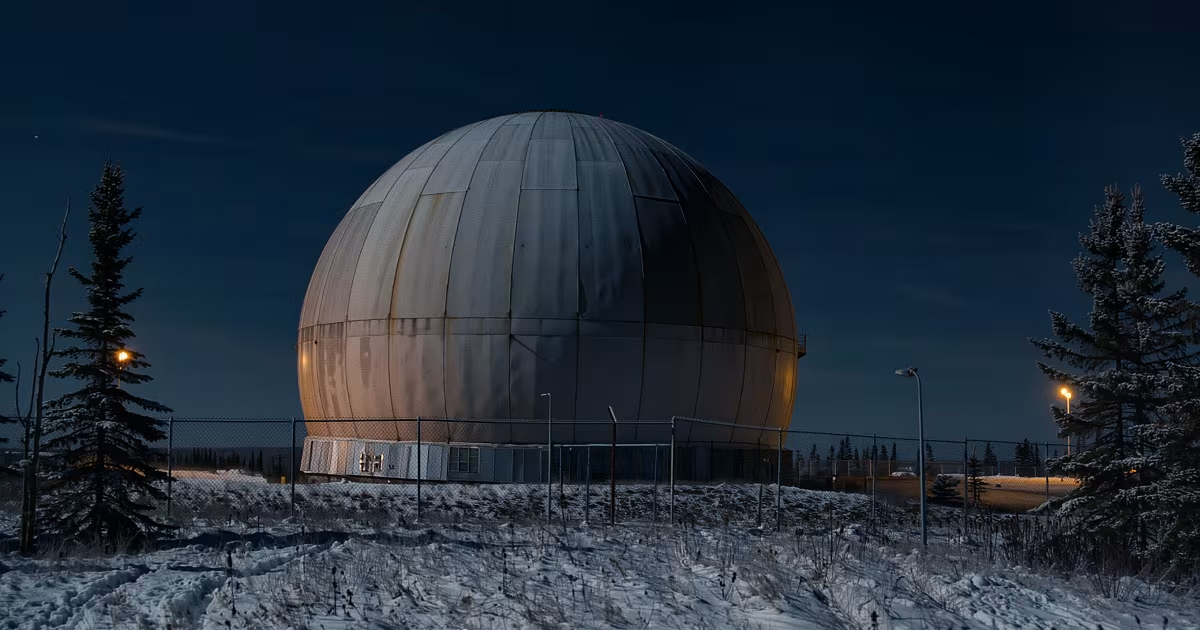
A large radar dome at the Falconbridge radar station at night.
Illustration, not a period photograph.

Opening
At around 3 a.m. on 11 November 1975, police in Sudbury, Ontario, began reporting bright lights low in the sky, some hovering and some shooting straight up. At Canadian Forces Station Falconbridge, a NORAD radar site on the hills outside the city, the radar picked up an object 25 to 30 miles south.
The height-finder radar tracked it climbing from 26,000 feet to 72,000 feet in stages. The station's commanding officer watched through binoculars and took photographs. Hours later, two US fighters were scrambled from Michigan and found nothing. It happened in the same weeks as the intrusions over Loring, Wurtsmith and Malmstrom.
Timeline
11 November 1975, about 3 a.mSudbury police and Ontario Provincial Police officers report lights. Two officers see four objects, three hovering and one moving in a circle. Two others watch a cylinder-shaped object through binoculars until 7 a.m.
05:40 local time (10:40 GMT)NORAD's 22nd Region headquarters at North Bay gets a call about two objects being followed by Sudbury police.
MorningFalconbridge's search and height-finder radars track an object south of the site at altitudes from 26,000 to 72,000 feet. Between 6:15 and 6:29 a.m. local time, Major Robert Oliver, the station commander, and other personnel see two brilliant objects through binoculars, one rising vertically at great speed. Oliver takes three snapshots with a Brownie camera.
Shortly before 1 p.m. local time (17:50 GMT)Two F-106 interceptors are scrambled from Selfridge Air Force Base near Detroit. They search between 8,000 and 30,000 feet and find nothing.
12 NovemberTwo police officers and another witness report more objects, pulsating brilliant white and moving in a jerky way.
August 1976The National Enquirer runs the story: "Air Defense Chiefs Admit: We Tracked UFO on Radar and Scrambled Fighter Jets."
Key figures
Major Robert Oliver commanded the radar station and was its key military witness. Captain Gordon Hilchie, public affairs director for the 22nd NORAD Region, confirmed the radar details to the press. Palmiro Campagna, a Department of National Defence engineer, later reviewed the case in his book The UFO Files: The Canadian Connection Exposed and found the basic facts of the press reports were accurate.
Physical and documentary trail
The record: the NORAD log entries, the radar altitude readings, police reports, the record of the F-106 scramble, and Hilchie's public statements. It is one of very few cases with radar, trained visual observers and photographs on the same morning.
Still missing: Oliver's three photographs, whose fate is unknown, and any published analysis of the radar returns.
They shot up from 26,000 feet to 45,000 feet, stopped for a period of time, and then shot up to 72,000 feet.
Things you might not know
- The commander used a Brownie. Major Oliver photographed the objects with a simple Kodak Brownie camera. Nobody knows what happened to the pictures.
- It was described as cratered. One description from the station estimated a sphere about 100 feet across with a cratered surface.
- The jets came from another country. The interceptors were American, from Selfridge in Michigan, because NORAD was a joint command.
- The station is gone. Falconbridge, part of the Pinetree Line of Cold War radars, closed in the 1980s, and its operations building was torn down in 2007.
- It came back the next night. Police reported more objects on 12 November.
Competing explanations
Astronomical and atmospheric. Officials suggested Venus or other planets, lenticular clouds, aurora or misidentified aircraft for the lights. These fit lights seen from the ground at dawn. They fit less well a radar target climbing in stages to 72,000 feet.
A balloon. A high-altitude research balloon would reach those heights. No launch has been matched to that morning, and a balloon doesn't stop and start.
An unknown object. Radar, a station commander, several police officers and a scramble, all on the same morning and during the same autumn of intrusions at US bases.
Later life of the case
Falconbridge is Canada's best-known radar case, and it is usually discussed as part of the late-1975 wave over North American nuclear and radar sites.
Finding
NORAD's own spokesman confirmed that its radar tracked something climbing to 72,000 feet while trained observers watched lights over the same area, and the fighters sent to look found nothing. A planet explains some of the visual reports. It doesn't explain the radar.
What still will not resolve: what Falconbridge's height-finder was tracking, and what is on Major Oliver's three missing photographs.
Evidence signature
8/9 Strong
- Witnesses
- trained, independent witnesses
- Instruments
- more than one sensor agrees
- Paper
- official records at the time
How well documented the case is, not whether it's true. A strong record can still have an ordinary answer, and a thin one can still be real.
You decide · FALCONBRIDGE
What do you think happened?
One vote per case, anonymous. You'll see how other readers voted once you've voted.