BOIANAI
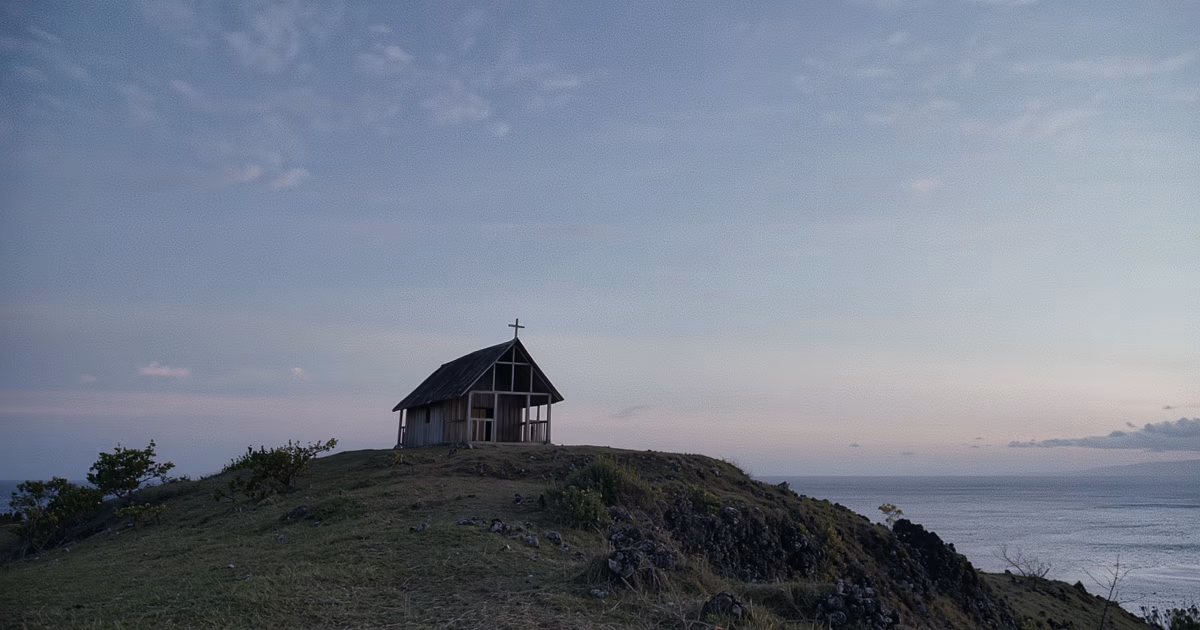
Papuan mission hillside dusk. Sea beyond, empty sky.
Illustration, not a period photograph.
Opening
On the evening of 26 June 1959, Father William Booth Gill, an Australian Anglican missionary at Boianai on the Papua New Guinea coast, stepped outside his mission house and saw a bright light near Venus begin descending through the cloud cover. Over the following four hours, joined eventually by thirty-seven other mission residents, he watched what resolved into a large, disc-shaped craft with a narrower upper deck, hovering at low altitude with human-like figures visible moving on top of it. When Gill raised his arm and waved, according to his own contemporaneous notes, one of the figures appeared to wave back. This remains one of the most extensively multi-witnessed close encounters ever formally documented, and one where the official investigation that followed did not actually interview the central witness for over five months.
Timeline
5 April 1959. Gill, a self-described skeptic at the time, personally observes a stationary white light near uninhabited Mount Pudi twice in one night, in two different locations, faster-moving than he believed any person could travel on foot. His assistant teacher, Stephen Moi, separately reports an "inverted saucer" over the mission around the same period.
Following weeks. Gill drafts a letter to Reverend David Durie describing the accumulating reports as puzzling but not yet convincing, writing that his "simple mind still requires scientific evidence" before accepting an extraterrestrial explanation, and suggesting the objects might instead be an electrical phenomenon or a byproduct of atomic testing.
26 June 1959, 6:45 p.m. Before that letter is even sent, Gill sees a bright white light in the northwest sky from in front of the mission house. It descends and hovers roughly 100 meters up. Over the following four hours, thirty-eight people gather to watch, including Gill, teachers Stephen Gill Moi and Ananias Rarata, and Mrs. Nessie Moi. The object presents as a large, solid-looking disc with a wide base and a narrower upper deck, standing on what witnesses describe as four leg-like supports, with human figures visible moving on the upper deck, at times appearing to pause and look down at the observers below.
Same night. Gill describes a blue searchlight-like beam switching on briefly from the craft on two occasions. At one point Gill raises his arm and waves at the figures; per his own notes, one figure appears to wave back, and several children in the crowd wave as well, prompting what Gill records as an increase in the figures' apparent activity in response.
27 June 1959, following evening. Similar activity recurs, with Gill and other witnesses again observing lights and craft-like objects, though this second night's events are cut short by encroaching weather.
Following the sightings. Gill compiles a formal written report and sends it, along with sketches, to Reverend Durie and civilian UFO research organizations in Australia, generating significant press coverage once the story breaks in August 1959.
August-November 1959. The story becomes a sensation in the Australian press. Civilian UFO groups distribute copies of Gill's report to members of the federal House of Representatives, and on 24 November a Western Australian MP formally asks the Minister for Air whether the Department had investigated the New Guinea sightings.
The Minister's actual reply. Rather than directly answering the question, the Minister for Air states generally that most UFO reports are explainable and that only roughly three percent remain unexplained, without addressing the Boianai case specifically. Civilian investigator Peter Norris is separately told by Air Force Intelligence that the department is still awaiting "depth of evidence," despite Gill himself not yet having been interviewed by any investigator.
29 December 1959, over five months after the sighting. Two RAAF officers, led by Squadron Leader F. A. Lang, finally visit Gill in person. By Gill's own later recollection, the meeting consisted largely of the officers discussing stars and planets with him before departing; he reports hearing nothing further from the RAAF afterward. Lang's resulting conclusion, reached after what several later reviewers characterize as a brief and procedurally thin visit, attributes the sightings to a combination of misidentified celestial objects and aircraft.
1966-1968. American astronomer J. Allen Hynek, then a scientific consultant to the U.S. Air Force's Project Blue Book, personally reviews and later interviews Gill, and comes to regard Boianai as one of the best-documented close encounters of the third kind on record, a case type he would formally define in his own later classification system substantially informed by this and comparable cases.
Skeptical review, primarily associated with Harvard astronomer Donald Menzel. Menzel argues Gill's account can be explained by a combination of the planet Venus, low clouds refracting and distorting its light into an apparently structured shape, and social reinforcement among the assembled witnesses, who Menzel suggests were inclined to defer to Gill's own interpretation of what they were collectively seeing. Fred Beckman, a colleague of Hynek's who personally traveled to Boianai with Gill to examine the site and circumstances, directly disputes part of Menzel's reasoning, specifically confirming Gill was wearing correctly prescribed glasses at the time of the sighting, countering an early version of the skeptical argument that had proposed uncorrected vision problems as a contributing factor.
Key figures
Gill is the case's central witness, and his own documented shift from stated skepticism in April to a detailed, convinced account by late June is itself part of the record rather than something later added; his contemporaneous private correspondence shows him working through his own doubts in writing before the main event occurred, rather than his final account being constructed after the fact to fit a pre-existing belief.
The thirty-seven additional mission witnesses, mission teachers, students, and residents observing alongside Gill, represent the case's most distinctive feature: a close encounter with a large number of simultaneous, named or nameable witnesses rather than one or two isolated observers, a rarity in this category of report.
Lang is the case's official but procedurally weak investigating figure; his conclusion, reached after a single brief visit more than five months after the event and with no apparent detailed on-site investigation, has been characterized by multiple later reviewers, sympathetic and skeptical alike, as inadequate to the case's actual evidentiary scale.
Hynek is the case's most significant scientific validator, whose personal, direct engagement with Gill and firsthand site assessment fed into his broader, highly influential classification framework for close encounters.
Menzel and Beckman represent the case's central evidentiary dispute: a credentialed astronomer's skeptical Venus-and-refraction theory, and a specific, direct rebuttal from someone who actually traveled to the site and checked one of that theory's factual premises, Gill's eyewear, against the record.
Physical and documentary trail
On the paper, this file has Gill's own contemporaneous written notes and letters, predating the sighting's public sensation and showing his views evolving in real time rather than after the fact; a formal report circulated to Australian civilian UFO organizations and eventually the national parliament; direct interviews conducted by both Hynek and Beckman; and an official, if procedurally thin, RAAF investigation and conclusion.
There is no photograph, despite the sighting's four-hour duration and dozens of witnesses, an absence some skeptics cite as notable given the circumstances, and supporters attribute to the mission's limited access to nighttime photographic equipment at the time. There is no independent radar or instrumented data corroborating the object's altitude or structure beyond witness estimation.
Last night we at Boianai experienced about four hours of UFO activity, and there is no doubt whatsoever that they are handled by beings of some kind.
Competing explanations
Venus, distorted through low cloud and atmospheric refraction into an apparently structured, moving shape, per Menzel's proposed explanation. This reading accounts for the light's initial appearance near the planet's actual position and for the extended, largely stationary viewing period, but strains considerably to explain the specifically reported structural details, the disc shape, the visible figures, and above all the reciprocal waving Gill and the other witnesses describe, none of which a distorted planetary light would plausibly produce.
Misidentified aircraft, per the RAAF's own brief official conclusion. This explanation faces the same basic problem as the Venus theory: it does not account for the reported human-like figures, their apparent activity, or the described waving interaction, and no aircraft of the era matches the extended, near-stationary hovering multiple witnesses independently described.
Social reinforcement and shared suggestion among a crowd already primed by Gill's own developing interest in the subject, amplifying an initially ambiguous light into a collectively agreed, more elaborate account. This reading does not require Gill himself to have fabricated anything, but treats the crowd's converging description as a product of mutual influence during a genuinely ambiguous nighttime observation rather than independent corroboration of a single objective event.
A genuine unconventional craft, as Gill's own detailed account and Hynek's professional assessment concluded. This reading rests on the sheer number of simultaneous named witnesses, the specificity and consistency of the reported details, and Gill's own documented, gradual, reluctant shift from stated skepticism to conviction, a pattern that does not match a witness looking to manufacture a sensational story.
Later life of the case
Boianai remains a foundational case in the specific category Hynek would later term "close encounters of the third kind," cited in his own influential books and referenced widely in subsequent UFO literature specifically because of its combination of witness scale, sustained duration, and an official investigation record showing a genuinely slow and procedurally thin government response, five months to a first interview, that itself became a documented part of the case's political fallout in the Australian parliament.
Finding
A missionary who began the year explicitly skeptical of UFO reports ended it with a detailed, four-hour, multiply-witnessed account of a structured craft and its apparent occupants, corroborated in real time by dozens of named observers and supported by his own private correspondence written before the story became a public sensation. The RAAF's official investigation, when it finally occurred five months later, has been widely criticized as inadequate to the case's actual scale, and the leading skeptical explanations struggle specifically with the reported figures and the reciprocated waving, details a misidentified planet or aircraft does not plausibly produce.
What still will not resolve: any photograph or instrumented data from an event lasting four hours and witnessed by three dozen people, and a fuller accounting of why Australia's own Air Force Intelligence took over five months to conduct what even sympathetic reviewers describe as a minimal interview. Until either changes, Boianai remains one of the strongest witness-scale cases in the entire close-encounter literature, resting entirely on testimony that has never been definitively explained away.