NIGHTMARCHERS
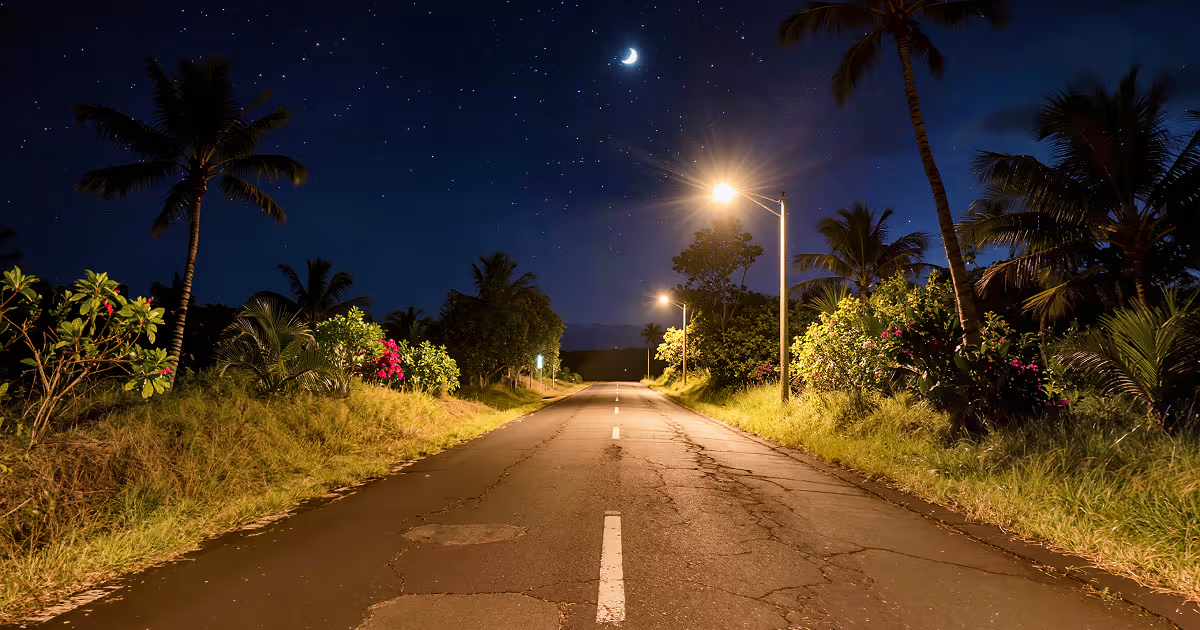
A lone road through palms on Oahu at night under a crescent moon.
Illustration, not a period photograph.

Archive / Paranormal / BOT313-0317
PAR-1883ParanormalFOLKLORE
HUAKAʻI PŌ, THE PROCESSIONS OF THE DEAD
Fig. 01 A lone road through palms on Oahu at night under a crescent moon. Illustration, not a period photograph.
Opening
In Hawaiian tradition, the night marchers, huakaʻi pō (procession of the night) or ʻoiʻo, are processions of chiefs, gods, warriors and ancestral spirits who travel the old routes after dark. They are announced by drums, chanting, the conch shell and lines of torches. Anyone caught in their path risks death unless a relative among the marchers speaks up for them. The traditional response is to get out of sight or lie face down and not look.
This is a living tradition, not a single event, and it belongs to Hawaiian families who still pass it on. In 1983 the anthropologist Katharine Luomala gathered over twenty accounts, most from 1950 to 1970, and found the processions reported on all five main islands. Hawaiian writers today stress that the marchers are not monsters. They are kin and sacred figures continuing the protocols they kept in life.
Timeline
Before and after 1778High-ranking chiefs travel in processions, often at night. Heralds order people to prostrate themselves (kapu moe) or crouch (kapu noho), and breaking these rules can mean death. The night marcher tradition carries these rules forward.
1827On a tour of Oʻahu, Kaʻahumanu's retinue sees strange lights at night. Samuel Kamakau later writes that people of old called such lights the "innumerable fires of the ʻaumakua o ka Po, the divine ancestors of the Night".
19th centuryHawaiian scholars David Malo, Kamakau, Kepelino and John Papa ʻĪʻī write, some in Hawaiian-language newspapers, about the processions of living chiefs that form the background to the tradition.
1883Joseph S. Emerson's piece in the Hawaiian Almanac and Annual mentions a phantom army led by Kamehameha's spirit, the first published reference Luomala found.
1930Mary Kawena Pukui writes the fullest early description, "The Marchers of the Night", from relatives in Kaʻū. It is published in 1932 in Kepelino's Traditions of Hawaii, edited by Martha Beckwith.
1983Luomala publishes "Phantom Night Marchers in the Hawaiian Islands" in Pacific Studies.
October 2025Ka Wai Ola, the newspaper of the Office of Hawaiian Affairs, publishes "Nā Huakaʻi o ka Pō", a family account that also corrects online misrepresentations.
Key figures
Kūpuna, the elders, who carry the tradition in families, including what to do and where not to be.
Mary Kawena Pukui, the Hawaiian scholar whose 1930 account remains the core written source.
Samuel Kamakau, David Malo, Kepelino and John Papa ʻĪʻī, 19th-century Hawaiian historians.
Katharine Luomala of the University of Hawaiʻi, who studied the accounts as folklore.
The guest author of the 2025 Ka Wai Ola article, who writes from the teachings of his mother, Angeline Kapanui, and his aunt, Ella Kalawa Alcon.
Physical and documentary trail
The record is oral first and written second. Pukui's account, Luomala's collection and Hawaiian-language sources describe the same core: marchers keep to their routes, often on nights sacred to particular gods, especially the Pō Kāne nights from the 27th to the 29th of the lunar month. They are not lapu, the restless evil spirits of the dead, but ʻaumakua, family guardian gods and kin. Many Hawaiians regard the processions as sacred and are reluctant to talk about them.
A fisherman's account from 1970, collected for Luomala, shows the protocol in practice. He and a companion saw torches approaching along the coast near Mahukona: "We knew you aren't supposed to look upon the marchers and to lay on the ground face down. We did this." The 2025 Ka Wai Ola article sets out the family view:
From them, I came to understand that our Hawaiian traditions are our own, meaning that we, our family, do not speak for all Hawaiians.
Specific routes are family and local knowledge, and this report does not list them. That is part of the tradition, not a gap.
Corrections to the earlier version of this report. The earlier version said 19th-century writers recorded nightmarcher accounts in Hawaiian-language newspapers. What Malo, Kamakau and ʻĪʻī described were processions of living chiefs; the first published reference to a phantom procession Luomala found is from 1883. The earlier version also said many Hawaiians treat commercial use with discomfort. The documented concern is narrower: the 2025 Ka Wai Ola article criticises online and popular retellings that turn the marchers into violent pursuers.
Things you might not know
- Genealogy is protection. Ka Wai Ola's account advises calling out one's moʻokūʻauhau, family genealogy, so an ancestor in the procession may speak for you.
- A shared sighting counts as true. By Hawaiian criteria Luomala recorded, a vision seen by a group together is a "true vision"; one seen by only one person in a group is not.
- The marchers respected a closed door. In a story from Schofield Barracks during the Second World War, soldiers kept hearing marchers pass through until an older Hawaiian advised closing the doors at each end.
- Ti plants guide them. Ka Wai Ola notes the belief that a hedge of kī, ti leaf plants, will guide the procession around a home.
- Doctors and families read deaths differently. Pukui recorded that a sudden roadside death a doctor would call heart failure might be understood by Hawaiians as the work of the night march.
- Non-Hawaiians report them too. Luomala's observers included Chinese, Japanese, Filipino and Caucasian residents, among them soldiers, a physician and a tourist.
Competing explanations
The marchers as they are understood within the tradition. Ancestors, gods and the retinues of chiefs still travel their old routes and keep the protocols of their lifetimes. Witnesses who follow those protocols survive, and the experience is often remembered with awe and pride rather than only fear.
Natural readings, some offered by Hawaiians themselves. Luomala notes that Kamakau put the 1827 lights down to phosphorescence, and that others pointed to wind, earth tremors or decomposition gases. She also notes that these readings address torches and deaths but not the sounds, and that many listeners found them unsatisfying.
Cultural memory and experience. Luomala reads the accounts as carrying memory of real chiefly processions and attachment to sacred sites, and as a source of continuity with ancestors. None of this requires deciding the tradition is false on its own terms.
Later life of the case
Night marchers now appear in ghost tours, horror fiction and online lists, often stripped of context. The Office of Hawaiian Affairs newspaper's 2025 piece is an example of Hawaiian writers reclaiming the account: it separates family teaching and older written sources from later inventions, including a description added to Wikipedia's night marchers page of marchers incinerating people with light from their eyes.
Finding
Folklore in the folklorist's sense: a living Hawaiian tradition, in print since 1883 and much older in oral form, with no single event to test. It is not a cryptid case or a haunting to rule on. It describes how the living should behave on routes and places that belong to their ancestors.
What still will not resolve: nothing needs to. The tradition belongs to the families who carry it, and an outside report can record it accurately but cannot settle it for them.
Evidence signature
5/9 Solid
- Witnesses
- several people
- Instruments
- nothing on record
- Paper
- formal investigation, court or declassified file
How well documented the case is, not whether it's true. A strong record can still have an ordinary answer, and a thin one can still be real.
You decide · NIGHTMARCHERS
What do you think happened?
One vote per case, anonymous. You'll see how other readers voted once you've voted.