MINNESOTA ICEMAN
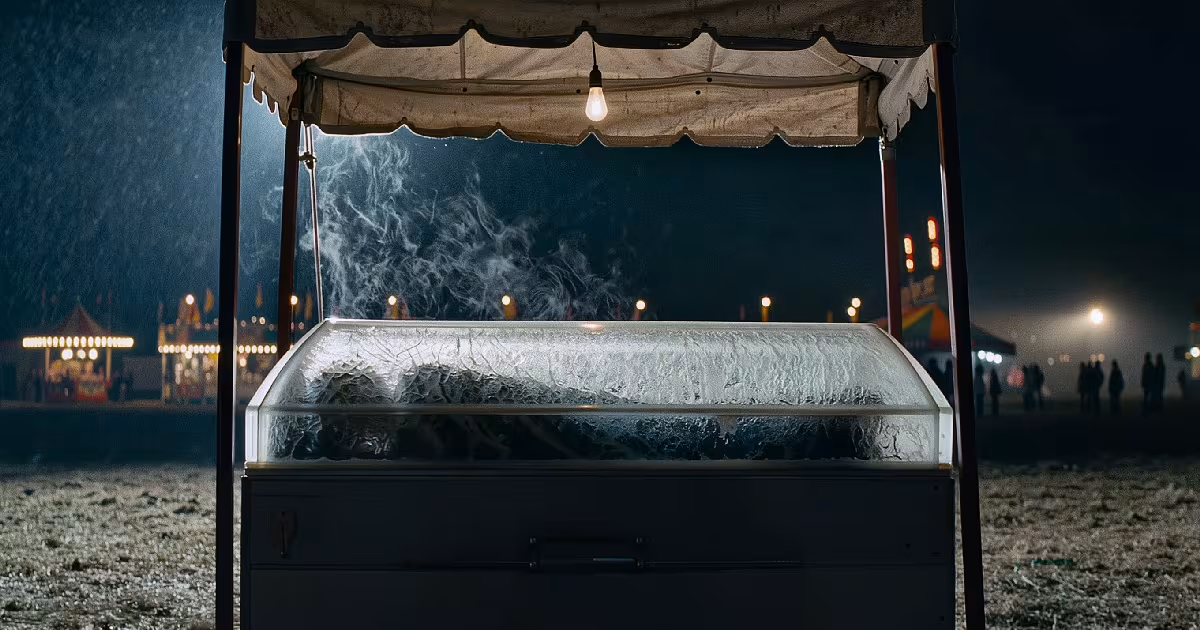
A frosted glass case under a small canvas awning at a night fair, with a dark shape inside the ice.
Illustration, not a period photograph.
Opening
In the late 1960s a showman named Frank Hansen toured American fairs and shopping centres with a refrigerated coffin. Inside, under frosted ice, lay a hairy, man-sized figure with one arm flung over its head and an eye apparently shot out. It was billed as “the Minnesota Iceman.” Then in December 1968 two of the best-known names in cryptozoology came to examine it, and one of them described it in a scientific journal as a new species of human.
Timeline
1967. A lifelike figure is built on the West Coast. Later accounts name the modelmaker Howard Ball, with hair set in by hand by Pete and Betty Corral. It debuts on 3 May 1967 as a “What is it?” exhibit.
November 1967. Hansen closes a run at the Louisiana State Fair and takes the exhibit home to his farm near Rollingstone, Minnesota.
1968. The figure tours fairs and malls through the Midwest. In December, Terry Cullen, a zoology student from Milwaukee, sees it at the International Livestock Exposition in Chicago, decides it may be a real decaying body, and tips off Ivan T. Sanderson.
December 1968. Sanderson and Bernard Heuvelmans spend days examining the case at Hansen’s farm, drawing and photographing through the ice. At one point the glass cracks and they report a smell of rotting flesh.
Early 1969. Heuvelmans publishes a preliminary note in the Bulletin de l’Institut Royal des Sciences Naturelles de Belgique, naming the creature Homo pongoides. Sanderson writes it up for Argosy magazine and urges the Smithsonian to look.
Spring 1969. Primatologist John Napier looks into it for the Smithsonian, which withdraws, saying it is satisfied the figure is a carnival exhibit of latex and hair. Hansen now says the original body has been swapped for a model.
July 1970. Hansen publishes his own story in Saga magazine. He writes that he shot the creature while deer hunting near Whiteface Reservoir, about 60 miles north of Duluth, in 1960, and kept it in his home freezer.
2013. A figure matching the photographs is sold on eBay to Steve Busti and goes on show at his Museum of the Weird in Austin, Texas.
Key figures
Frank Hansen, who said he was an Air Force captain and pilot with a fighter unit at Duluth before turning exhibitor, and who told at least four origin stories. Ivan Sanderson, naturalist and writer. Bernard Heuvelmans, the zoologist often called the father of cryptozoology, who staked his name on the body. John Napier, the primatologist who concluded it was a model. Terry Cullen, the student who started it all.
Physical and documentary trail
On the paper: Heuvelmans’ paper and drawings, Sanderson’s article and photographs, Hansen’s own Saga account, and the figure now in Austin, which looks identical to what they drew. What is missing is the one thing that matters: no tissue sample, no X-ray and no examination without the ice. Hansen’s origin stories include a Russian sealing ship off Siberia, a Japanese whaler, a freezer in Hong Kong and his own hunting trip. Canadian customs once held him on suspicion of carrying a corpse. By his own account, he also asked a lawyer about the rules on transporting dead bodies and wrote to his senator about customs. A later rumour says the body was brought back from Vietnam in a body bag. None of the origin stories has any record behind it.
Competing explanations
A real body, later swapped. Heuvelmans believed he saw real decay, real hair and real wounds, and that Hansen hid the original once talk turned to whether shooting it had been a crime. Hansen’s own account says the swap happened the other way round: model first in 1967, real body on show from March 1968. This is the only reading that keeps both the scientists’ observations and the surviving model.
Always a model. Napier’s reading. A figure was made in 1967, the man who built it was named, and a model that looks just like the photographs survives. The smell could come from meat left rotting in the case, an old fairground trick.
Heuvelmans was fooled. Viewing through cloudy ice with poor light, over a few days, with the owner in the room, is a hard way to judge anatomy.
Later life of the case
The Iceman damaged Heuvelmans’ standing, though he kept faith with it, and gave Hansen years of publicity. Hansen’s story of the 1960 hunt reads like an adventure magazine piece, which is what it was. The eBay sale listed the figure as “the actual sideshow gaff”. The museum that owns it now presents it and leaves the verdict to visitors.
Finding
The best explanation is that the Minnesota Iceman was a well-made carnival figure from start to finish. A model was commissioned in 1967, a model survives, and the man who owned both gave a different origin every time he was asked. Heuvelmans was a serious zoologist and wrote what he believed he saw, and Cullen believed he was looking at a real body. Nothing they saw through the ice was ever tested.
What still will not resolve: whether there was ever a second figure in that coffin, and what gave off the smell in December 1968.